
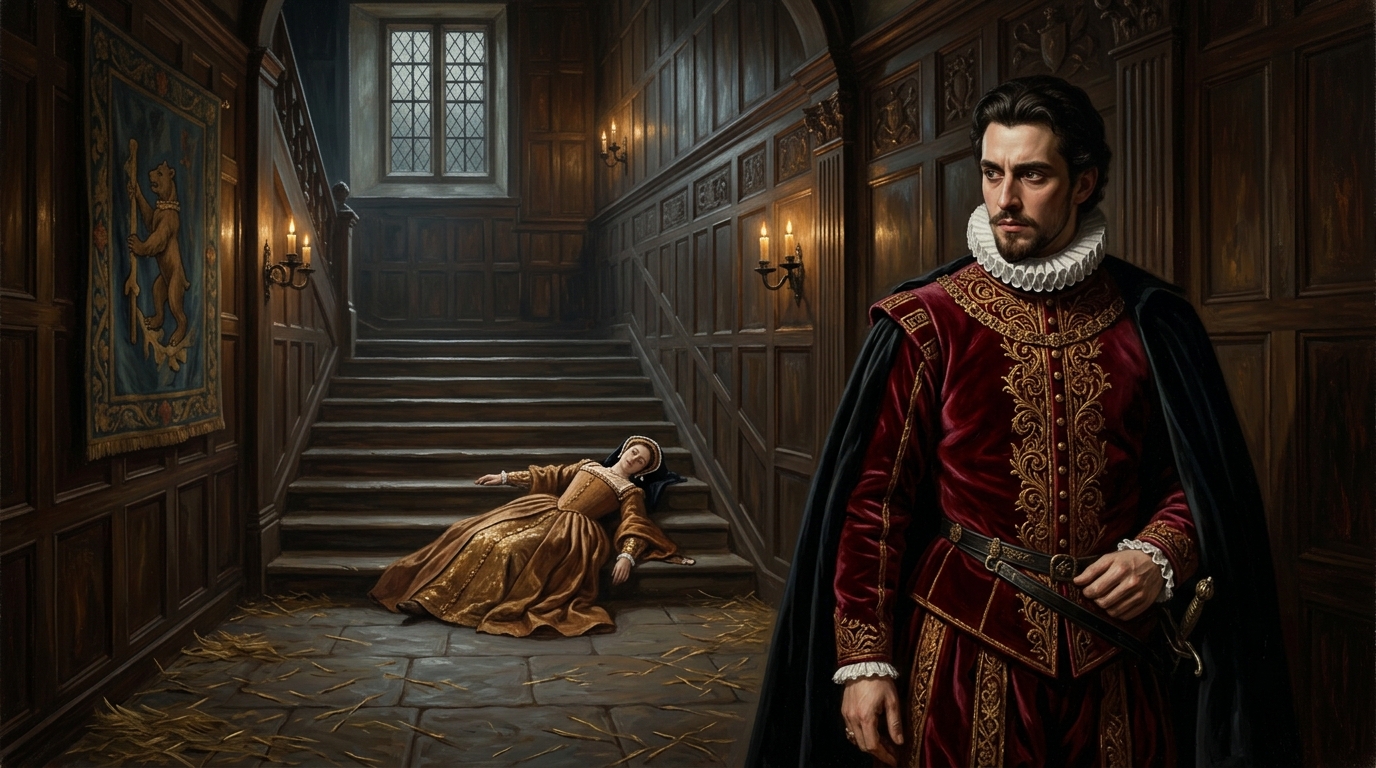
The Queen, Her Favourite, and a Suspicious Death: The Amy Robsart Scandal
Of all the mysteries that surrounded the court of Elizabeth I, few have proved as enduringly fascinating as the death of Amy Robsart in September 1560. Was it accident, suicide, or cold-blooded murder? The question gripped Elizabethan England and has captivated historians, novelists, and dramatists ever since. At the heart of this scandal lay one of the most complicated relationships of the Tudor age: the intense, politically explosive bond between the Queen and her childhood friend, Robert Dudley, Master of the Horse and, later, Earl of Leicester.
As a historical fiction author who has spent years immersed in the primary sources of Tudor England, I find the Amy Robsart affair endlessly compelling precisely because it resists simple answers. It touches on power, desire, ambition, and the brutal realities facing women in the sixteenth century. Elizabeth I was a queen who never married, yet the story of why she did not marry is bound up, in no small part, with the death of a woman she likely never met. Understanding this scandal means understanding something fundamental about the precarious nature of Tudor queenship itself.
In this post, we will explore who Amy Robsart was, what happened at Cumnor Place on 8th September 1560, why contemporaries immediately suspected foul play, and what the consequences were for Dudley, for Elizabeth, and for England. We will also consider the evidence as it survives in the Dudley Papers held at the National Archives (SP 12), and draw on the authoritative scholarship of Elizabeth Jenkins, whose biography Elizabeth the Great (Coward-McCann, 1958) remains an essential starting point for anyone studying this period.
Historical Background: Robert Dudley, Amy Robsart, and the Court of Elizabeth I
Robert Dudley was born in 1532 or 1533, the fifth son of John Dudley, Duke of Northumberland, the powerful lord who had attempted to place Lady Jane Grey on the throne after Edward VI's death. The Dudley family had suffered catastrophically for that ambition: John was executed, and Robert himself was imprisoned in the Tower of London in 1553, at the same time as the young Princess Elizabeth. It was a shared experience of danger and confinement that many historians believe deepened a bond between them that had existed since childhood. When Elizabeth came to the throne in November 1558, one of her earliest acts was to appoint Dudley as her Master of the Horse, a prestigious position that kept him in constant close proximity to her.
The problem was that Robert Dudley was already married. He had wed Amy Robsart in June 1550, in a match that appears, at least initially, to have been a love match rather than a purely dynastic arrangement. Amy was the daughter of Sir John Robsart of Norfolk, a man of respectable but not outstanding means. By the late 1550s, however, the marriage seems to have become increasingly strained by separation. As Dudley rose in royal favour, Amy lived apart from the court, moving between various country houses. The Dudley Papers at the National Archives contain correspondence that hints at Amy's isolation and ill health during this period, though the precise nature of her condition remains disputed by scholars.
By 1559 and into 1560, the court gossip had become impossible to ignore. The Spanish ambassador, Álvaro de la Quadra, wrote alarming dispatches home suggesting that Dudley and Elizabeth were openly behaving as though they intended to marry. De la Quadra reported, with evident distaste, that it was being said openly that Dudley's wife was ill and would soon die, and that the Queen intended to take him as her husband. Whether this was reliable intelligence or malicious rumour mattered less than the fact that such stories were circulating at all. They placed Elizabeth in an extraordinarily vulnerable position at a moment when her throne was still far from secure.
Then, on 8th September 1560, Amy Robsart was found dead at the foot of a staircase at Cumnor Place, a house near Abingdon in Oxfordshire that she had been sharing with friends and servants. She had apparently sent everyone in the household away to attend a local fair that day, insisting on being alone. When they returned, they found her body at the bottom of the stairs with a broken neck. She was approximately twenty-eight years old.
Significance and Impact: Scandal, Suspicion, and the Limits of Royal Power
The reaction to Amy's death was immediate and overwhelming. As Elizabeth Jenkins observed in Elizabeth the Great, the circumstances were so suspicious, and the timing so convenient for Dudley, that contemporaries found it almost impossible not to draw the obvious conclusion. If Amy had been murdered, the most likely beneficiary was her husband, who would now be free to marry the Queen. Rumours swept through the English court, across the Channel to the French court, and into the dispatches of every foreign ambassador in London.
Dudley himself reacted with apparent shock and moved swiftly to demand a formal inquest. The jury returned a verdict of accidental death, but this satisfied almost nobody. Did you know? The jury at the Cumnor inquest was reconvened more than once because the first verdict was considered insufficiently thorough, a sign of how seriously even local authorities took the need to be seen to investigate properly. The records suggest genuine uncertainty, but uncertainty was not innocence in the court of public opinion.
For Elizabeth, the political consequences were severe and long-lasting. Whatever her personal feelings for Dudley, she was sharp-minded enough to understand that marrying him in the wake of Amy's death would be political suicide. As Jenkins notes, even if Elizabeth believed entirely in Dudley's innocence, the mere appearance of guilt made any marriage unthinkable. Her chief minister, William Cecil, who had long viewed Dudley with barely concealed hostility, was confirmed in his opposition. Foreign powers that Elizabeth needed as potential allies or at least as neutral parties would have found a marriage to the man suspected of murdering his first wife deeply scandalous. The scandal effectively ended any realistic prospect of Dudley becoming Elizabeth's consort, even as their relationship continued for decades more.
The affair also illuminates something important about the position of women in Tudor England. Amy Robsart had virtually no agency in the events that destroyed her. She was isolated from court, separated from a husband whose ambitions had far outgrown their marriage, and entirely dependent on the good will of those around her. Whether she died by accident, by her own hand in a moment of despair, or at someone else's instigation, her fate was shaped entirely by forces over which she had no control.
Connections and Context: The Wider Tudor World of 1560
It is worth pausing to consider what else was happening in England and Europe in September 1560, because context matters enormously when assessing this scandal. Elizabeth had been queen for less than two years. The religious settlement of 1559 had only just been established, and its durability was far from certain. Mary, Queen of Scots, was still Queen of France by virtue of her marriage to François II, and her claim to the English throne was actively promoted by the French crown. The Treaty of Edinburgh, signed in July 1560, had represented a significant diplomatic achievement, but England remained militarily and financially fragile.
In this context, any suggestion that Elizabeth might marry a man tainted by suspicion of murder was not merely personally scandalous but strategically catastrophic. Cecil understood this with perfect clarity. It is worth noting, as some historians have suggested, that Cecil himself may have been aware of, or even facilitated the spread of, damaging rumours about Dudley during this period. The Dudley Papers at SP 12 in the National Archives reveal something of the complex web of correspondence and intelligence-gathering that characterised the Elizabethan court, though they cannot, of course, prove any conspiracy.
The Amy Robsart affair also connects directly to the broader question of Elizabeth's marriage that would dominate the first two decades of her reign. Parliament, her councillors, and foreign powers all pressed her repeatedly to marry and produce an heir. The Dudley scandal became one of the reasons Elizabeth could deploy, publicly or privately, for her refusal to take any particular suitor. It was, in a deeply ironic way, a wound that served her political purposes even as it remained personally painful.
Modern Relevance and Fascinating Details: A Mystery That Endures
The question of what really happened at Cumnor Place has never been definitively answered, and that enduring uncertainty is part of what makes the story so compelling to modern readers and writers. In recent decades, historians have proposed a range of explanations. Some, noting references to Amy's ill health in the Dudley Papers, have suggested she may have been suffering from breast cancer, which can cause spontaneous fractures of the spine, meaning she could have fallen accidentally even on a relatively shallow staircase. Others have pointed to the suspicious circumstances of her isolation that day as evidence of deliberate planning. A smaller number have suggested that Amy, isolated, unwell, and aware that her husband was effectively courting the Queen, may have taken her own life.
Did you know? Sir Walter Scott immortalised the story in his 1821 novel Kenilworth, in which Amy Robsart is murdered on Dudley's orders. Scott's version shaped popular understanding of the affair for generations, even though it takes considerable liberties with the historical record. More recently, the story has inspired numerous historical novels, television dramas, and even operas, testament to its enduring grip on the imagination.
As a historical fiction author, I find the Amy Robsart story irresistible precisely because it sits at the intersection of the personal and the political in a way that feels entirely modern. We are dealing with a powerful man, a politically constrained woman, and a queen trapped between her heart and her duty. These are not abstract historical themes. They resonate because the questions they raise, about power, gender, ambition, and justice, are questions we are still asking today.
Conclusion: A Scandal That Shaped a Reign
The death of Amy Robsart in September 1560 was a pivotal moment in the reign of Elizabeth I. It effectively closed off the possibility of her marrying the man she may have loved most, shaped her relationship with her councillors for years to come, and provided her enemies with ammunition they would use repeatedly throughout her reign. The scandal is documented in the Dudley Papers at the National Archives and has been analysed by historians from Elizabeth Jenkins onwards, yet it retains its power to fascinate and disturb precisely because the central question remains unanswered. Whether Amy died by accident, by her own hand, or by murder, her death changed the course of English history.
If you want to explore this period further, I would strongly recommend beginning with Elizabeth Jenkins' Elizabeth the Great for a beautifully written overview, before diving into the primary sources at the National Archives. The Tudor world rewards curiosity, and few stories within it are as rich, as strange, or as human as this one.