Bloody Mary: The Truth Behind England’s Most Controversial Queen
Few figures in English history provoke as much debate, fascination, and outright horror as Queen Mary I. The eldest daughter of Henry VIII and his first wife, Catherine of Aragon, Mary Tudor ascended to the throne in 1553 with a singular, burning mission: to return England to the Catholic faith her father had so brutally dismantled. What followed was a reign of religious persecution so severe that it branded her with a nickname that has endured for nearly five centuries. But was Mary I truly the monster history remembers, or is the story of Bloody Mary far more complicated than the nickname suggests?
As a Tudor history enthusiast and historical fiction author, I have spent years immersed in the primary sources and scholarly debates surrounding this remarkable, tragic queen. The reality of Mary’s reign sits at the intersection of personal grief, religious conviction, political necessity, and genuine cruelty. Understanding it properly requires us to look beyond the legend and into the historical record itself, drawing on sources such as John Foxe’s extraordinary Acts and Monuments of These Latter and Perilous Days (1563) and David Loades’s authoritative The Tudor Queens of England (2009).
In this post, we will explore who Mary I really was, why she ordered the execution of approximately 280 Protestant dissenters between 1555 and 1558, how those burnings shaped Tudor society, and why this story continues to resonate with readers, historians, and anyone who grapples with the intersection of faith, power, and violence.
Historical Background: Mary I and the Catholic Restoration
Mary Tudor was born on 18 February 1516, the only surviving child of Henry VIII and Catherine of Aragon. Her early life was marked by political upheaval and personal humiliation. When Henry sought to annul his marriage to Catherine in order to wed Anne Boleyn, Mary was declared illegitimate, stripped of her title as Princess, and forced to serve as a lady-in-waiting to her infant half-sister, Elizabeth. The trauma of those years never left her. Her Catholic faith, instilled by her devout Spanish mother, became the bedrock of her identity during a period of profound personal suffering.
When Mary came to the throne in July 1553, after outmanoeuvring the Protestant faction that had attempted to place Lady Jane Grey on the throne, she inherited a country that had been officially Protestant for over two decades. Her half-brother Edward VI had pushed the Reformation further than even their father had intended, introducing a firmly Protestant liturgy and dismantling Catholic practices with considerable thoroughness. Mary’s determination to reverse this was not simply political calculation. It was, to her mind, a sacred duty.
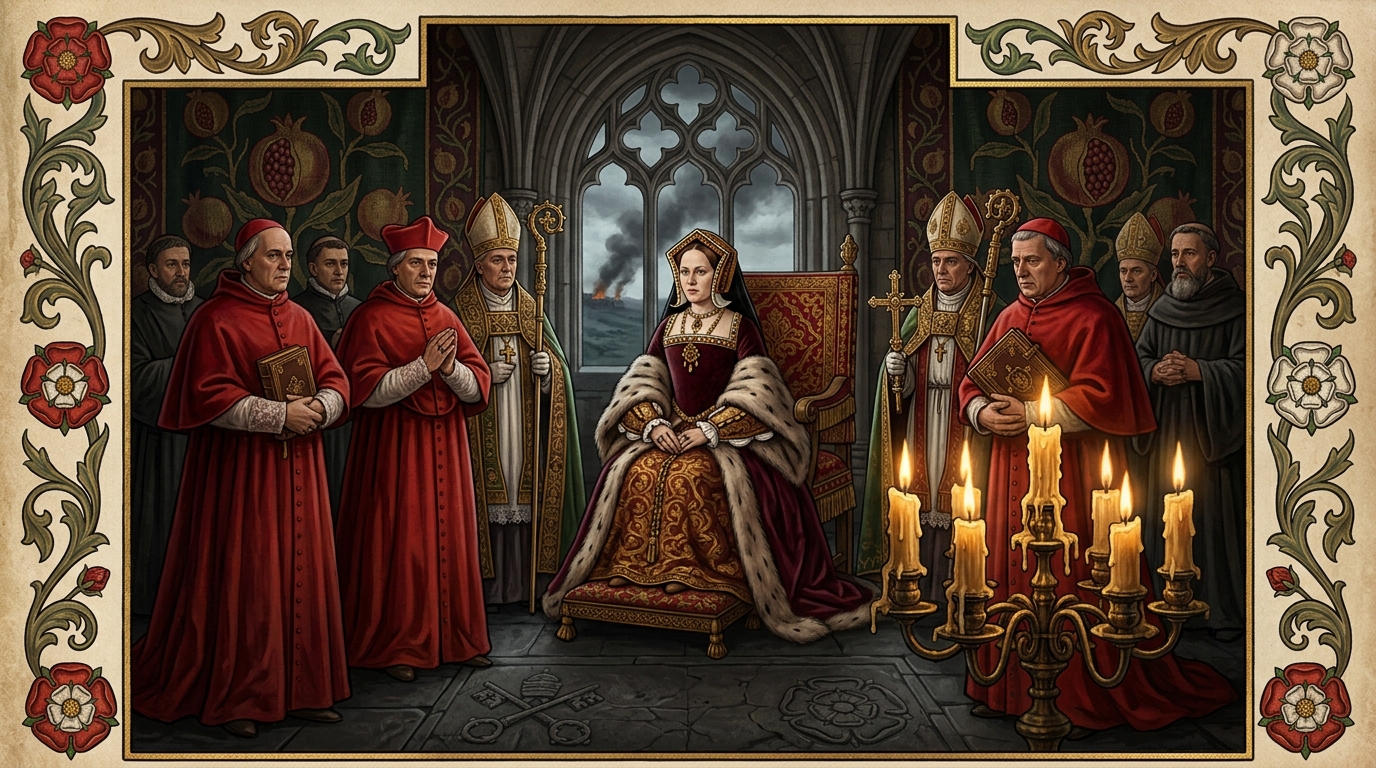
The persecutions that earned Mary her grim nickname began in earnest in February 1555. The first victim was John Rogers, a Protestant clergyman burnt at Smithfield in London. Over the following three years, approximately 280 men and women were executed for refusing to recant their Protestant beliefs, the majority burnt at the stake in public spectacles intended to demonstrate the consequences of heresy. John Foxe, a Protestant exile who witnessed the aftermath of many of these events and gathered testimony from survivors, documented these deaths in extraordinary detail in his Acts and Monuments, a work commonly known as Foxe’s Book of Martyrs. His account, though written from an explicitly Protestant perspective, remains an invaluable primary source.
The burnings took place across England, from London to Canterbury, from Oxford to Colchester. Among the most famous victims were the Oxford Martyrs: Hugh Latimer, Nicholas Ridley, and Thomas Cranmer, the former Archbishop of Canterbury who had been the chief architect of the Protestant Reformation under Henry VIII and Edward VI. Cranmer’s death in March 1556 was particularly dramatic. Having initially recanted his Protestant beliefs under pressure, he publicly withdrew his recantation at the moment of his execution, thrusting his right hand into the flames first, declaring that the hand which had signed the recantation should be punished.
Significance and Impact: How the Marian Persecutions Shaped Tudor England
The significance of Mary’s religious persecution extends far beyond the grim arithmetic of lives lost. In terms of Tudor society, the burnings had consequences that Mary almost certainly did not anticipate. Rather than stamping out Protestantism, the public executions created martyrs. Foxe’s Acts and Monuments transformed the victims into heroes of faith, and the book became one of the most widely read texts in Elizabethan England, second only to the Bible in many households. The image of steadfast Protestants dying in the flames became a cornerstone of English Protestant identity for generations.
Politically, the persecutions damaged Mary’s reputation irreparably, even during her own lifetime. As David Loades notes in The Tudor Queens of England, contemporary observers both at home and abroad expressed unease at the scale and nature of the executions. Even Mary’s husband, King Philip II of Spain, reportedly advised caution, concerned that the burnings were generating more resistance than submission. Public sympathy, it seems, lay increasingly with the victims rather than the crown.
The consequences for Tudor culture were equally profound. The Marian persecutions hardened the association between Catholicism and tyranny in the English popular imagination, an association that would shape English politics, foreign policy, and national identity well into the seventeenth century and beyond. When Elizabeth I came to the throne in November 1558, just weeks after Mary’s death, her Protestant restoration was greeted with widespread relief and celebration. The contrast between the two half-sisters, deliberately cultivated by Protestant propagandists, cast a long shadow over how both queens would be remembered.
Connections and Context: The Marian Persecutions in the Wider Tudor World
It is worth pausing to place Mary’s actions within the broader context of sixteenth-century Europe. Religious persecution was not unique to England. The burning of heretics was standard practice across Catholic Europe, and Protestant rulers were by no means innocent of similar violence. John Calvin’s Geneva saw the execution of the theologian Michael Servetus in 1553, the very year Mary came to the throne. What distinguished the Marian burnings in the English context was their concentration within a short period and their political visibility.
Mary’s reign also coincided with significant developments in European geopolitics. Her marriage to Philip II of Spain in July 1554 drew England into the orbit of the Habsburg Empire, with consequences that included England’s loss of Calais to France in January 1558, the last English territory on the European mainland. This military humiliation compounded Mary’s domestic unpopularity and is said to have broken her spirit in her final months. She died on 17 November 1558, possibly of uterine or ovarian cancer, aged just forty-two.
For readers interested in exploring related threads, the story of Mary’s reign connects naturally to the broader narrative of the English Reformation, the rise of Protestant martyrology, the political complexities of the Tudor succession, and the fascinating question of how history remembers queens who wielded power in ways that defied the expectations of their age. The fates of figures such as Thomas Cranmer, Cardinal Reginald Pole (Mary’s Archbishop of Canterbury), and the ill-fated Lady Jane Grey are all rich veins worth exploring.
Modern Relevance and Fascinating Details: Why Bloody Mary Still Captivates Us
The story of Mary I continues to fascinate for reasons that go well beyond morbid curiosity. In recent decades, historians have made a concerted effort to rehabilitate Mary’s reputation, or at least to complicate it. Scholars such as Anna Whitelock and Judith Richards have argued persuasively that Mary was an intelligent, capable ruler whose legacy has been distorted by Protestant propaganda. She was the first queen regnant of England, navigating a political landscape designed exclusively for male rulers, and she managed her accession with considerable political skill. Her religious convictions, however sincere and however catastrophic in their consequences, were not so different from those of rulers across Europe who used state violence to enforce religious conformity.
Did you know? The cocktail known as a Bloody Mary, typically made with vodka and tomato juice, is popularly said to be named after Queen Mary I, though the historical evidence for this connection is tenuous at best. The drink’s name may be a twentieth-century invention, but the association speaks to how deeply the queen’s grim nickname has embedded itself in popular culture.
In historical fiction, Mary I has been portrayed with increasing sympathy and nuance. She appears as a complex, deeply human figure: a woman shaped by abandonment, loss, and unshakeable faith, driven to cruelty by a combination of genuine religious conviction and political desperation. As someone who writes Tudor historical fiction, I find Mary one of the most compelling and difficult characters of the period precisely because she resists simple moral judgement. Her story raises questions that feel urgently contemporary: How do we balance personal conscience with political power? What happens when the state decides it has the right to determine what its citizens believe? How does history choose its villains?
Conclusion: Understanding the Real Legacy of Mary I
Mary I’s attempt to restore Catholicism to England, and the approximately 280 executions that accompanied it, represents one of the most dramatic and consequential episodes in Tudor history. It shaped English national identity, fuelled Protestant martyrology, and left a legacy of suspicion towards Catholicism that persisted for centuries. The nickname Bloody Mary has proved extraordinarily durable, but it captures only one dimension of a reign that was also marked by political intelligence, genuine piety, and profound personal tragedy.
Whether you come to this history as a student, a casual reader, a historical fiction enthusiast, or someone simply curious about why a sixteenth-century queen still has a cocktail named after her, the story of Mary I rewards careful attention. The sources are rich, the debates are lively, and the questions the period raises are as relevant today as they were in the smoky air of Smithfield in 1555. I invite you to explore further: read Foxe, read Loades, and perhaps most importantly, resist the temptation to let a nickname tell the whole story.