
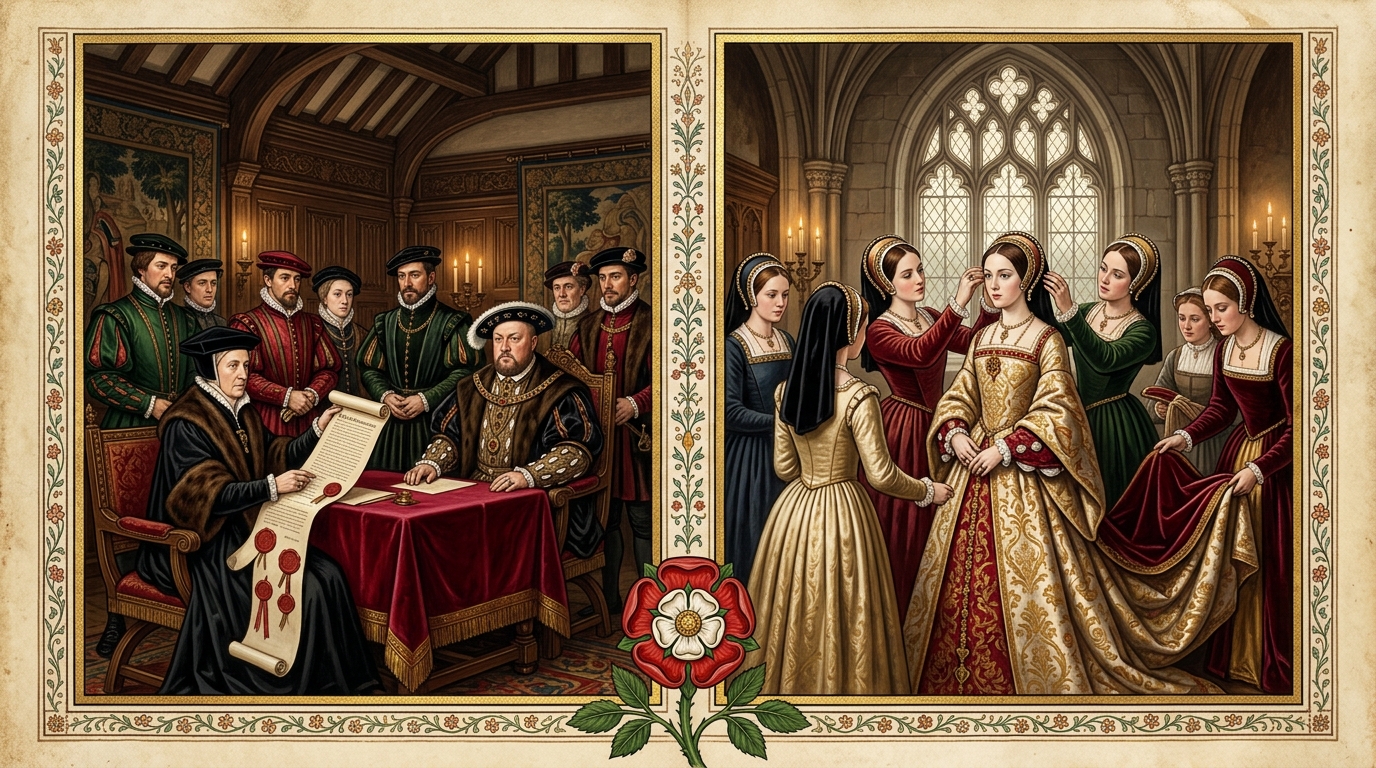
The Six-Month Marriage That Changed Tudor England: Henry VIII, Anne of Cleves, and the Rush to Catherine Howard
In the long and turbulent story of Henry VIII’s marriages, few episodes are as remarkable as the swift collapse of his union with Anne of Cleves and the startling speed with which he replaced her. Within the space of a single summer in 1540, Henry managed to annul one marriage, dispatch a queen consort to comfortable retirement, and wed an entirely new bride, all within nineteen days of the annulment being finalised. It is the kind of sequence that reads like historical fiction, yet every detail is meticulously documented by scholars including David Starkey and Alison Weir, whose authoritative works on the six wives remain essential reading for anyone wishing to understand this period.
As a Tudor historian and historical fiction author, I find this particular episode endlessly fascinating precisely because it reveals so much about the intersection of personal desire, political calculation, and the sheer unpredictability of life at the Henrician court. The Anne of Cleves affair was not merely a failed marriage; it was a diplomatic catastrophe, a personal embarrassment for the king, and ultimately a death sentence, albeit an indirect one, for the young woman who followed her. Understanding what happened in those six extraordinary months tells us a great deal about the nature of power in Tudor England.
In this post, we shall explore who Anne of Cleves actually was, why the marriage was arranged, how and why it collapsed so rapidly, and what consequences flowed from Henry’s almost indecent haste to marry his fifth wife, the ill-fated Catherine Howard. Along the way, we shall uncover some surprising details that even many Tudor enthusiasts do not know.
Historical Background: The Marriage That Never Really Was
Anne of Cleves was born around 1515, the daughter of John III, Duke of Cleves, and his wife Maria of Jülich-Berg. She was raised in the German Protestant tradition, though her precise theological leanings were somewhat ambiguous, a detail that made her a diplomatically attractive prospect for Henry VIII following the death of his third wife, Jane Seymour, in October 1537. As Alison Weir explains in The Six Wives of Henry VIII, Henry’s chief minister Thomas Cromwell was anxious to forge a Protestant alliance on the Continent, and a match with the Duke of Cleves’s sister seemed an elegant solution to both diplomatic and dynastic concerns.
The famous portrait by Hans Holbein the Younger, commissioned so that Henry could assess Anne’s appearance before agreeing to the match, has become one of the most discussed images in Tudor art history. Henry reportedly found the portrait pleasing, but when Anne arrived in England in late December 1539, the king was, according to contemporary accounts, deeply disappointed by what he found. He is said to have complained privately that she was nothing like her portrait, famously calling her, in words recorded by his courtiers, a "Flanders mare", though historians including Starkey have noted this phrase may be apocryphal.
The marriage went ahead on 6th January 1540 at the Palace of Placentia in Greenwich, but it was clear from the very beginning that Henry found the union intolerable. The king confided to his physicians and close advisers that he could not bring himself to consummate the marriage, citing his profound distaste for his new queen. This was, of course, both a personal humiliation and a political problem of the first order. A marriage that had not been consummated could be annulled, and by the summer of 1540, that is precisely what happened. The annulment was granted on 9th July 1540, on the grounds of non-consummation and a pre-contract Anne had allegedly entered into with the Duke of Lorraine in her youth.
What followed was remarkably civilised by Tudor standards. Anne, displaying considerable political intelligence, accepted the annulment without resistance. She was granted a generous settlement including the properties of Richmond and Bletchingley, an annual income of four thousand pounds, and the curious title of "the King’s Beloved Sister." She outlived all of Henry’s other wives, dying in 1557, and in many respects had by far the most comfortable fate of the six.
Significance and Impact: Nineteen Days and a New Queen
The most staggering aspect of this episode is the timeline. Henry VIII married Catherine Howard on 28th July 1540, just nineteen days after the annulment of his marriage to Anne of Cleves was finalised. Catherine was a niece of Thomas Howard, Duke of Norfolk, and almost certainly a teenager at the time of the marriage, with most historians placing her birth somewhere between 1521 and 1525. David Starkey, in Six Wives: The Queens of Henry VIII, describes her as vivacious and appealing, qualities that captivated the ageing, increasingly unwell king.
The speed of the remarriage is significant for several reasons. Firstly, it demonstrates the degree to which Henry’s personal desires overrode all diplomatic and political considerations. The Cleves alliance had been Cromwell’s project, and its failure sealed the minister’s fate: Cromwell was arrested in June 1540, charged with treason and heresy, and executed on 28th July 1540, the very day Henry married Catherine Howard. The timing was, to say the least, pointed.
Secondly, the rapidity of the marriage reflects the influence of the Howard family at court. The Duke of Norfolk and his allies had long opposed Cromwell, and Catherine’s elevation was, in part, a Howard political triumph. As Weir notes, Catherine’s youth and apparent warmth represented everything Anne of Cleves had not been, at least in Henry’s perception, and the conservative Catholic faction saw in her an opportunity to roll back the Protestant reforms Cromwell had championed.
The consequences for Catherine Howard were, of course, devastating. She was accused of adultery and pre-marital sexual conduct in late 1541, arrested, and executed on 13th February 1542. Whether the charges were entirely fair remains a matter of historical debate, but the swiftness of her rise and fall serves as a sobering reminder of how dangerous proximity to Henry VIII could be.
Connections and Context: A Year of Extraordinary Change
It is worth stepping back to appreciate just how turbulent 1540 was in the broader context of Tudor history. The year witnessed the fall of Cromwell, two royal marriages, an annulment, and the ongoing dissolution of the monasteries, which had begun in earnest in 1536. Henry himself was fifty years old, increasingly obese due to a jousting injury that had prevented him from exercising, and suffering from a leg ulcer that caused him chronic pain. The contrast between the vigorous young king who had married Catherine of Aragon in 1509 and the bloated, paranoid figure who discarded Anne of Cleves in 1540 could not be more stark.
The Anne of Cleves episode also connects to the broader question of how Henry VIII used marriage as a tool of foreign policy. His six marriages were not simply expressions of personal desire; they were entangled with questions of succession, religious reform, and international diplomacy. The failure of the Cleves match effectively ended England’s Protestant alliance strategy on the Continent for the remainder of Henry’s reign, leaving England in a somewhat isolated diplomatic position.
Did you know? Anne of Cleves actually outlived not only Henry VIII, who died in 1547, but also his children Edward VI and Mary I. She was present at Mary’s coronation in 1553 and died in July 1557, the last of Henry’s six wives to survive. Her pragmatic acceptance of the annulment ensured her a long and, by Tudor standards, remarkably peaceful life.
Modern Relevance and Fascinating Details
The story of Henry VIII and Anne of Cleves continues to captivate audiences in the twenty-first century, partly because it feels so unexpectedly modern in certain respects. The idea of a marriage arranged on the basis of a portrait, which proved misleading in person, has obvious resonances in an age of online dating and carefully curated digital profiles. As a historical fiction author, I find that readers are frequently struck by this parallel when it is pointed out to them.
The Anne of Cleves marriage has also attracted renewed scholarly interest in recent decades, with historians questioning the traditional narrative that painted Anne as plain or unappealing. Some scholars have suggested that the negative descriptions of Anne originated largely with Henry and his allies seeking to justify the annulment, and that she may have been perfectly attractive by the standards of her time. The Holbein portrait, now housed in the Louvre in Paris, depicts a woman of serene dignity, and many visitors find it difficult to understand what Henry found so objectionable.
In popular culture, the six wives of Henry VIII have never been more prominent. The long-running musical Six, which opened in the West End in 2017 and subsequently transferred to Broadway, gives each wife a contemporary pop voice, with Anne of Cleves portrayed as a confident, self-assured survivor who got the best deal of all. It is a refreshingly positive interpretation that owes something to the genuine historical record: Anne did, in many respects, land on her feet.
Conclusion: What the Six-Month Marriage Tells Us About Tudor England
The brief marriage of Henry VIII and Anne of Cleves, and the nineteen-day interval before his wedding to Catherine Howard, encapsulates many of the central themes of the Tudor age: the overwhelming power of personal royal will, the fragility of diplomatic arrangements, the dangerous proximity of those who sought favour at court, and the very different fates that awaited those who navigated its complexities wisely or unwisely. Anne of Cleves chose wisely and lived long; Catherine Howard did not, and paid the ultimate price.
For anyone wishing to explore this period further, the works of David Starkey and Alison Weir cited throughout this post provide an excellent foundation. Both historians bring rigorous scholarship and compelling narrative to what remains one of the most extraordinary episodes in English royal history. Whether you approach the Tudor court as a historian, a historical fiction enthusiast, or simply a curious reader, the story of 1540 offers rewards that are difficult to exhaust.