
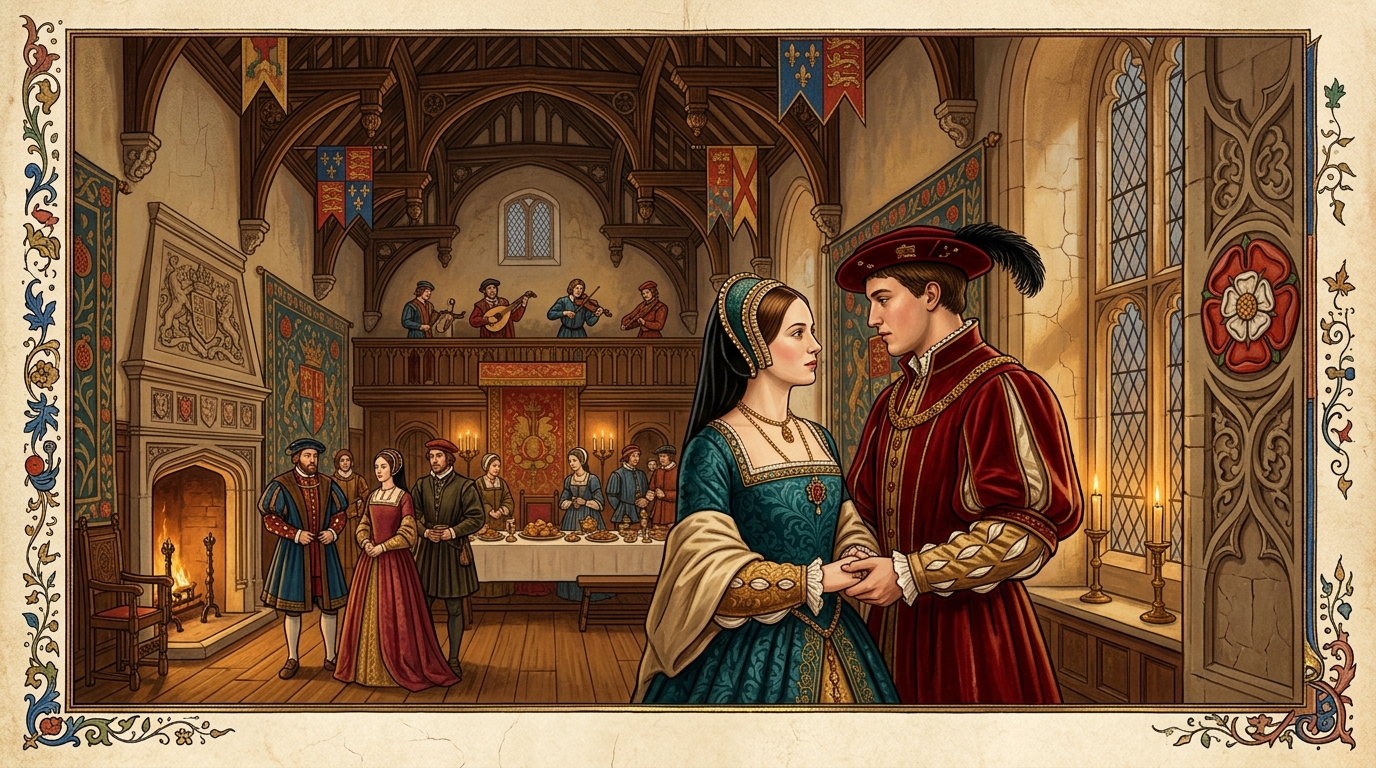
The Secret Marriage That Changed England Forever: Anne Boleyn, Henry VIII, and the Tudor Revolution
Few moments in English history carry the dramatic weight of the secret marriage between Henry VIII and Anne Boleyn in January 1533. This was not merely a royal wedding conducted in haste and secrecy; it was the spark that ignited a religious revolution, redrew the boundaries of English sovereignty, and set in motion a chain of events whose consequences we still feel today. As both a historian and a historical fiction author deeply immersed in the Tudor world, I find this particular episode endlessly fascinating precisely because it sits at the intersection of passionate human desire and cold political calculation.
To understand why this marriage mattered so profoundly, we must appreciate the sheer audacity of what Henry and Anne did. In January 1533, Henry was still, in the eyes of Rome and most of Europe, legally married to Catherine of Aragon. His archbishop had not yet granted an annulment. The Pope had not consented. And yet Henry married Anne anyway, in a quiet, pre-dawn ceremony that would shatter the unity of Western Christendom. Eric Ives, in his authoritative biography The Life and Death of Anne Boleyn (Blackwell Publishers, 2004), describes Anne as a woman of remarkable intelligence and political acumen, someone who was far more than a passive participant in the drama that unfolded around her.
In this post, we will explore how the relationship between Henry and Anne began, why their secret marriage in January 1533 was so historically explosive, and what the birth of their daughter, the future Queen Elizabeth I, meant for England and for the world. Along the way, we will uncover some lesser-known details that even dedicated Tudor enthusiasts sometimes overlook.
Historical Background: A Romance Born at Court
The story begins, as so many Tudor stories do, at the royal court. Around 1526, Henry VIII, already well into his reign and growing increasingly desperate for a male heir, began to direct his considerable romantic attention towards Anne Boleyn. Anne had spent years in France and at the English court, developing a sophisticated, Continental elegance that set her apart from the women around her. She was not conventionally beautiful by the standards of the age, but she possessed a magnetism and a sharpness of wit that captivated the king absolutely.
At this point, Henry had been married to Catherine of Aragon for approximately seventeen years. Catherine had borne him several children, but only one, the Princess Mary, had survived infancy. Henry, convinced that God was punishing him for marrying his brother's widow, had already begun seeking ways to dissolve the marriage. Anne Boleyn's arrival in his affections accelerated that process dramatically. Crucially, unlike some of Henry's other romantic interests, Anne refused to become his mistress. She held out for marriage, a decision that Ives argues was central to everything that followed.
The courtly romance that developed from around 1526 was conducted partly through letters, some of which survive and offer a remarkable glimpse into Henry's emotional state during this period. The king was genuinely besotted, writing to Anne with a tenderness that contrasts sharply with his later treatment of her. What followed was what historians call the 'King's Great Matter': Henry's prolonged, expensive, and ultimately unsuccessful attempt to persuade Pope Clement VII to annul his marriage to Catherine. The Pope, heavily influenced by Catherine's nephew, the Holy Roman Emperor Charles V, refused to comply.
By late 1532, the situation had reached a critical point. Anne had at last agreed to become Henry's lover, and she quickly became pregnant. The timeline was urgent. Henry needed to marry Anne before the child was born so that the heir, if it was a son, would be legitimate. In January 1533, probably on the 25th of that month, Henry and Anne were married in a secret ceremony. The location is not definitively confirmed by historical record, but most scholars believe it took place at Whitehall or possibly at the Tower of London. The secrecy was essential: Henry was still officially married to Catherine, and the political and religious implications of what he was doing were enormous.
Significance and Impact: A Marriage That Broke with Rome
The significance of this secret marriage cannot be overstated. Within months of the ceremony, Henry's newly appointed Archbishop of Canterbury, Thomas Cranmer, formally declared the marriage to Catherine of Aragon null and void in May 1533, and confirmed the validity of Henry's marriage to Anne. This was accomplished not with papal approval, but in defiance of it. The Act of Supremacy of 1534 would follow, formally establishing Henry as the Supreme Head of the Church of England and completing England's break with Rome.
For Tudor society, the consequences were seismic. The dissolution of the monasteries, the redistribution of Church wealth, the redefinition of religious authority, and the eventual development of English Protestantism all trace their origins, in significant part, to Henry's determination to marry Anne Boleyn. Suzannah Lipscomb, in The King is Dead: The Last Will and Testament of Henry VIII (Head of Zeus, 2015), offers a compelling analysis of how Henry's personal decisions reshaped the political landscape of England in ways that outlasted him by centuries.
For the individuals involved, the consequences were equally dramatic. Catherine of Aragon was stripped of her title as queen and spent her final years in increasingly difficult circumstances, dying in January 1536. Anne herself would be executed on 19th May 1536, accused of adultery, incest, and treason in a trial that most modern historians regard as deeply unjust. Yet the child she carried when Henry married her in January 1533 would grow up to become Queen Elizabeth I, one of the most celebrated monarchs in English history. The marriage that began in secrecy and ended in tragedy produced one of England's greatest rulers.
Did you know? Anne Boleyn was pregnant when she was crowned Queen of England in a magnificent coronation ceremony in June 1533. The elaborate public celebrations stood in stark contrast to the hushed secrecy of the marriage ceremony just months earlier.
Connections and Context: The Wider Tudor World
It is important to place these events within the broader context of sixteenth-century Europe. The 1530s were a period of profound religious upheaval across the continent. Martin Luther had nailed his Ninety-Five Theses to the church door at Wittenberg in 1517, and the Protestant Reformation was spreading rapidly through northern Europe. Henry's break with Rome, though motivated primarily by his desire to remarry, aligned England with broader currents of religious change that were transforming the continent.
Closer to home, the political tension generated by the 'King's Great Matter' had already claimed significant victims. Cardinal Wolsey, Henry's powerful Lord Chancellor, fell from favour in 1529 after failing to secure the annulment and died before he could be tried for treason. Sir Thomas More, Wolsey's successor as Lord Chancellor, refused to acknowledge the Royal Supremacy and was executed in 1535. The court of Henry VIII was becoming an increasingly dangerous place, a reality that Anne Boleyn herself would discover to her cost.
The relationship between Henry and Anne also intersected with England's diplomatic relationships abroad. The French had a complicated interest in the affair, given Anne's connections to the French court, whilst the Spanish were implacably opposed to anything that diminished Catherine of Aragon's status. Henry's marriage to Anne effectively ended his alliance with the Habsburgs and pushed England towards closer ties with France, at least for a time. These shifting alliances had significant implications for English foreign policy throughout the remainder of the Tudor period.
Modern Relevance and Fascinating Details
Why does a marriage that took place nearly five centuries ago continue to captivate us? Partly, it is because the story contains all the elements of compelling drama: forbidden love, political intrigue, religious upheaval, and ultimately, tragedy. As a historical fiction author, I am constantly struck by how the human dimensions of this story remain immediately accessible. Anne Boleyn was a real woman navigating an extraordinarily dangerous political landscape, using every tool available to her in a world where women had precious little formal power.
There are also some genuinely surprising details that continue to intrigue even experienced Tudor historians. For instance, the precise date of the secret marriage remains uncertain, with scholars debating whether it took place on the 14th, 25th, or even a different date in January 1533. The witnesses to the ceremony are also not definitively identified, which adds to the air of mystery surrounding the event. Ives notes that the secrecy was so carefully maintained that even the sources closest to the event offer conflicting accounts.
In popular culture, the story of Henry and Anne has proved irresistible to novelists, filmmakers, and television producers alike. Hilary Mantel's Wolf Hall trilogy brought the Tudor court to vivid life for a new generation of readers, whilst countless films and television series have attempted to capture the complexity of the relationship. The six wives of Henry VIII remain among the most-searched historical figures in the English-speaking world, a testament to the enduring fascination of the Tudor age. Anne Boleyn, perhaps more than any of the other wives, continues to inspire debate, empathy, and fascination in equal measure.
Conclusion: A Marriage That Echoes Through History
The secret marriage of Henry VIII and Anne Boleyn in January 1533 was one of those rare historical moments that genuinely changed the world. It broke England from Rome, transformed the religious landscape of an entire nation, and produced a queen whose reign, Elizabeth I's 1558 to 1603, is still celebrated as a golden age of English culture and political strength. The relationship that began as a courtly romance around 1526 ended in personal tragedy for Anne, but its consequences echoed through centuries of English and world history.
Whether you are a dedicated Tudor enthusiast, a newcomer to this period, or simply someone who finds themselves intrigued by a story of ambition, love, and power, the tale of Henry and Anne rewards deeper exploration. I would encourage you to seek out Eric Ives's biography of Anne Boleyn and Suzannah Lipscomb's work on Henry VIII for authoritative, richly detailed accounts of this extraordinary period. The Tudor world, with all its drama and complexity, has never felt more relevant or more alive.