
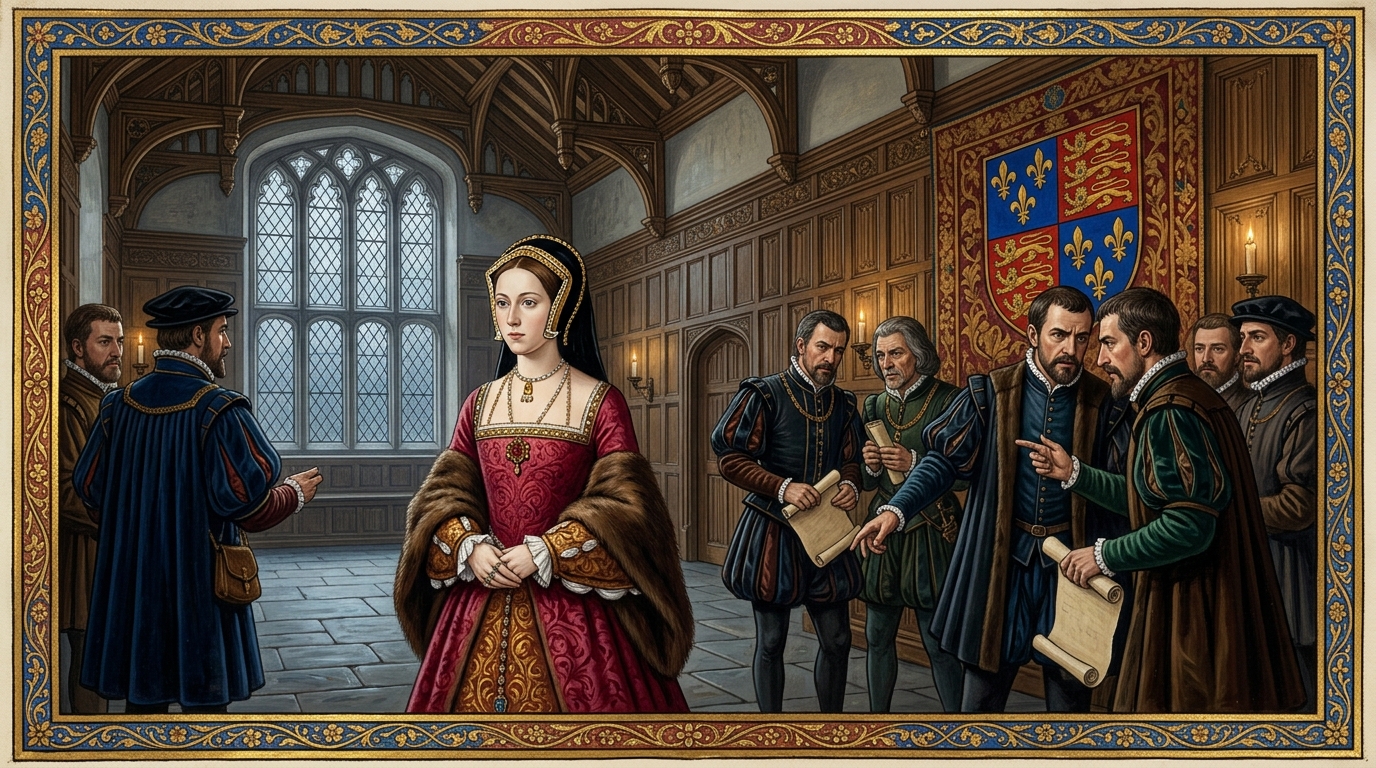
The Fall of Anne Boleyn: Were the Charges of Adultery Fabricated?
In the spring of 1536, the woman who had captivated a king, defied a pope, and transformed England forever was arrested on charges so shocking they sent ripples of disbelief through the courts of Europe. Anne Boleyn, Queen of England and mother of the future Elizabeth I, stood accused of adultery with five men, including her own brother George. Within weeks, she would be dead, beheaded on Tower Green on the 19th of May 1536. Yet historians have long questioned whether these charges were ever anything more than a convenient fiction, a brutal political mechanism designed to clear the path for Henry VIII to take a new wife.
As both a Tudor history expert and a historical fiction author, I find the case of Anne Boleyn endlessly compelling precisely because the truth remains so tantalisingly out of reach. The evidence, as recorded in the Letters and Papers, Foreign and Domestic, of the Reign of Henry VIII, paints a deeply ambiguous picture, one in which the machinery of Tudor justice moved with suspicious speed and the accused had almost no opportunity to mount a meaningful defence. What follows is a careful examination of the charges, the circumstances, and the lasting significance of one of the most dramatic episodes in English history.
By the end of this article, you will understand who the accused men were, why the charges are widely regarded as fabricated, how the fall of Anne Boleyn reshaped Tudor politics, and why this story continues to fascinate readers, historians, and storytellers more than five centuries later.
Historical Background: The Accused and the Accusations
Anne Boleyn had been Queen of England since January 1533, when Henry VIII secretly married her following his long and tortuous break from Catherine of Aragon. The marriage had required nothing less than the severing of England from Rome, the establishment of the Church of England, and the humiliation of one of the most powerful dynasties in Europe. Anne had given Henry a daughter, the future Elizabeth I, born in September 1533, but she had failed to provide the male heir the king so desperately craved. By early 1536, Henry’s attention had turned decisively towards Jane Seymour, a quiet, pale lady-in-waiting from Wiltshire.
The accusations against Anne were formally presented in late April and early May of 1536. According to the indictments, she had committed adultery with five men: Henry Norris, a courtier and the Groom of the Stool; Francis Weston, a young gentleman of the Privy Chamber; William Brereton, another gentleman of the Privy Chamber; Mark Smeaton, a court musician; and her own brother, George Boleyn, Lord Rochford. The charge of incest with George was perhaps the most sensational and, to many historians, the most clearly implausible of all.
Alison Weir, in her landmark study The Six Wives of Henry VIII (Grove Press, 1991), notes that the evidence against Anne and most of the accused men was remarkably thin. Mark Smeaton, the musician, was the only one to confess, and his confession was almost certainly extracted under torture or the threat of it. The other men all maintained their innocence to the scaffold. Henry Norris reportedly told Thomas Cromwell, who orchestrated the investigation, that he would rather die a thousand deaths than accuse the queen of anything dishonourable.
The trials themselves were conducted with breathtaking speed. The five accused men were tried on the 12th of May 1536, and Anne and George Boleyn faced their own separate trials on the 15th of May, before a panel of peers that included, remarkably, Anne’s own former suitor Henry Percy and her estranged uncle, the Duke of Norfolk. The verdicts were never seriously in doubt. All six were condemned to death, and all were executed between the 17th and 19th of May 1536.
Significance and Impact: Why This Matters
The fall of Anne Boleyn was not simply a personal tragedy. It was a seismic political event that demonstrated, with terrifying clarity, how absolute power operated in Tudor England. Thomas Cromwell, Henry’s chief minister, appears to have been the principal architect of Anne’s destruction, and his motives were almost certainly political rather than moral. Anne had opposed Cromwell’s plans for the dissolution of the monasteries and had clashed with him over foreign policy. Removing her served Cromwell’s interests as much as it served the king’s desire for a new wife.
Did you know? Henry VIII and Jane Seymour were formally betrothed on the 20th of May 1536, the very day after Anne Boleyn’s execution. They married on the 30th of May, just eleven days later. The indecent haste of this remarriage struck many contemporary observers as deeply suspicious and lent considerable weight to the view that Anne’s destruction had been planned well in advance.
For Tudor society, the implications were profound. If a queen of England could be destroyed on what appeared to be fabricated charges, then no one at court was truly safe. The executions of Norris, Weston, Brereton, Smeaton, and George Boleyn sent an unmistakable message about the cost of proximity to royal disfavour. The episode also reinforced the vulnerability of women at the Tudor court, whose reputations could be weaponised against them with devastating efficiency.
The long-term consequences extended far beyond 1536. Anne’s daughter Elizabeth survived, grew up, and eventually became Elizabeth I, one of the greatest monarchs in English history. There is a haunting irony in the fact that the child born of a marriage built on such ambition and destruction would go on to define an era. Anne’s religious legacy also persisted. She had been a significant patron of evangelical reform, and her influence on the English Reformation, though abruptly curtailed, was real and lasting.
Connections and Context: The Wider Tudor Picture
To understand the fall of Anne Boleyn fully, it is essential to place it within the broader context of Henry VIII’s reign. The year 1536 was one of extraordinary upheaval. In January, Catherine of Aragon died at Kimbolton Castle, removing the one figure whose continued existence had arguably given Anne a degree of political protection. Catherine’s death was greeted by Henry with unseemly celebration, but it also paradoxically weakened Anne’s position by making it easier for Henry to contemplate yet another new beginning without the complications of having two displaced queens.
Also in 1536, Anne suffered a devastating miscarriage, reportedly of a male foetus. This failure, coming after years of pressure to produce a male heir, appears to have been the moment Henry’s commitment to his second marriage finally broke. The Letters and Papers of the period document a court in which tension and factional rivalry were at their height, with the Seymour family manoeuvring skillfully to advance their sister’s prospects.
The episode also connects directly to the wider story of Thomas Cromwell, whose own fall would come just four years later in 1540, when Henry turned on him with the same ruthlessness he had once directed at Anne. There is a dark symmetry in the fact that the man who had engineered Anne’s destruction would himself be executed on Tower Hill in July 1540, a victim of the same system of royal favour and disfavour he had so expertly manipulated.
Modern Relevance and Fascinating Details
The story of Anne Boleyn has never lost its power to captivate. As a historical fiction author, I am struck by how contemporary the dynamics feel: the abuse of power, the destruction of inconvenient women through reputational attack, the speed with which allies become accusers when self-preservation demands it. These are themes that resonate in every era, which is perhaps why Anne continues to inspire novels, television dramas, and films in such extraordinary numbers.
Hilary Mantel’s Booker Prize-winning Wolf Hall trilogy brought the period to a new generation of readers, portraying Cromwell as a complex, morally ambiguous figure navigating an extraordinarily dangerous world. Showtime’s The Tudors dramatised Anne’s rise and fall for a global television audience. Philippa Gregory’s novel The Other Boleyn Girl explored the family dynamics surrounding Anne with imaginative flair. In each case, the central question remains the same: was Anne Boleyn guilty, or was she a victim of one of history’s most calculating judicial murders?
Did you know? Anne Boleyn’s supposed last words on the scaffold were characteristically composed and even gracious. She thanked the king for his treatment of her and asked those present to pray for her soul. The dignity she maintained in her final moments has been noted by historians from Weir onwards as consistent with a woman who believed herself innocent and refused to allow her enemies the satisfaction of a public breakdown.
Forensic historians have also pointed to the geographical impossibilities embedded in the indictments. Some of the alleged acts of adultery were said to have taken place on dates when Anne and the accused men can be shown, through other documentary evidence in the Letters and Papers, to have been in entirely different locations. This is not a minor inconsistency. It suggests that whoever drew up the charges did so with limited concern for factual accuracy.
Conclusion: A Queen Destroyed, a Mystery Enduring
The fall of Anne Boleyn remains one of Tudor history’s most compelling and troubling episodes. The weight of historical evidence, from the primary sources preserved in the Letters and Papers to the careful analysis offered by scholars such as Alison Weir, strongly suggests that the charges of adultery and incest brought against her in 1536 were fabricated, or at the very least grossly distorted, to serve the political and personal interests of Henry VIII and Thomas Cromwell. Five men lost their lives alongside her, men who almost certainly died innocent.
What endures is not only the tragedy of Anne Boleyn herself, but the questions her story forces us to ask about power, justice, and the way history is written by those who survive. If you want to explore this period further, I would strongly recommend beginning with Alison Weir’s The Six Wives of Henry VIII and then diving into the primary sources of the Letters and Papers for yourself. The more closely you look, the more the official version of events begins to unravel, and the more extraordinary Anne Boleyn’s story becomes.