
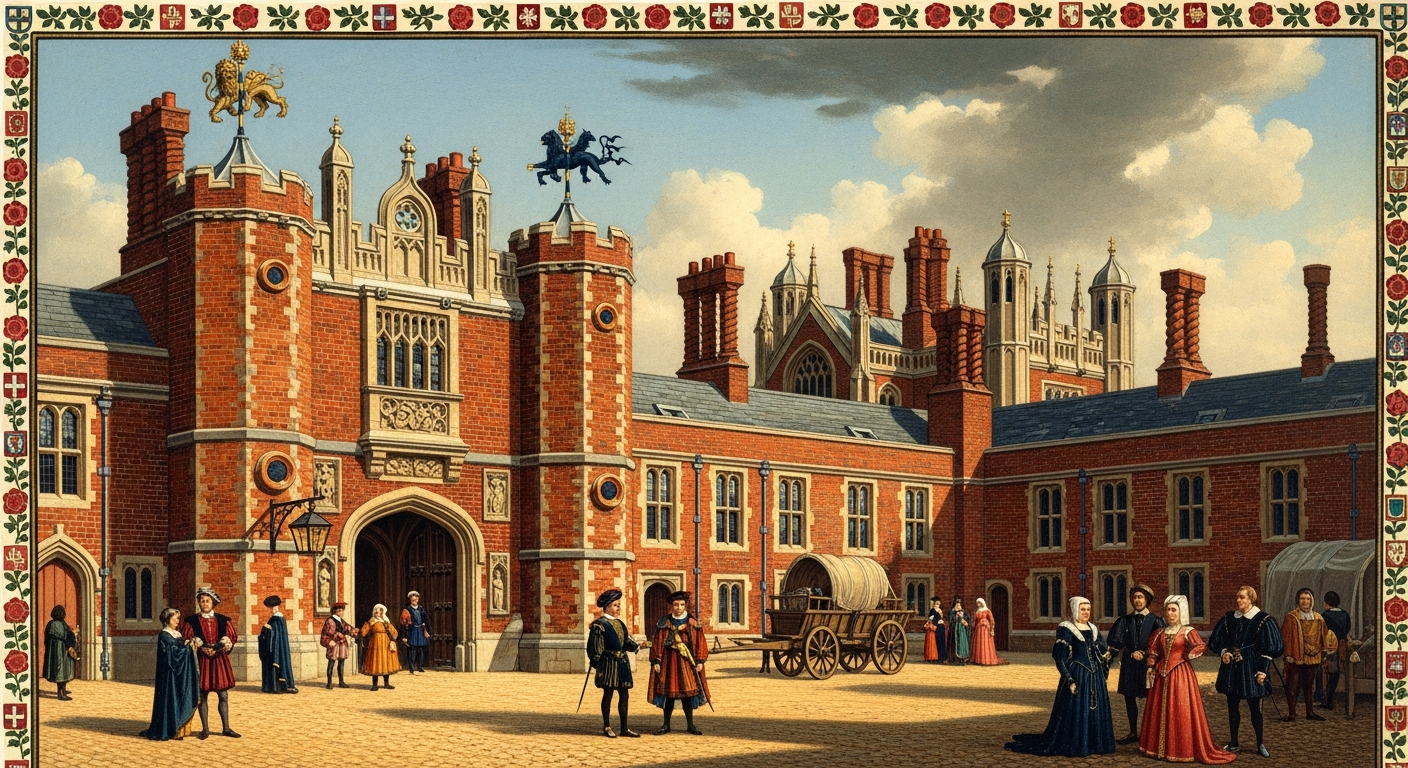
Hampton Court Palace and Henry VIII: The Royal Residence That Rewrote Tudor History
Imagine standing in the great hall of the most magnificent palace in Tudor England, knowing that the building beneath your feet was not built by a king, but seized from one of the most powerful men in the realm. Hampton Court Palace carries with it one of the most dramatic stories of ambition, downfall, and royal acquisition in British history. When Henry VIII formally took possession of Hampton Court from Cardinal Thomas Wolsey in 1528, he did not simply gain a building. He absorbed a statement of power so bold that only a monarch could truly wear it.
Today, Hampton Court Palace draws hundreds of thousands of visitors each year, many of whom come specifically to walk the famous maze or explore the Tudor kitchens. Yet much of what people believe about the palace’s history contains fascinating layers of complexity. The maze, for instance, is not Tudor at all. According to Historic Royal Palaces, the famous Hampton Court maze was commissioned by William III around 1700, more than 150 years after Henry VIII’s reign. Meanwhile, the palace still features a 17th-century Real Tennis court built on the site of Henry’s original court, connecting visitors physically to a sporting tradition that Henry himself passionately embraced.
In this post, we will explore how Hampton Court became synonymous with Henry VIII’s reign, why Cardinal Wolsey’s extraordinary generosity was anything but voluntary, and what the palace reveals about the nature of Tudor power, patronage, and politics. Whether you are a seasoned Tudor enthusiast or discovering this history for the first time, there is much here to surprise and captivate you.
Historical Background: From Wolsey’s Ambition to Henry’s Throne
To understand why Hampton Court matters so profoundly to Tudor history, we must first understand the man who built it into greatness. Thomas Wolsey was the son of an Ipswich butcher who rose, through extraordinary intelligence and political acumen, to become Lord Chancellor of England and a Cardinal of the Roman Catholic Church. By the early 1520s, he was effectively the second most powerful man in the kingdom, and he intended his residence to reflect that status. He leased the Hampton Court manor from the Knights Hospitaller in 1514 and immediately set about transforming it into a palace of breathtaking opulence.
Wolsey’s Hampton Court was not merely large. It was deliberately, provocatively magnificent. According to records held by The National Archives, Wolsey constructed lodgings, galleries, and gardens that rivalled anything the Crown itself possessed. He installed elaborate tapestries, fine furniture, and an extensive household staff. The Great Hall, the kitchens, and the private apartments were all designed to project an image of a man who sat comfortably alongside princes and popes. For a time, that image held.
However, Wolsey’s relationship with Henry VIII was always built on precarious ground. Henry had relied upon Wolsey as his chief minister since the early years of his reign, but the King’s patience was not unlimited. By the mid-1520s, Henry’s obsession with securing an annulment from Catherine of Aragon had placed enormous pressure on Wolsey to deliver a solution from Rome. When Wolsey failed to obtain the annulment, his position became dangerously exposed. In 1528, as part of what many historians interpret as a calculated effort to appease his royal master and perhaps forestall his own ruin, Wolsey formally transferred Hampton Court to the Crown.
The transfer did not save him. Wolsey was stripped of most of his offices and wealth in 1529, charged with praemunire, and died in 1530 while travelling south to face trial for treason, reportedly uttering the famous lament that he had served his king better than his God. Henry, meanwhile, had acquired not just a palace but a symbol: proof that no subject, however powerful, could surpass the glory of the Crown.
Significance and Impact: What Hampton Court Meant for Tudor England
The acquisition of Hampton Court was about far more than bricks and mortar. For Henry VIII, it represented a fundamental assertion of royal supremacy at precisely the moment when his authority was being tested on multiple fronts. The break with Rome, the dissolution of the monasteries, and the series of marriages that would define his legacy were all either underway or imminent by the time Henry settled into Hampton Court as his own. Having the grandest palace in England was not vanity; it was statecraft.
Henry invested enormous resources in expanding and improving the palace throughout the 1530s and 1540s. He added the Great Hall, completed around 1535, which remains one of the finest surviving examples of Tudor architecture in Britain. He also developed the royal kitchens, which could reportedly feed a household of several hundred people, and created elaborate gardens that demonstrated his interest in Renaissance ideas filtering through from continental Europe. The palace became the setting for significant royal events, including celebrations following the birth of his son, the future Edward VI, in 1537.
For Tudor society more broadly, Hampton Court embodied the cultural aspirations of the age. Henry fancied himself a Renaissance prince in the mould of his European contemporaries, and the palace was his most visible claim to that status. It attracted artists, musicians, scholars, and diplomats, functioning as a cultural hub as much as a political one. The fact that Henry chose to spend so much time here, rather than at the older royal palaces such as the Palace of Westminster, tells us a great deal about where he believed the heart of his court truly lay.
Did you know? Henry VIII was an enthusiastic Real Tennis player in his youth, and Hampton Court’s tennis court was a genuine centre of courtly recreation. The sport, quite different from modern lawn tennis, involved an elaborate indoor court and complex rules. The current Real Tennis court on the site dates from the 17th century, but it stands on the very ground where Henry’s original court once existed, according to Historic Royal Palaces.
Connections and Context: The Wider Tudor World
The story of Hampton Court does not exist in isolation. It sits at the intersection of several of the most consequential threads running through Tudor history. Wolsey’s fall was inextricably linked to the question of the royal annulment, which in turn led to the English Reformation, the break with Rome, and the sweeping changes to religious and political life that would shape England for generations. In this sense, the transfer of Hampton Court was a small but telling early sign of the seismic shifts to come.
It is also worth placing Hampton Court within the context of Henry’s wider building programme. He eventually owned or used more than sixty royal residences, according to sources at The National Archives, making him one of the most property-acquisitive monarchs in English history. Many of these properties, including Nonsuch Palace in Surrey, were entirely new constructions, testaments to Henry’s seemingly insatiable desire to project royal magnificence. Hampton Court, however, remained among his most favoured, perhaps because it combined genuine comfort with grandeur on a scale that few other palaces could match.
The palace also connects us to the lives of Henry’s six wives. Jane Seymour gave birth to Edward VI at Hampton Court and died there shortly afterwards in 1537. Catherine Howard, Henry’s fifth wife, is said to have fled along a gallery at the palace attempting to reach Henry and plead for her life before her arrest in 1541. That corridor is still known as the Haunted Gallery, and it remains one of the most atmospheric spaces in the entire building.
Modern Relevance and Fascinating Details
Hampton Court Palace continues to captivate visitors and historians in equal measure, and as a historical fiction author I find it one of the most atmospherically rich settings imaginable. Walking through the Great Hall or standing in the Tudor kitchens, it is remarkably easy to people those spaces with the men and women who shaped the course of English history. The palace is one of the very few places where the physical fabric of the Tudor world remains largely intact, which is why it features so prominently in historical novels, television dramas, and documentary series.
One detail that consistently surprises visitors is the question of the maze. Many people visit Hampton Court specifically to walk its famous hedgerow maze, assuming it to be a Tudor creation. In fact, as Historic Royal Palaces confirms, the maze was commissioned by William III around 1700, as part of a broader landscape redesign of the palace gardens. It is a wonderful feature, but it belongs to a different chapter of the palace’s long history entirely. This kind of layering, where different eras leave their marks on the same space, is part of what makes Hampton Court so endlessly fascinating.
The Real Tennis court is another detail that rewards closer attention. The game Henry played was one of the most fashionable aristocratic pursuits of the 16th century, associated with skill, athleticism, and refined competition. Henry was reportedly an accomplished player in his younger years, and the court at Hampton Court was a site of genuine competitive play rather than mere display. The survival of a Real Tennis court on the same site today, even if the current structure is later in date, creates a tangible link across the centuries.
Conclusion: A Palace That Still Has Secrets to Tell
Hampton Court Palace is, above all, a story about power: how it is acquired, how it is displayed, and how it passes from one hand to another. From Wolsey’s ambitious construction project to Henry’s triumphant acquisition, from the births and deaths of Tudor royalty to the later additions of Stuart and Dutch monarchs, the palace has witnessed more of England’s history than almost any other building still standing.
Whether you are drawn to the drama of Wolsey’s downfall, the architectural splendour of the Tudor Great Hall, the athletic traditions of the Real Tennis court, or simply the desire to stand in a space where Henry VIII himself once walked, Hampton Court repays every visit and every hour of study. We invite you to explore further, visit the palace in person if you can, and discover for yourself the layers of history that this extraordinary place contains. For further reading, the resources available through Historic Royal Palaces and The National Archives offer an excellent starting point for anyone wishing to go deeper into the Tudor world.