
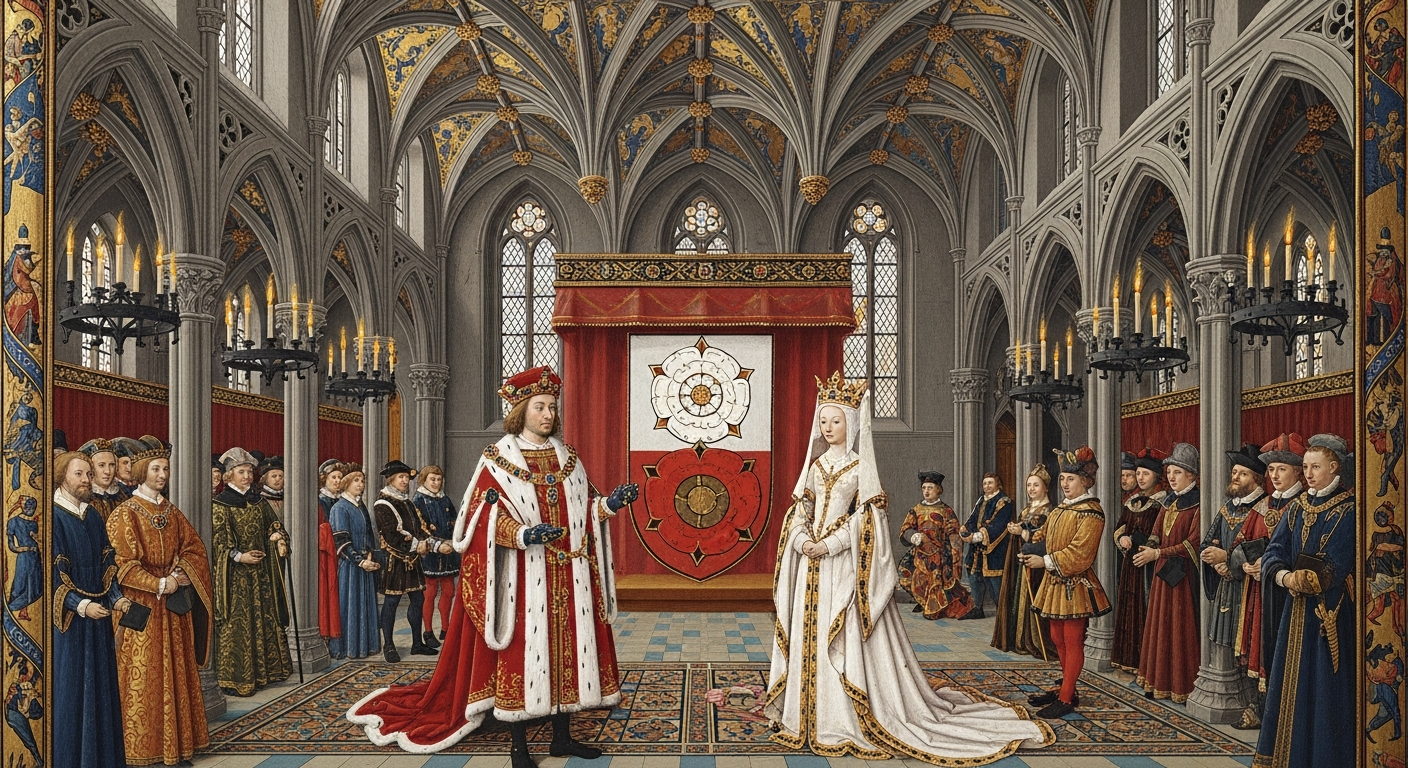
The Marriage That Changed England: Henry VII, Elizabeth of York, and the Birth of the Tudor Dynasty
Imagine two families who had spent decades tearing England apart, their rivalry soaked in blood and betrayal, suddenly bound together by a single wedding ceremony. On the 18th of January 1486, Henry VII married Elizabeth of York at Westminster, and in doing so, he accomplished something that neither military conquest nor political manoeuvring alone could ever have achieved: he gave England peace. This was not merely a royal wedding. It was the symbolic closing of a wound that had festered for over thirty years, and it planted the seeds of one of the most celebrated dynasties in British history.
The union of the red rose of Lancaster and the white rose of York is one of those moments in history that feels almost too neat, too perfectly theatrical, to be real. Yet it happened, and its consequences rippled outward through centuries of English and British life. As a historical fiction author who has spent years immersed in the Tudor world, I find this marriage endlessly compelling, not just as a political manoeuvre, but as a deeply human story of two people caught at the intersection of dynasty, duty, and destiny.
In this post, we will explore who Henry and Elizabeth were, why their marriage mattered so profoundly, how it shaped the Tudor age, and why it continues to fascinate historians, novelists, and readers alike. Whether you are new to Tudor history or a seasoned enthusiast, there is something here to surprise and engage you.
Historical Background: Who Were Henry VII and Elizabeth of York?
To understand why this marriage was so significant, we must first understand the two people at its centre. Henry Tudor, who became Henry VII on the 22nd of August 1485 following his victory at the Battle of Bosworth Field, was by no means an obvious candidate for the English throne. His claim through the Lancastrian line was tenuous at best, running through his mother, Lady Margaret Beaufort, who was descended from John of Gaunt, Duke of Lancaster, and his mistress-turned-wife Katherine Swynford. The Beaufort line had been declared legitimate by Parliament but barred from royal succession, a complication that Henry’s supporters conveniently chose to overlook. As Michael K. Jones notes in Bosworth 1485: The New Beginning of the Tudor Age, Henry’s victory was as much a matter of political fortune and battlefield timing as it was of dynastic right.
Elizabeth of York, by contrast, had one of the most unimpeachable royal pedigrees in England. Born on the 11th of February 1466, she was the eldest daughter of King Edward IV and Elizabeth Woodville, making her a princess of the House of York and a figure of enormous symbolic importance. Her life had already been shaped by the turbulence of the Wars of the Roses. She had seen her father’s throne wobble and recover, witnessed the mysterious disappearance of her brothers, the Princes in the Tower, and endured the controversial reign of her uncle, Richard III. Arlene Naylor Okerlund, in her biography Elizabeth of York, describes her as a woman of considerable intelligence and dignity who navigated the treacherous politics of her era with remarkable composure.
The idea of uniting these two bloodlines had been floated even before Bosworth. Henry had publicly pledged, whilst in exile in Brittany, to marry Elizabeth if he took the crown, and this promise had won him crucial Yorkist support. When he did take the crown, the pressure to honour that pledge was immense, both politically and practically. Henry delayed the marriage until after his own coronation, a calculated decision designed to make clear that he ruled by right of conquest, not merely by virtue of his wife’s superior claim.
The wedding itself took place at Westminster Abbey, with great ceremony and public celebration. It was a moment the exhausted English populace had been longing for, a visible sign that the dynastic bloodletting might finally be over.
Significance and Impact: Why This Marriage Mattered
The political significance of the marriage can hardly be overstated. The Wars of the Roses, that long and devastating series of civil conflicts between the Lancastrian and Yorkist factions, had claimed thousands of lives, destabilised the English nobility, and left the monarchy itself looking dangerously fragile. By marrying Elizabeth, Henry symbolically united the two warring houses and, crucially, gave his future heirs a claim that transcended factional loyalties. Their children would be both Lancaster and York, red rose and white rose, a new thing entirely: Tudor.
The heraldic symbol that emerged from this union, the Tudor rose, combining red and white, was not merely decorative. It was a piece of political propaganda of the highest order, a visual declaration that the old divisions had been healed. You can still see Tudor roses carved into the stonework of churches, palaces, and civic buildings across England, silent testament to the enduring power of that symbolic marriage.
Beyond symbolism, the marriage had concrete dynastic consequences. Elizabeth bore Henry seven children, of whom four survived infancy. Their eldest son, Arthur, Prince of Wales, was born in September 1486, just eight months after the wedding, and his very existence was proof that the new dynasty had taken root. When Arthur died tragically young in 1502, it was his younger brother who would eventually reign as Henry VIII, perhaps the most famous English monarch of all. The entire extraordinary story of the English Reformation, the break with Rome, the establishment of the Church of England, flows, in a very real sense, from the decision Henry VII made to marry Elizabeth of York.
Elizabeth herself, though often overshadowed by her more flamboyant successors, played a vital role in stabilising the new regime. Okerlund argues persuasively that her quiet dignity and her popularity with both Yorkist sympathisers and the general public helped to legitimise a dynasty that many still regarded with suspicion. She was beloved by the people in a way that Henry, cautious and somewhat cold in manner, never quite managed to be.
Connections and Context: The Wider Tudor World
The marriage of Henry and Elizabeth did not occur in isolation. It was part of a broader programme of dynastic consolidation that Henry VII pursued with characteristic shrewdness throughout his reign. He suppressed Yorkist rebellions, most notably those led by Lambert Simnel in 1487 and Perkin Warbeck in the 1490s, with a combination of military force and political calculation. Each challenge to his throne was, in part, a challenge to the legitimacy that his marriage to Elizabeth was meant to provide.
It is also worth remembering what was happening elsewhere in Europe at this time. The late fifteenth century was an era of extraordinary change. In 1492, the same year that Perkin Warbeck began his campaign against Henry, Christopher Columbus sailed to the Americas. The Italian Renaissance was transforming art, philosophy, and science. The printing press, introduced to England by William Caxton just a decade earlier, was beginning to reshape how information spread. Henry VII’s England was not a medieval backwater but a kingdom on the cusp of early modernity, and the stability provided by his marriage was a precondition for England’s engagement with that wider world.
Did you know? Henry VII was so determined to project an image of dynastic unity that he commissioned elaborate genealogical rolls tracing both his Lancastrian descent and, through Elizabeth, his Yorkist connections. These documents were works of political art as much as historical record.
Modern Relevance and Fascinating Details
For those who come to Tudor history through popular culture, the marriage of Henry VII and Elizabeth of York may be most familiar through Philippa Gregory’s novel The White Princess, adapted for television in 2017. Gregory imagines Elizabeth as a complex, conflicted figure, grieving for Richard III whilst being compelled to marry his supplanter. Whilst historians debate the accuracy of some of Gregory’s interpretations, her work has introduced millions of readers to this pivotal moment, and there is genuine historical basis for the tensions she portrays. Elizabeth’s feelings about her uncle Richard III remain a subject of genuine scholarly debate, and her adjustment to life as queen consort to a man whose political needs she served as much as his heart must have been challenging in ways we can only speculate about.
What surprises many people is how little we actually know about Elizabeth of York as an individual. Unlike her son Henry VIII, whose every word and whim seems to have been recorded, Elizabeth left behind relatively few personal documents. We know her through accounts, through the testimony of others, and through the artefacts of her queenship. Her portrait, believed to have been painted around 1500, shows a composed, fair-haired woman of perhaps thirty, holding a white rose. It is a face that gives little away, which perhaps suited her purpose perfectly.
Elizabeth died on the 11th of February 1503, her thirty-seventh birthday, shortly after giving birth to a daughter, Katherine, who did not survive. Henry VII is said to have been devastated by her loss. After years of a marriage that had begun as political necessity, it seems genuine affection, perhaps even love, had grown between them. He never remarried.
Conclusion: A Marriage That Echoes Through History
The marriage of Henry VII and Elizabeth of York was, at its core, a political arrangement designed to solve a political problem. But history rarely stays tidy within such neat boundaries. What began as a dynastic calculation became the foundation of a family whose members would include some of the most dramatic, controversial, and consequential figures in British history. Without this marriage, there is no Henry VIII, no Catherine of Aragon, no break with Rome, no Elizabeth I, no Shakespeare writing for an Elizabethan stage. The Tudor century, in all its turbulent glory, begins here, in Westminster Abbey, on a January day in 1486.
If this story has sparked your curiosity, I encourage you to explore Arlene Naylor Okerlund’s biography of Elizabeth and Michael K. Jones’s account of Bosworth and its aftermath. The Wars of the Roses, the Tudor dynasty, and the remarkable people who lived through these events offer a lifetime of fascinating reading. History, as I have always believed, is never just about the past. It is about understanding how the world we inhabit came to be shaped, one consequential decision at a time.