
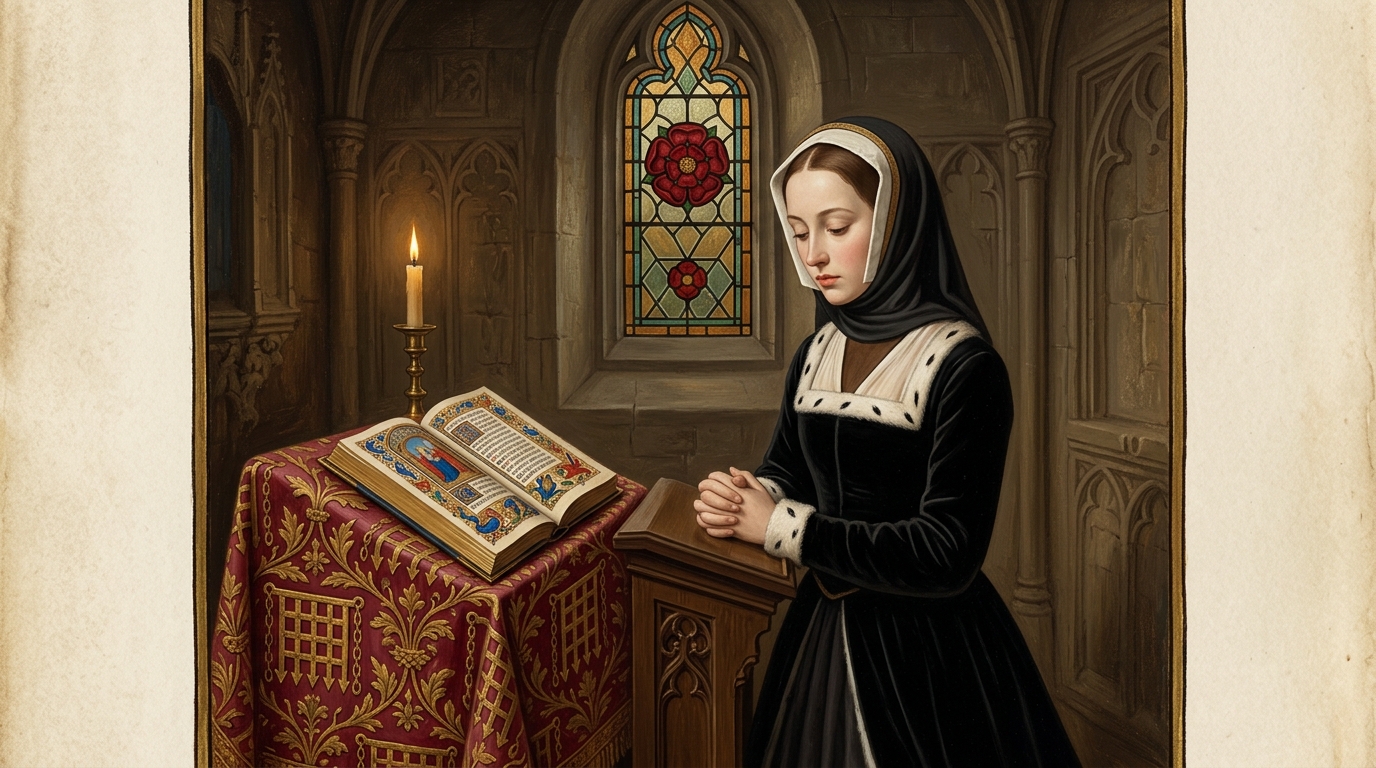
The Girl Who Changed History: Margaret Beaufort’s Tragic Pregnancy and the Birth of the Tudor Dynasty
Imagine being twelve years old, politically married off to a man not of your choosing, and carrying a child before your body was remotely ready for such an ordeal. This was the reality for Lady Margaret Beaufort, one of the most remarkable women in English history, and a figure whose suffering would quite literally shape the destiny of a nation. Her story raises urgent questions that historians, medical professionals, and readers of historical fiction continue to grapple with today: what were the consequences of child marriage in medieval England, and how did one woman’s trauma become the foundation of an entire royal dynasty?
Margaret Beaufort is often spoken of in reverential terms as the mother of King Henry VII, the founder of the Tudor dynasty. She was a formidable political operator, a devoted patron of learning, and a woman of extraordinary resilience. Yet beneath the official portraits and the scholarly tributes lies a deeply human story of a child bride whose body was permanently damaged in the service of dynastic ambition. According to Margaret Beaufort: Mother of the Tudor Dynasty by Dulcie M. Ashdown, Margaret became pregnant at just twelve years of age and gave birth at thirteen, sustaining such severe internal injuries during labour that she was never able to conceive again, despite two subsequent marriages.
In this post, we will explore who Margaret Beaufort was, the circumstances of her early marriage and pregnancy, the lasting political and personal consequences of that birth, and why her story remains as compelling and as relevant today as it was in the fifteenth century.
Historical Background: A Child in a World of Political Intrigue
Margaret Beaufort was born on 31st May 1443, the daughter of John Beaufort, 1st Duke of Somerset, and Margaret Beauchamp of Bletso. Her father died when she was just an infant, leaving her an immensely wealthy heiress in one of the most turbulent periods of English history. The Beaufort family were descendants of John of Gaunt and his mistress-turned-wife Katherine Swynford, which placed Margaret in direct proximity to the royal bloodline, albeit through a legitimised but controversial branch.
As a wealthy ward of the Crown, Margaret’s hand in marriage was a valuable political commodity. She was first betrothed to John de la Pole, son of the Duke of Suffolk, when she was just a small child, though this arrangement was later dissolved. Her wardship was then granted to Jasper and Edmund Tudor, half-brothers of the troubled King Henry VI. It was Edmund Tudor, Earl of Richmond, who married Margaret in 1455, when she was approximately twelve years old. Edmund was around twenty-four years his bride’s senior, a sobering detail that underscores the transactional nature of noble marriage in this period.
According to Desmond Seward’s The Shadow King: The Life and Death of Henry VI, the political climate of the 1450s was one of increasing instability, with the Wars of the Roses already beginning to reshape the English nobility. Edmund Tudor had every reason to want an heir quickly, as his own position was precarious. Despite the known risks of early pregnancy, and despite the fact that Margaret’s own guardians reportedly recognised she was too young, Edmund consummated the marriage and Margaret fell pregnant almost immediately.
Edmund Tudor died of plague in November 1456, before his child was born, leaving the thirteen-year-old Margaret a pregnant widow in Pembroke Castle, Wales. On 28th January 1457, she gave birth to her son, the future King Henry VII. The birth was extraordinarily difficult. Margaret’s small, immature body was ill-equipped for childbirth, and the labour caused severe internal damage. As Dulcie M. Ashdown documents, these injuries were permanent, rendering Margaret incapable of bearing further children despite her subsequent marriages to Henry Stafford and later Thomas Stanley, 1st Earl of Derby.
Significance and Impact: One Birth That Reshaped England
The consequences of that single, traumatic birth in Pembroke Castle in the winter of 1457 cannot be overstated. The child Margaret delivered against all the odds grew up to defeat Richard III at the Battle of Bosworth in 1485, claiming the English throne and establishing the Tudor dynasty that would endure for over a century. Without Henry Tudor, there is no Henry VIII, no English Reformation, no Elizabeth I. The entire arc of early modern English history pivots on the survival of that infant boy.
For Margaret herself, the physical consequences shaped the remainder of her long life. Unable to have further children, she channelled her considerable energies, intelligence, and wealth into a single, consuming purpose: securing the throne for her son. She became one of the most skilled political operators of the age, navigating the treacherous currents of Yorkist and Lancastrian conflict with extraordinary dexterity. She conspired, negotiated, and endured house arrest under the Yorkist regime, all in service of Henry’s eventual triumph.
The impact on Tudor society was equally profound. Margaret Beaufort’s story is a striking illustration of how the bodies and lives of aristocratic women were treated as political resources. Her experience did not prompt any immediate social reform, of course, but it did contribute to a gradual, centuries-long conversation about the appropriate age of marriage and the rights of women over their own persons. Historians studying gender in the medieval and early modern periods frequently cite Margaret’s case as a particularly well-documented example of the dangers of child marriage among the nobility.
Did you know? Margaret Beaufort went on to become one of the great patrons of education in English history. She co-founded Christ’s College and St John’s College at Cambridge University, institutions that continue to thrive today. Her motto, Souvent me souvient (Often I remember), appears on both colleges to this day.
Connections and Context: The Wars of the Roses and the Tudor Rise
Margaret’s story cannot be properly understood without appreciating the wider chaos of the Wars of the Roses, the series of civil conflicts between the Houses of York and Lancaster that dominated English politics from the 1450s to 1485. As Desmond Seward’s biography of Henry VI makes clear, the instability of Henry VI’s reign created a political environment in which marriages like Margaret’s were conducted with ruthless pragmatism. Dynastic survival trumped personal wellbeing at every turn.
It is worth noting that Margaret’s experience, though extreme, was not entirely unusual for women of her class and era. The average age of first marriage for noble women in fifteenth-century England was considerably younger than we would consider acceptable today, though medical practitioners of the period did acknowledge that very early pregnancies carried significant risks. What made Margaret’s case particularly acute was the combination of her extreme youth, the urgency of Edmund Tudor’s desire for an heir, and the brutal physical demands of a difficult labour without modern medical intervention.
Elsewhere in the Tudor world, questions of female agency, marriage, and bodily autonomy would continue to surface throughout the dynasty. Katherine of Aragon, Anne Boleyn, and the other wives of Henry VIII all experienced, in different ways, how completely a royal or noble woman’s body could be subject to political calculation. Margaret’s story sits at the beginning of this continuum, offering a particularly clear-eyed view of the cost exacted from women at the very foundation of the Tudor age.
Modern Relevance and Fascinating Details
As a historical fiction author, I find Margaret Beaufort to be one of the most compelling figures in the entire Tudor period, precisely because her story defies easy categorisation. She was simultaneously a victim of her circumstances and one of the most powerful agents of change in fifteenth-century England. Writing her into fiction requires holding both truths at once, refusing to reduce her to either a passive sufferer or an impossibly heroic figure.
Her story has attracted significant attention in popular culture in recent years. Philippa Gregory’s novel The Red Queen (2010) brought Margaret to a wide modern audience, portraying her with the fierce, unsentimental ambition that the historical record certainly supports. Television adaptations and documentaries have further renewed interest in her life, and she is frequently cited in discussions about the representation of women in historical drama. What strikes contemporary audiences most forcefully, invariably, is the sheer youth at which her life’s great trauma occurred.
Did you know? Margaret Beaufort outlived her son, King Henry VII, by just two months. She died on 29th June 1509, having witnessed the coronation of her grandson Henry VIII. She was sixty-six years old, a remarkable age for the period, and to the very end she remained a formidable presence at the English court.
The medical dimension of Margaret’s story also continues to interest historians and medical professionals alike. The internal injuries she sustained during childbirth at thirteen are consistent with what modern medicine recognises as the serious risks of pregnancy in early adolescence, including obstructed labour and damage to the pelvic floor and reproductive organs. Her case is cited in academic discussions of the historical evidence for child marriage and its physical consequences, lending her story a significance that extends well beyond the narrowly political.
Conclusion: A Legacy Forged in Suffering
Margaret Beaufort’s story is, at its heart, a story about the relationship between personal suffering and historical consequence. A twelve-year-old girl was married off for political advantage, became pregnant, endured a traumatic labour that left her permanently injured, and in doing so gave birth to the boy who would one day become King of England. The entire Tudor dynasty, with all its extraordinary drama, its religious upheaval, its cultural flowering, traces its origins back to that difficult winter night in Pembroke Castle.
Understanding Margaret Beaufort fully means holding the political and the personal in balance. She was not simply the mother of a king; she was a survivor who transformed her own trauma into a fierce, lifelong purpose. For readers, historians, and lovers of historical fiction alike, her story offers an entry point into the complex, often brutal world of medieval and early modern England, and a reminder that behind every great dynastic narrative lies the lived experience of real human beings. If you would like to explore further, both Dulcie M. Ashdown’s Margaret Beaufort: Mother of the Tudor Dynasty and Desmond Seward’s The Shadow King are essential and highly rewarding reads.