
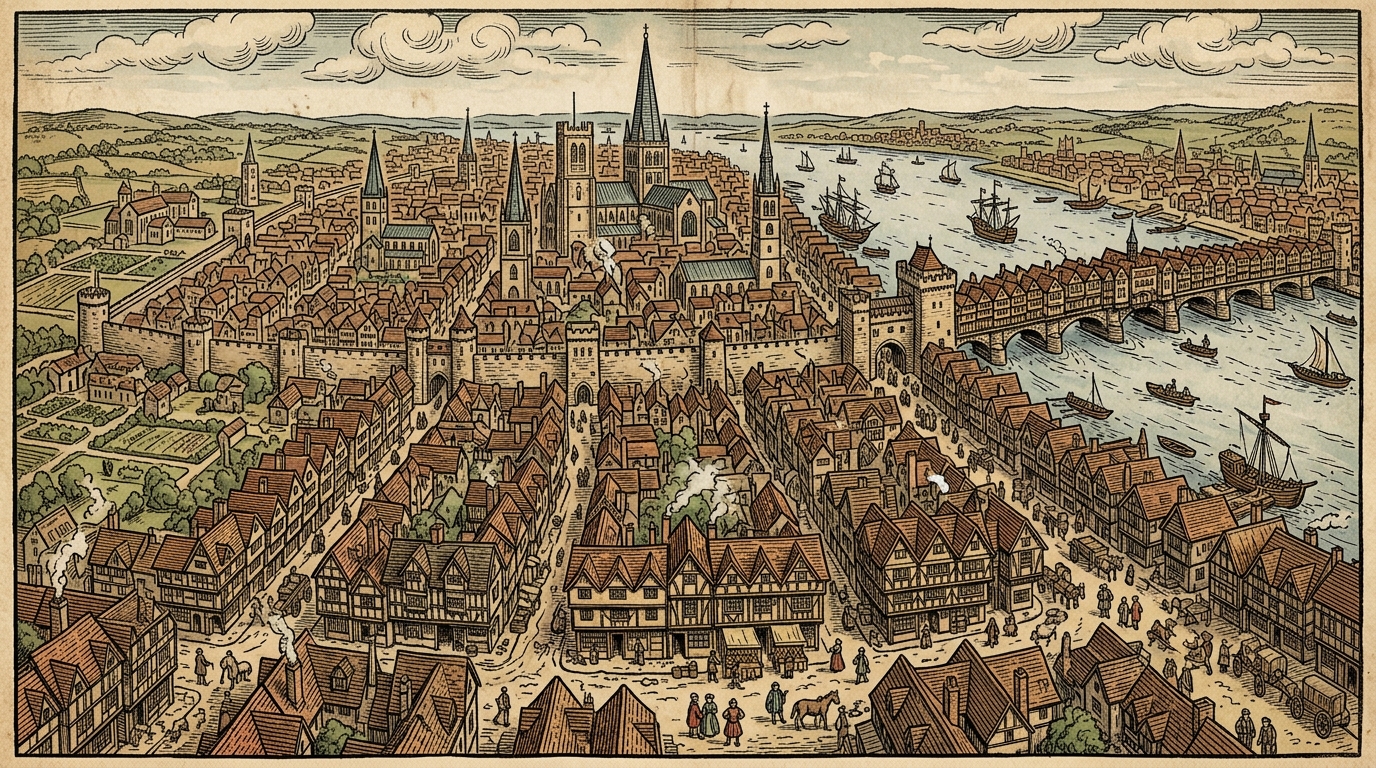
Tudor London’s Population Explosion: How a City of 50,000 Became a Metropolis of 200,000
Imagine stepping off a boat at the Thames waterfront in 1500. London is a bustling but manageable city of roughly 50,000 souls, its medieval street plan largely unchanged since the Norman Conquest. Now fast-forward a century. By 1600, that same city has swelled to approximately 200,000 inhabitants, making Tudor London one of the largest and most chaotic urban centres in all of Europe. This extraordinary transformation reshaped everything: politics, culture, commerce, disease, crime, and the very fabric of daily life. It is one of the most dramatic urban stories in British history, and it begins with the ambitions of a dynasty.
As a historical fiction author who has spent years immersed in Tudor sources, I find this population explosion endlessly fascinating precisely because it was not a planned miracle but a messy, often terrifying, human experience. The streets grew narrower as buildings jutted further outward at each storey. The Thames grew fouler. The parish graveyards filled faster. And yet, amid the squalor, London also became a crucible of Renaissance culture, theatrical genius, and mercantile ambition. Understanding how and why London grew so dramatically is essential to understanding the entire Tudor era.
In this post, we will explore the causes behind Tudor London’s astonishing population growth, the social and sanitary consequences that followed, and why this urban revolution still matters today. Whether you are a history enthusiast, a student, or simply someone who has ever wondered what life in Elizabethan London truly smelled like, read on.
Historical Background: The Making of a Tudor Metropolis
At the dawn of the sixteenth century, London was already England’s undisputed commercial and administrative capital, but it was not yet the dominant European city it would become. John Stow, the tireless Elizabethan chronicler whose Survey of the Cities of London and Westminster (1598) remains one of our most invaluable primary sources, described a city still largely contained within its ancient Roman walls, with suburbs creeping outward but not yet overwhelming the surrounding parishes. The City of London, that square mile governed by its Lord Mayor and aldermen, was the beating heart of this world.
So what drove the population from roughly 50,000 in 1500 to around 200,000 by 1600? Historians A.L. Beier and Roger Finlay, in their landmark edited volume London 1500-1700: The Making of the Metropolis (Longman, 1986), identify several overlapping causes. First, migration from the English countryside played a dominant role. As agricultural enclosures dispossessed thousands of rural labourers, many drifted toward the capital seeking work, charity, or simply survival. London’s expanding trades, particularly cloth, leather, and metalwork, offered wages unavailable in depressed rural communities.
Second, immigration from continental Europe contributed significantly to London’s growth. Protestant refugees fleeing persecution in the Spanish Netherlands arrived in considerable numbers during the mid-to-late sixteenth century, particularly after the Duke of Alba’s brutal suppression of the Dutch revolt in the 1560s. These so-called ‘Strangers’ established their own churches, notably the French and Dutch congregations at Austin Friars, and brought with them specialist skills in weaving, printing, and instrument-making that enriched the city’s economy. By the 1590s, foreign-born residents may have accounted for as much as five to ten per cent of London’s total population.
Third, and perhaps most counterintuitively, London’s growth was partly sustained despite appalling mortality rates. The city was regularly scourged by plague, sweating sickness, and typhus. The plague outbreaks of 1563, 1578, 1582, 1592, and 1603 each carried off thousands of Londoners. Yet still the city grew, because the rate of in-migration consistently outpaced the losses. As Beier and Finlay note, Tudor London essentially consumed people, drawing in the young and the desperate from across England and beyond, and the city survived on their labour and their lives.
Significance and Impact: The Consequences of Overcrowding
The human cost of this rapid urbanisation was severe and immediate. London’s medieval infrastructure was catastrophically ill-suited to housing 200,000 people. The water supply, drawn primarily from the Thames and from wells, was increasingly contaminated by the waste of a densely packed population. Cesspits overflowed into streets already thick with animal dung, discarded food, and the effluent of dozens of trades. John Stow, walking his beloved city in the 1590s, lamented the encroachment of new buildings and the loss of open spaces that had once allowed the city to breathe.
Housing conditions for the poor were particularly dire. Landlords subdivided existing properties into ever-smaller tenements, cramming multiple families into single rooms. The Privy Council repeatedly issued proclamations attempting to halt new building within a three-mile radius of the City gates, fearing that overcrowding would breed both disease and sedition. These proclamations were almost entirely ignored. The economic pressures driving people to London were simply too powerful for Tudor government to resist.
Did you know? The authorities’ fear of London’s growth was not merely humanitarian. Tudor governments genuinely worried that a vast, hungry, and poorly governed urban population posed a threat to political stability. The riots of ‘Evil May Day’ in 1517, when London apprentices attacked foreign merchants, demonstrated how quickly urban discontent could turn violent, and the memory lingered for decades.
The cultural consequences of London’s growth were, however, profoundly positive in some respects. A city of 200,000 could sustain permanent professional theatre in a way that a city of 50,000 could not. The Theatre, built by James Burbage in Shoreditch in 1576, and the later Globe on Bankside, were commercial enterprises that depended upon a large, literate-enough, and leisure-seeking urban audience. William Shakespeare, Christopher Marlowe, and Ben Jonson were, in a very real sense, products of Tudor London’s population explosion. Without the crowds, there would have been no stage.
Connections and Context: London’s Growth in the Wider Tudor World
London’s demographic surge did not occur in isolation. It was intimately connected to the broader upheavals of the Tudor period: the Dissolution of the Monasteries under Henry VIII, the religious turmoil of the mid-sixteenth century, and the expanding English overseas trade that brought new wealth and new commodities into the capital’s markets. The Dissolution, completed between 1536 and 1541, released enormous quantities of urban property onto the market and simultaneously destroyed the charitable infrastructure that monasteries had provided for the poor and sick. The consequences for London’s growing population of destitute migrants were severe.
The Elizabethan Poor Laws, culminating in the great statutes of 1597 and 1601, were partly a response to the social crisis generated by London’s and England’s urban growth. Parliament and the Privy Council recognised, however reluctantly, that the medieval assumption that the Church would care for the poor was no longer tenable in a Protestant, post-Dissolution England. The parish became the new unit of poor relief, a system that would endure, with modifications, until the nineteenth century.
It is also worth noting that London’s growth happened against a backdrop of comparable urban expansion across Europe. Paris, Antwerp, Amsterdam, and Naples were all growing rapidly in the sixteenth century. Tudor England’s engagement with Renaissance Europe meant that London absorbed not only refugees but ideas, fashions, architectural styles, and intellectual movements that transformed it from a provincial backwater into a genuinely cosmopolitan capital.
Modern Relevance and Fascinating Details
Tudor London’s population explosion resonates with modern readers partly because the challenges it generated feel surprisingly contemporary. Rapid urbanisation, inadequate housing, strained public health systems, tension between established residents and newcomers: these are not merely Tudor problems. Cities across the world continue to grapple with precisely these pressures today, and the Tudor experience offers both cautionary lessons and unexpected models of adaptation and resilience.
For those drawn to historical fiction, Tudor London’s overcrowded streets are an extraordinarily rich setting. The sensory detail alone is remarkable: the noise of apprentices crying their masters’ wares, the sight of bear-baiting crowds crossing London Bridge, the smell of the river at low tide in August. Authors from Hilary Mantel to C.J. Sansom have drawn deeply on the vivid social texture of this period, and with good reason. A city under demographic and cultural pressure is a city in which drama is always imminent.
Did you know? John Stow, our indispensable guide to Tudor London, was not a professional historian but a tailor by trade. He spent decades and a considerable personal fortune researching and writing his Survey, and died in poverty in 1605. King James I granted him a licence to beg for alms in his final years. It is a poignant reminder that the recording of history has never guaranteed its recorder a comfortable living.
Conclusion: A City Transformed
Tudor London’s growth from a city of 50,000 to a metropolis of 200,000 in the space of a single century was one of the defining phenomena of the age. It shaped English culture, politics, religion, and commerce in ways that are still visible today. It gave the world Shakespeare’s theatre and the Elizabethan Poor Law, the cosmopolitan energy of a city open to European ideas and the terrible social cost of rapid, unplanned urbanisation. Drawing on the contemporary testimony of John Stow and the careful scholarship of historians such as Beier and Finlay, we can begin to appreciate both the excitement and the suffering that this transformation entailed.
If this glimpse into Tudor London’s urban revolution has sparked your curiosity, I encourage you to explore Stow’s Survey in one of its modern editions, or to delve into Beier and Finlay’s collection of essays for a richer scholarly perspective. The streets of Tudor London are waiting for you, noisy, crowded, dangerous, and utterly alive.