
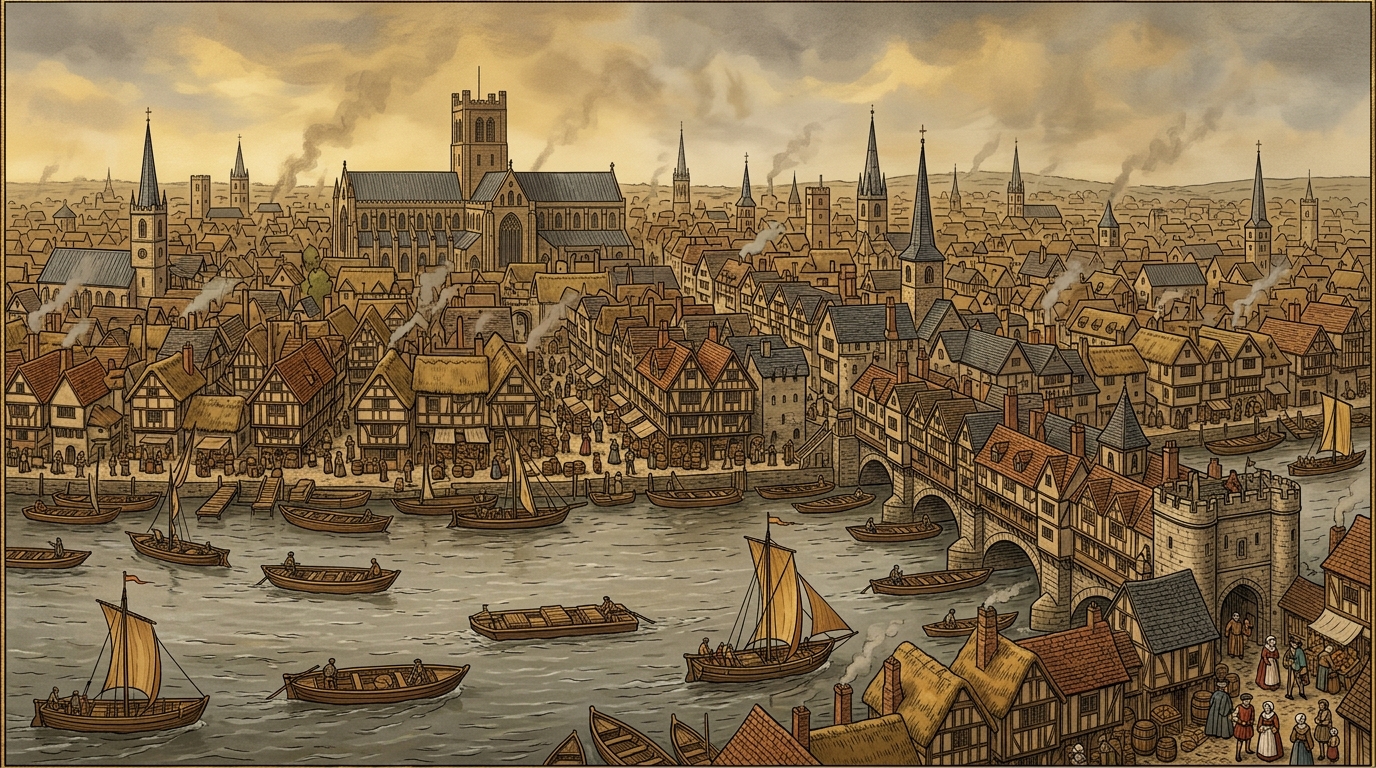
Tudor London’s Population Explosion: How a City of 50,000 Became a Metropolis of 200,000
Imagine walking through the streets of London in 1500. The city is bustling, certainly, but it remains a manageable medieval town of roughly 50,000 souls, its boundaries still largely defined by ancient Roman walls, its rhythms governed by church bells and market days. Now fast-forward a mere century. By 1600, that same city has swelled to nearly 200,000 inhabitants, making Tudor London one of the fastest-growing urban centres in all of Europe. The streets that were once navigable are now choked with people, waste, and noise. The consequences, for public health, for politics, for everyday life, were nothing short of extraordinary.
This remarkable transformation is one of the most fascinating and underexplored stories of the Tudor period. Most people know Henry VIII for his wives, or Elizabeth I for defeating the Spanish Armada, but far fewer appreciate how the sheer physical growth of London shaped the entire Tudor century. As a historical fiction author who has spent years immersed in the primary sources and scholarship of this era, I find this demographic explosion endlessly compelling precisely because it affected everyone, from the monarch in her palace to the pauper sleeping beneath London Bridge.
In this post, we will explore who was flooding into Tudor London and why, what conditions they encountered when they arrived, how the city struggled (and often failed) to cope, and why this story still resonates with powerful relevance today. Whether you are a student of history, a lover of historical fiction, or simply someone who has ever wondered what life in Tudor England was really like, the story of London’s population explosion is essential reading.
Historical Background: A City Bursting at Its Seams
To understand Tudor London’s growth, we must first appreciate what kind of city it was at the century’s opening. In 1500, London was England’s undisputed commercial and political capital, home to the royal court, the principal law courts, and the great trading guilds. Yet by the standards of continental Europe, it was a middling city. Paris and Naples both dwarfed it. The city’s physical fabric, as documented in John Schofield’s authoritative Medieval London Houses (1994), consisted largely of timber-framed structures crowded along narrow lanes, with the River Thames serving as both the city’s highway and, rather less pleasantly, its primary sewer.
The causes of the population surge were multiple and interconnected. The dissolution of the monasteries under Henry VIII between 1536 and 1541 displaced thousands of people who had depended on religious institutions for employment, charity, and housing. Many drifted towards London seeking opportunity. Simultaneously, agricultural changes in the countryside, particularly the enclosure of common land for sheep farming, pushed rural labourers off the land and into urban migration. London, with its markets, its river trade, and its court, was the natural destination for the ambitious and the desperate alike.
Immigration from abroad also played a significant role. Protestant refugees fleeing persecution in the Low Countries and France, known as the Strangers, settled in significant numbers in parishes such as Aldgate and Southwark. These communities brought skilled trades, particularly in cloth weaving and printing, that enriched the city’s economy even as they strained its housing stock. Roger Finlay’s meticulous demographic study, Population and Metropolis: The Demography of London 1580-1650 (1981), remains the foundational scholarly text for understanding these patterns, drawing on parish registers to reconstruct birth, death, and migration rates with remarkable precision.
By the reign of Elizabeth I, the pressure on the city had become impossible to ignore. The queen herself issued a series of proclamations attempting to restrict new building within three miles of the city gates, recognising that uncontrolled growth threatened both public order and public health. These proclamations were largely ignored. Landlords subdivided existing properties with ruthless ingenuity, cramming multiple families into spaces designed for one. Suburban areas beyond the walls, in Southwark to the south and Shoreditch to the north, expanded with dizzying speed, largely beyond the jurisdiction of the City of London’s aldermen.
Significance and Impact: The Human Cost of Urban Growth
The consequences of this population explosion were felt most acutely in the realm of public health. Tudor London had no modern sewerage system, no clean piped water, and no understanding of germ theory. Waste, both human and animal, accumulated in streets and waterways. The Thames, from which many Londoners drew their drinking water, received effluent from tanneries, slaughterhouses, and privies in almost equal measure. Under these conditions, epidemic disease was not a distant threat but a recurring fact of life.
Plague struck the city with devastating regularity throughout the Tudor period. The outbreaks of 1563, 1593, and 1603 each killed tens of thousands of Londoners, yet the city’s population continued to grow because the rate of in-migration consistently outpaced mortality. As Finlay’s research demonstrates, Tudor London was in many respects a demographic sink: it consumed migrants faster than it could replace them through natural increase, yet it grew regardless, sustained by the endless flow of people from the countryside and from abroad.
The social consequences were equally profound. Overcrowding bred poverty, and poverty bred crime. The Elizabethan authorities became increasingly anxious about the growing numbers of what they called the masterless men, vagrants and unemployed labourers who drifted through the city’s expanding margins. The Poor Laws of 1598 and 1601 were in large part a legislative response to urban overcrowding, an attempt to create a systematic framework for poor relief at a time when traditional parish-based charity was simply overwhelmed by the scale of need.
For those with wealth and ambition, however, Tudor London’s growth created extraordinary opportunity. The building trades boomed. New industries, from printing to glass-making, found eager markets. The theatre, perhaps the most celebrated cultural achievement of the Elizabethan age, was itself a product of urbanisation: Shakespeare’s Globe could not have existed without the dense, literate, commercially minded population that Tudor London’s growth had created. In this sense, the same overcrowding that spread plague and poverty also gave birth to some of the greatest artistic achievements in the English language.
Connections and Context: London’s Growth Within the Wider Tudor World
It is impossible to understand Tudor London’s population explosion in isolation. The city’s growth was intimately connected to England’s expanding role in international trade. The establishment of companies such as the Muscovy Company in 1555 and the Levant Company in 1581 brought new wealth into London’s merchant class, funding the grand townhouses and civic buildings that were reshaping the city’s skyline even as its back-streets grew ever more squalid.
The religious upheavals of the Tudor period also shaped the city’s demography in ways that are easy to overlook. The break with Rome under Henry VIII, the brief Catholic restoration under Mary I, and the Elizabethan Settlement all produced waves of refugees, exiles, and returning migrants whose movements contributed to London’s fluctuating population. The Stranger communities of Elizabethan London were not merely economic migrants; they were often survivors of religious violence in continental Europe, bringing with them skills, capital, and cultural traditions that permanently enriched English urban life.
It is worth noting, too, that London’s extraordinary growth was not replicated uniformly across England. Cities such as Bristol, Norwich, and York grew in this period, but none came close to matching London’s pace. By 1600, London contained perhaps ten per cent of England’s entire population, a degree of urban primacy remarkable by any historical standard and one that would shape English culture, politics, and economics for centuries to come.
Modern Relevance and Fascinating Details
The story of Tudor London’s population explosion carries striking resonances for our own age of rapid urbanisation. Cities across the developing world today face challenges, of housing, sanitation, disease control, and social cohesion, that would have been entirely familiar to an Elizabethan alderman, even if the scale is vastly greater. Historians and urban planners alike have found in Tudor London a remarkably well-documented case study of what happens when urban growth outpaces the institutions and infrastructure designed to manage it.
Did you know? The Elizabethan authorities were so alarmed by London’s growth that William Cecil, Lord Burghley, Elizabeth’s chief minister, personally drafted memoranda warning of the social dangers of overcrowding. He feared, presciently, that a city too large to be governed effectively would become a breeding ground for sedition and disorder. His concerns would prove justified during the food riots and social unrest of the 1590s, a decade of harvest failures and economic hardship that hit London’s swollen population with particular severity.
For those who encounter Tudor London through historical fiction, the city’s population explosion provides an endlessly rich backdrop. As an author, I find that this demographic reality explains so much about the texture of Tudor life: why the streets smelled as they did, why disease moved so quickly through communities, why the poor and the wealthy lived in such uncomfortable proximity, and why the theatre, that most democratic of art forms, found such a ready audience in the crowded parishes of Elizabethan London. The best historical fiction set in this period, from Hilary Mantel’s Wolf Hall trilogy to C. J. Sansom’s Shardlake series, succeeds precisely because it grounds its characters in this vivid, chaotic, teeming urban reality.
Conclusion: A Century of Transformation
Tudor London’s growth from a city of 50,000 to a metropolis of nearly 200,000 in the space of a single century represents one of the most dramatic urban transformations in English history. Driven by rural displacement, religious upheaval, international migration, and commercial expansion, it reshaped not just the city’s physical fabric but its social structure, its cultural life, and its political institutions. The scholarship of Roger Finlay and John Schofield has given us the tools to understand this transformation in demographic and architectural detail, but the human reality behind the statistics remains endlessly compelling.
If you would like to explore this subject further, I would encourage you to seek out Finlay’s Population and Metropolis for its rigorous demographic analysis, and Schofield’s Medieval London Houses for an intimate understanding of the physical spaces in which Tudor Londoners lived and worked. And if you want to experience Tudor London’s crowded, vibrant, dangerous streets through the eyes of those who inhabited them, the world of Tudor historical fiction offers a wonderful gateway into this extraordinary century of change.