
Henry VIII’s Palaces of Power: How Tudor Royalty Reshaped London’s Landscape
Imagine walking through a palace so vast, so glittering with gold leaf and imported Flemish tapestries, that foreign ambassadors returned home to their own monarchs lost for words. This was the deliberate intention of Henry VIII, a king who understood, with extraordinary political sophistication, that architecture was not merely shelter but propaganda in stone and timber. The Tudor royal palaces of London were not simply places to sleep and govern; they were carefully constructed arguments for why the Tudors deserved to rule England.
When we think of Tudor history today, we often focus on the drama of wives, executions, and religious upheaval. Yet as Simon Thurley argues in his essential study The Royal Palaces of Tudor England (Yale University Press, 1999), the physical spaces in which this drama unfolded tell their own compelling story. Hampton Court, Whitehall Palace, and Greenwich Palace formed a triumvirate of royal magnificence that fundamentally altered how monarchy presented itself to the world.
In this post, we will explore the history, significance, and enduring fascination of these extraordinary buildings, examining why Henry VIII spent what would today amount to billions of pounds on their construction, and what this tells us about the nature of Tudor power.
Historical Background: Building a Dynasty in Brick and Gold
The story of Tudor palace-building begins, as so much Tudor history does, with insecurity. Henry VII, founder of the dynasty, had won his throne on a battlefield in 1485 and spent his reign acutely conscious that his hold on power was not ancient or unquestioned. His son Henry VIII inherited this anxiety but responded to it in a characteristically different manner, choosing spectacle and overwhelming magnificence rather than careful financial husbandry.
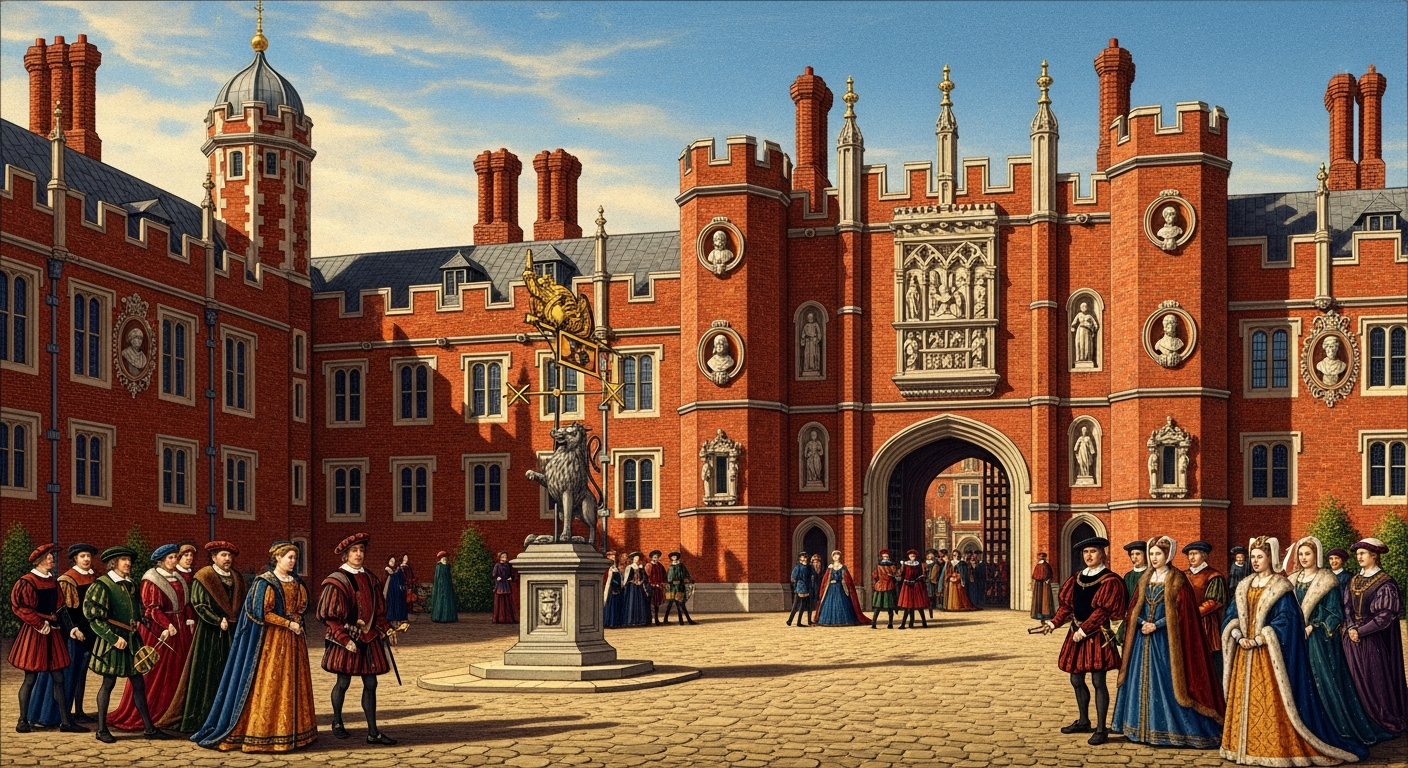
Hampton Court Palace offers the most dramatic example of Tudor royal ambition made physical. Originally built by Cardinal Thomas Wolsey from around 1515 onwards, it was, at the time of its construction, arguably the finest private residence in England. Wolsey understood that to serve a king who craved magnificence, one had to demonstrate magnificence oneself. However, when Wolsey fell from favour in 1529, Henry seized Hampton Court and immediately set about expanding it on a breathtaking scale. Between 1529 and the 1540s, Henry spent over sixty-two thousand pounds on Hampton Court alone, a sum that represented a significant portion of the entire royal revenue.
Whitehall Palace, situated along the Thames in central London, became the principal royal residence after Henry acquired it from Wolsey alongside Hampton Court. Built on the site of the former York Place, Whitehall eventually grew to cover approximately twenty-three acres, making it one of the largest palaces in Europe. Thurley’s research reveals that Whitehall was less a single coherent building than a sprawling complex of interconnected structures, galleries, tennis courts, cockpits, and tiltyard, all linked by covered walkways and designed to keep the entire court entertained and under the king’s watchful eye.
Greenwich Palace, situated downstream on the south bank of the Thames, held particular sentimental significance for the Tudors. Henry VIII had been born there in 1491, as had his daughters Mary and Elizabeth. Greenwich was the palace most closely associated with Tudor dynastic identity, and Henry invested heavily in its renovation and expansion, creating a riverside facade of considerable grandeur that announced royal power to every vessel approaching London from the sea.
Significance and Impact: Architecture as Political Theatre
Why does palace-building matter to our understanding of Tudor history? The answer lies in what Arthur MacGregor’s scholarly work The Late King’s Goods (Oxford University Press, 1989) reveals about the extraordinary concentration of wealth and art within these spaces. When the contents of Henry VIII’s palaces were inventoried after his death in 1547, the lists ran to thousands of items, including over two thousand tapestries, hundreds of paintings, and vast quantities of plate, armour, and jewellery. These objects were not merely decorative; they were political instruments.
Foreign ambassadors visiting Henry’s palaces were being shown, quite deliberately, that England under Tudor rule was a wealthy, sophisticated, and powerful nation. When the French ambassador visited Hampton Court in the 1540s and reported back to Francis I on the scale of Henry’s building works, he was fulfilling exactly the function Henry intended. The palaces were, in a very real sense, the most important pieces of diplomatic correspondence Henry ever composed.
Did you know? Henry VIII employed Italian craftsmen and artists to work on his palaces, bringing Renaissance aesthetic sensibilities to England at a time when the new learning was transforming European culture. The terracotta roundels of Roman emperors that still survive at Hampton Court are examples of this deliberate cultural importation, Henry associating himself visually with the grandeur of antiquity.
The impact on Tudor society extended beyond mere diplomacy. The court that surrounded a Renaissance monarch was not simply an administrative body but a social institution that shaped the behaviour, culture, and ambitions of the entire English nobility. By creating palaces of extraordinary scale and elaboration, Henry ensured that attendance at court was an experience of overwhelming sensory impact, one that reminded every nobleman of the vast gulf between royal and merely aristocratic wealth.
Connections and Context: The Wider Tudor World
Palace-building did not occur in isolation from the other great upheavals of Henry’s reign. The dissolution of the monasteries between 1536 and 1541 was not only a religious and political revolution but also a financial one, and much of the stone, lead, and material wealth stripped from England’s religious houses found its way into royal building projects. There is a direct and somewhat uncomfortable connection between the destruction of medieval religious culture and the construction of Tudor royal magnificence.
It is also worth placing Henry’s building ambitions in their European context. His great rival Francis I of France was simultaneously constructing Fontainebleau and Chambord, palaces of extraordinary Renaissance grandeur. The competition between these two monarchs was expressed not only on the battlefield and in diplomatic negotiations but also in the realm of architecture and artistic patronage. The Field of the Cloth of Gold in 1520, that extraordinary temporary palace of canvas and gold erected for a Franco-English summit, was perhaps the most extravagant single expression of this competitive magnificence.
Readers interested in exploring this theme further might wish to investigate the relationship between Henry’s palace-building and his break with Rome. The Royal Supremacy of 1534, which made Henry the Supreme Head of the Church of England, created a new theological justification for royal magnificence. A king who was also head of the church required palaces that expressed a quasi-divine authority, and Henry’s building projects after 1534 reflect this heightened sense of royal sacredness.
Modern Relevance and Fascinating Details: Why These Palaces Still Captivate Us
Hampton Court Palace remains one of England’s most visited historic sites, attracting hundreds of thousands of visitors each year who come to walk the same corridors that Henry VIII once dominated. As a historical fiction author, I find these spaces endlessly fertile ground for the imagination. The Great Hall at Hampton Court, completed in 1536, the same year Anne Boleyn was executed, carries that weight of history in its very timbers. One can stand beneath the magnificent hammerbeam roof and feel the presence of a world simultaneously glittering and brutal.
Did you know? Whitehall Palace, once the largest palace in Europe, was almost entirely destroyed by a catastrophic fire in 1698, leaving only the Banqueting House, designed by Inigo Jones in 1622, as a surviving remnant. The loss is incalculable from both historical and architectural perspectives. What survives of the Tudor Whitehall exists almost entirely in documents, drawings, and the archaeological investigations that Thurley’s team conducted beneath modern government buildings.
Greenwich Palace fared little better, being demolished in the 1660s and replaced by the Royal Naval Hospital, the magnificent baroque complex now known as the Old Royal Naval College. Yet the Tudor palace’s outline and orientation influenced the placement of its successor, and archaeologists have periodically uncovered traces of Henry’s Greenwich beneath the later construction. Popular culture continues to engage with these spaces: Hampton Court in particular has featured in numerous television dramas, films, and novels, most recently serving as a principal location in various streaming productions exploring Tudor history.
Conclusion: Palaces as Mirrors of Power
The Tudor royal palaces of London represent far more than architectural achievement, extraordinary as that achievement was. They are evidence of a monarchy actively engaged in constructing its own mythology, using space, light, gold, and the accumulated treasures of an age to argue, persuasively and continuously, for the legitimacy and magnificence of Tudor rule. Henry VIII understood instinctively what modern political strategists understand consciously: that environment shapes perception, and that those who control the most impressive spaces control, to a significant degree, the imaginations of those who inhabit them.
Whether you are approaching Tudor history as a student, a general reader, or a fellow enthusiast of historical fiction, I would encourage you to engage directly with Simon Thurley’s scholarship and with the physical remains of these remarkable buildings. Hampton Court awaits, its red brick warming in the English sun, its corridors still whispering of a world where magnificence was not vanity but strategy, and where a king built his power in stone as surely as he built it in statute and sword.