
The Virgin Queen: How Elizabeth I Used Marriage as the Ultimate Political Weapon
Imagine holding the most powerful card in the deck and choosing never to play it. That was precisely the strategy employed by Elizabeth I of England, one of history’s most brilliant political minds, who transformed her unmarried status from a perceived weakness into an extraordinary source of power. In an era when women were expected to seek the protection and authority of a husband, Elizabeth turned convention entirely on its head, declaring herself wed not to any mortal man but to the kingdom of England itself. It is a story of calculated genius, personal sacrifice, and political theatre that continues to fascinate historians and readers alike.
As a historical fiction author deeply immersed in the Tudor period, I find Elizabeth's marriage strategy to be one of the most compelling narratives of the sixteenth century. It was not simply a matter of romantic preference or personal quirk. Every refusal, every prolonged negotiation, every coy hint at possible matrimony was a carefully orchestrated move in a high-stakes game of European diplomacy. Christopher Hibbert, in his authoritative study The Virgin Queen: Elizabeth I, Genius of the Golden Age (Addison-Wesley, 1991), describes Elizabeth as possessing a genius for using ambiguity as a weapon, keeping foreign powers and domestic factions perpetually off balance.
In this post, we will explore who proposed to Elizabeth and why she refused, how her unmarried status shaped Tudor politics, and why this remarkable story still resonates so powerfully today. Whether you are a Tudor history enthusiast, a student, or simply curious about one of history's most fascinating women, you will find that the question of whom Elizabeth I should marry was, for forty-five years, at the very heart of English political life.
Historical Background: The Suitors and the Queen Who Refused Them All
Elizabeth Tudor was born on 7th September 1533 at Greenwich Palace, the daughter of Henry VIII and his second wife, Anne Boleyn. Her path to the throne was turbulent and treacherous, passing through the reigns of her half-brother Edward VI and her half-sister Mary I before she finally acceded on 17th November 1558. She was twenty-five years old, highly educated, politically astute, and already deeply aware of the dangers that marriage had posed to the women around her. Her own mother had been executed. Her stepmother Catherine Howard had suffered the same fate. Marriage, in the Tudor court, could be a death sentence.
Almost immediately upon her accession, Parliament and her Privy Council began pressing Elizabeth to marry and produce an heir, anxious to secure the Protestant succession. The list of suitors who sought her hand reads like a register of European royalty and English nobility. Philip II of Spain, the widower of her half-sister Mary, was among the first to propose, motivated by the desire to maintain Spanish influence over England. Elizabeth managed his proposal with characteristic deftness, neither accepting nor outright refusing in a manner that might make an enemy of the most powerful monarch in Europe.
Closer to home, the man who captured Elizabeth's deepest personal affections was Robert Dudley, Earl of Leicester, her childhood friend and Master of the Horse. Their relationship was the subject of intense speculation and considerable scandal, particularly after the mysterious death of Dudley's wife, Amy Robsart, in 1560. Elizabeth Jenkins, in her landmark biography Elizabeth the Great (Coward-McCann, 1958), argues that Elizabeth genuinely loved Dudley but understood with clear-eyed pragmatism that marrying him would fatally undermine her authority. He was an English subject, and wedding him would elevate one noble faction above all others, destabilising the careful balance of power she worked so hard to maintain.
Other significant suitors included Archduke Charles of Austria, whose candidacy occupied negotiations for nearly a decade, Henri, Duke of Anjou (later Henry III of France), and most seriously in her later years, Francis, Duke of Anjou, with whom Elizabeth conducted a surprisingly warm courtship during the late 1570s and early 1580s. She reportedly called Francis her 'frog' as a term of endearment. Yet even this relationship, which came closest to producing a marriage, ultimately dissolved. By the time Francis died in 1584, Elizabeth was fifty years old and the question of the succession had become, to all practical purposes, moot.
Significance and Impact: A Kingdom as a Consort
Why does Elizabeth's refusal to marry matter so profoundly? The answer lies in the nature of sixteenth-century queenship. Under English law and contemporary social doctrine, a wife was legally subordinate to her husband. Had Elizabeth married a foreign prince, England might effectively have become an adjunct to another European power, as had happened during the reign of her sister Mary, whose marriage to Philip II had drawn England into an unpopular war with France and the humiliating loss of Calais in 1558. Hibbert emphasises that Elizabeth was acutely conscious of this precedent and determined never to repeat it.
By remaining single, Elizabeth retained sole sovereign authority. She answered to no husband, ceded power to no foreign dynasty, and kept the competing factions of her court perpetually competing for her favour rather than aligning with a consort's household. This was governance through deliberate ambiguity, and it was extraordinarily effective. Foreign powers dared not attack England too aggressively while there remained the possibility that Elizabeth might yet marry one of their princes. The promise of her hand was, in diplomatic terms, worth more undelivered than it ever could have been fulfilled.
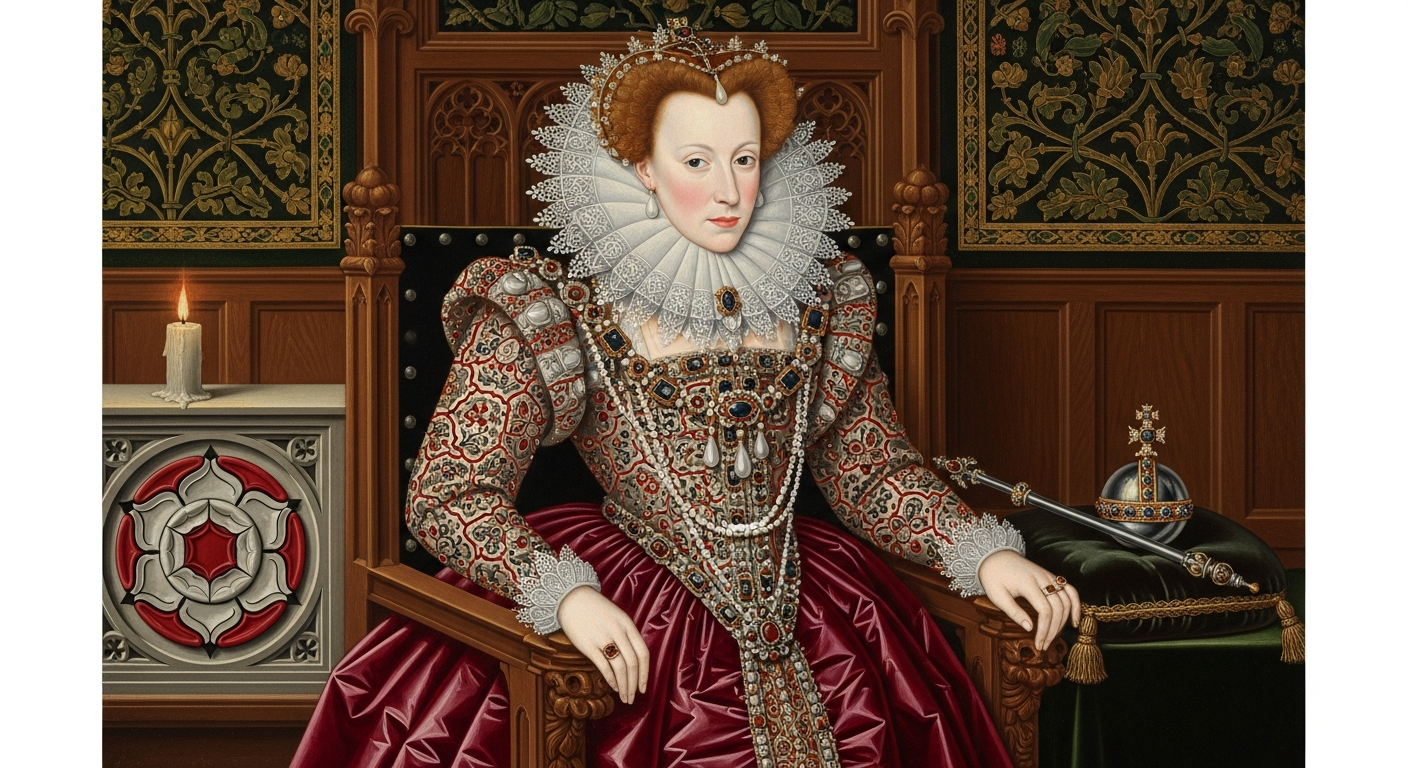
The impact on Tudor society and culture was equally profound. Elizabeth cultivated an elaborate iconography of virginity, presenting herself as a sacred, almost mystical figure. The cult of the Virgin Queen drew consciously on both classical imagery of Diana, the huntress goddess, and residual Catholic veneration of the Virgin Mary. Portraits, pageants, poems, and court entertainments all reinforced the idea that Elizabeth's unmarried state was not a failure or a lack but a noble, chosen condition. Poets and courtiers competed to celebrate her in verse, giving rise to a rich literary culture of courtly flattery that produced some of the most beautiful writing of the English Renaissance.
The consequences for the succession were, however, genuinely dangerous. Elizabeth's refusal to name an heir or marry left the kingdom perpetually anxious about what would follow her death. This anxiety fuelled conspiracies, most notably those surrounding Mary, Queen of Scots, Elizabeth's Catholic cousin and the focus of repeated plots to place her on the English throne. The tension between Elizabeth's political mastery in life and the instability her childlessness created was the central paradox of her reign.
Connections and Context: The Wider Tudor World
Elizabeth's marriage question cannot be understood in isolation from the broader religious and political upheavals of her age. The Protestant Reformation had shattered the unity of European Christendom, and England's position as a Protestant kingdom made it a target for Catholic powers. A Spanish or Austrian marriage might have offered security but at the price of religious compromise. A French marriage brought the spectre of Guise Catholic influence. Every potential alliance carried with it the seeds of domestic religious conflict.
It is also worth noting that Elizabeth's situation was shaped by the reigns that preceded hers. Her father Henry VIII had famously married six times in pursuit of a male heir, tearing the country away from Rome in the process. Her brother Edward VI had died young without issue. Her sister Mary's Spanish marriage had been deeply unpopular. Elizabeth had grown up watching marriage destroy lives and destabilise kingdoms. Jenkins suggests that her wariness of matrimony was not merely political calculation but something rooted in genuine psychological awareness of what marriage had cost the women of her family.
Did you know? When Elizabeth addressed her troops at Tilbury in 1588, on the eve of the expected Spanish Armada invasion, she famously declared that she had the heart and stomach of a king. This speech, one of the most celebrated in English history, drew directly on the identity she had constructed as a sovereign who needed no male partner to rule effectively.
Modern Relevance and Fascinating Details
Five centuries after her death in 1603, Elizabeth I remains one of the most written-about monarchs in history, and her marriage strategy is a subject that continues to generate scholarly debate. Modern historians have increasingly examined the personal cost of Elizabeth's chosen path. Did she genuinely wish to remain unmarried, or was she constrained by circumstances she presented as choice? Hibbert suggests the answer is genuinely complex, that Elizabeth may have wanted both the freedom her single state provided and the companionship and family life she never permitted herself to have.
In popular culture, Elizabeth's romantic life has been dramatised countless times, from Glenda Jackson's iconic television portrayal in the 1970s to Cate Blanchett's luminous performance in the 1998 film Elizabeth and its 2007 sequel. Historical fiction authors, myself included, find her endlessly compelling precisely because the inner life behind that magnificent public performance remains tantalizingly unknowable. What did Elizabeth truly feel for Robert Dudley? Did she weep privately for the children she never had? The gaps in the historical record are the spaces where imagination takes root.
One particularly fascinating lesser-known detail is that Elizabeth kept a portrait of Robert Dudley in a small cabinet beside her bed until her death. When her ladies opened it after she died, they found the miniature with the words his last letter written in her own hand. For all the political calculation, it seems clear that real human feeling lay beneath the carefully constructed image of the Virgin Queen.
Conclusion: The Enduring Legacy of the Virgin Queen
Elizabeth I's decision to remain unmarried was one of the most consequential political choices of the Tudor age. It preserved England's independence, maintained the balance of domestic power, and created the extraordinary cultural phenomenon of the Virgin Queen cult that shaped English art, literature, and national identity for generations. As Jenkins and Hibbert both demonstrate, it was a strategy born from intelligence, personal history, and a clear-eyed understanding of the world she inhabited.
Whether you approach her story as a historian, a student, or a lover of historical fiction, Elizabeth I rewards deeper exploration at every turn. Her life raises questions that feel remarkably contemporary: about the price women pay for power, about the relationship between public persona and private self, and about whether a kingdom can ever truly substitute for human connection. If you would like to explore further, both Jenkins' Elizabeth the Great and Hibbert's The Virgin Queen remain essential and highly readable starting points for anyone captivated by this most extraordinary of queens.