
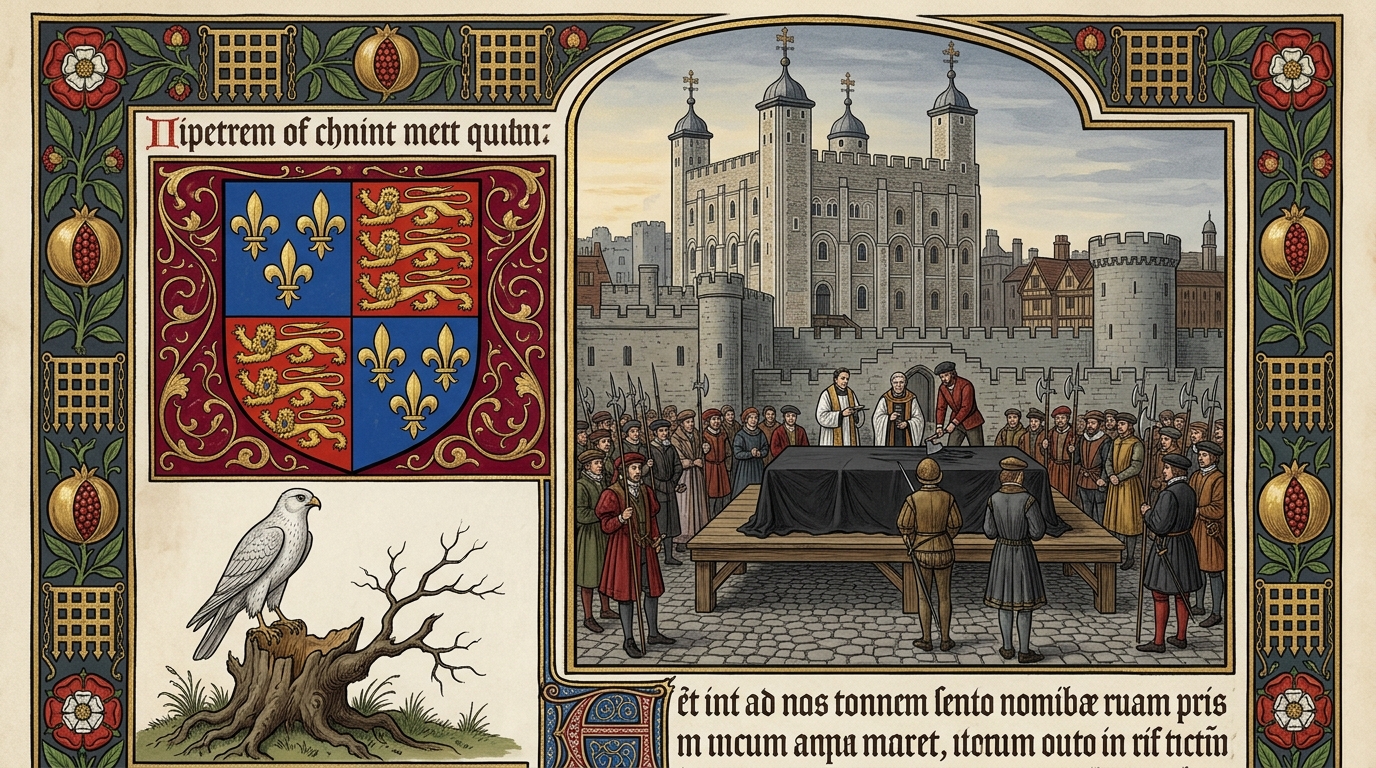
The Fall of Anne Boleyn: Betrayal, Politics, and the Price of Power in Tudor England
Few moments in English history carry the weight of 19th May 1536, the day Anne Boleyn, Queen of England, walked to the scaffold on Tower Green and lost her head. Her execution remains one of the most debated and emotionally charged events of the Tudor period, raising questions that historians and readers alike continue to wrestle with nearly five centuries later. Was she truly guilty of the monstrous crimes laid at her feet? Or was she the victim of a king who had grown tired of her and a court that had turned against her? The answers, as scholar Eric Ives argues so compellingly in The Life and Death of Anne Boleyn, point strongly towards the latter.
Anne Boleyn's story is not simply a tale of romantic intrigue or royal caprice. It is a story about power, survival, and the terrifying fragility of a woman's position in sixteenth-century England, no matter how high she had climbed. Understanding her fall requires understanding the world she inhabited, a world where a king's favour could elevate a woman to the throne and his displeasure could send her to the block with equal swiftness.
In this post, we will explore the circumstances surrounding Anne's arrest and execution, examine why historians believe the charges against her were fabricated, consider the political consequences of her death, and reflect on why her story continues to captivate audiences across the world today. Whether you have encountered her through academic history or through works of historical fiction such as Nora Roberts's Anne Boleyn: A King's Obsession, there is always more to discover about this remarkable and tragic woman.
Historical Background: The Rise and Fall of a Queen
Anne Boleyn was the daughter of Sir Thomas Boleyn and Lady Elizabeth Howard, born around 1501 or 1507 (historians debate the precise year). She was educated at the French court and returned to England as a sophisticated, intellectually formidable young woman. By the mid-1520s, King Henry VIII had become utterly captivated by her, setting in motion one of the most consequential obsessions in English history. His determination to marry Anne drove him to break with the Roman Catholic Church, dissolve his marriage to Katherine of Aragon, and reshape the religious and political landscape of an entire nation. They married in secret in late 1532 or early 1533, and Anne was crowned Queen of England in June 1533.
Yet the very qualities that had attracted Henry, her sharp wit, her refusal to be simply a mistress, her forceful opinions, eventually contributed to the atmosphere in which her enemies could move against her. She failed to produce a male heir, suffering a miscarriage in January 1536 of what may have been a son. Henry, meanwhile, had become increasingly interested in one of Anne's own ladies-in-waiting, Jane Seymour. The timing is crucial: within months of Anne's final miscarriage, the machinery of her destruction was set in motion.
In April and May of 1536, Anne was accused of adultery with five men: Henry Norris, Francis Weston, William Brereton, Mark Smeaton (a court musician), and most shockingly, her own brother George Boleyn, Lord Rochford. The charge of incest with George was among the most devastating accusations ever levelled at an English queen. Anne was arrested on 2nd May 1536 and conveyed to the Tower of London, the same fortress where she had stayed in royal splendour before her coronation just three years earlier. She was tried on 15th May 1536, found guilty, and beheaded four days later.
As Eric Ives meticulously documents in his definitive biography, the evidence against Anne was extraordinarily thin. Mark Smeaton, the only man to confess, almost certainly did so under torture or the threat of it. The dates and circumstances cited in the indictments were riddled with inconsistencies, and several of the alleged encounters were later shown to be impossible given the documented movements of those involved. Ives argues persuasively that the charges were orchestrated primarily by Thomas Cromwell, Henry's chief minister, who had his own political reasons for wanting Anne removed and who understood precisely what the king wished to hear.
Significance and Impact: A Kingdom Reshaped by One Woman's Death
The execution of Anne Boleyn sent shockwaves through Tudor England and across Europe. It demonstrated, with brutal clarity, that no one, not even a crowned queen, was safe from the king's wrath once his favour had been withdrawn. For the women of the Tudor court, it was a lesson that would never be forgotten. Henry married Jane Seymour just eleven days after Anne's execution, on 30th May 1536, a timeline that speaks volumes about the nature of Anne's fall.
Politically, the execution consolidated Cromwell's power and removed a queen who had been closely associated with a particular reformist faction at court. Anne had been a genuine supporter of evangelical religion and had patronised reformist scholars and preachers. Her death did not reverse the English Reformation, which had already gone too far to be undone, but it did alter its character and slow some of its more radical impulses for a time. Those who had allied themselves with Anne found themselves suddenly vulnerable, while the conservative faction around the Seymours gained influence.
Perhaps the most enduring consequence of Anne's execution was its effect on her daughter, the future Queen Elizabeth I. Anne was barely two years old when her mother was beheaded. Elizabeth grew up under the shadow of her mother's attainder, officially declared illegitimate after Anne's conviction. Yet she would go on to become arguably the greatest monarch in English history, a woman who, consciously or not, carried the legacy of her mother's intelligence, determination, and refusal to be underestimated.
Did you know? Anne's alleged lovers, including her brother George, were executed on 17th May 1536, two days before Anne herself. George's wife, Jane Parker, Lady Rochford, was widely believed to have provided testimony against him, though historians continue to debate the extent of her culpability.
Connections and Context: A Tudor World in Turmoil
Anne's execution did not occur in isolation. The year 1536 was one of the most turbulent in Henry VIII's reign. Just months earlier, in January, Katherine of Aragon had died at Kimbolton Castle, finally releasing Henry from one complicated dynastic situation. The Dissolution of the Monasteries was already underway, with Cromwell systematically dismantling the monastic houses of England and funnelling their wealth into the royal coffers. Later that same year, the Pilgrimage of Grace, a massive popular uprising in the north of England against the Reformation, would shake the Tudor state to its foundations.
Anne's fall is also deeply connected to the broader pattern of Henry's marriages. She was the second of his six wives, and her fate foreshadowed that of his fifth wife, Catherine Howard, who was also executed on charges of adultery in 1542. Together, their stories illustrate the extraordinary danger faced by women who married Henry VIII, particularly those who failed to produce a male heir or who attracted the hostility of powerful factions at court.
Those wishing to explore further might consider examining the role of Thomas Cromwell more closely: the man who engineered Anne's downfall would himself be executed just four years later, in 1540, after engineering the disastrous marriage between Henry and Anne of Cleves. Tudor politics had a way of consuming even its most adept practitioners.
Modern Relevance and Fascinating Details: Why Anne Boleyn Still Captivates Us
Anne Boleyn has never really left the public imagination, and it is not difficult to understand why. Her story touches on themes that remain urgently relevant: the vulnerability of women in systems designed by and for men, the use of judicial processes to serve political ends, the intersection of personal desire and public consequence. In an era when questions of justice, power, and gender remain hotly contested, Anne's story feels anything but distant.
In historical fiction, Anne has been portrayed across an extraordinary range of interpretations. Nora Roberts's Anne Boleyn: A King's Obsession approaches her story with both emotional immediacy and careful historical grounding, bringing readers into the inner life of a woman navigating impossible circumstances. As a historical fiction author myself, I find Anne endlessly compelling precisely because the historical record leaves so much room for imaginative engagement, the private conversations, the moments of fear and defiance that no chronicle preserved, are where fiction earns its place alongside scholarship.
Did you know? Anne Boleyn is often depicted with six fingers on one hand, a detail that originates with the Catholic polemicist Nicholas Sander, writing decades after her death. Eric Ives and other serious historians consider this almost certainly a fabrication designed to suggest she was marked by the devil. Contemporary portraits show no such abnormality.
Anne's influence on popular culture has been immense. She has been portrayed on screen by luminaries including Natalie Portman in The Other Boleyn Girl (2008) and Natalie Dormer in the television series The Tudors. Each portrayal reflects the anxieties and preoccupations of its own era as much as it illuminates the sixteenth century, which is itself a testament to the enduring power of her story.
Conclusion: The Legacy of a Queen Who Changed England
Anne Boleyn was executed on 19th May 1536, convicted on charges that most serious historians now believe were fabricated to serve the political and personal desires of a king who wished to move on. Her fall was swift, her trial a travesty, and her death a stark illustration of the limits of female power in Tudor England. Yet she had already changed her world irrevocably. She had pushed England towards the Reformation, challenged the authority of Rome, and produced a daughter who would one day rule as Elizabeth I. Anne lost her head, but her influence proved impossible to sever.
If her story compels you as it compels so many of us, I would encourage you to begin with Eric Ives's The Life and Death of Anne Boleyn, the most thorough and authoritative account available, before exploring the rich tradition of historical fiction that has sought to give voice to the woman behind the legend. History and imagination together offer the fullest picture of a queen who deserved far better than the fate she received.