
The Day Coventry’s Heart Went Silent: The End of the Mystery Plays in 1579
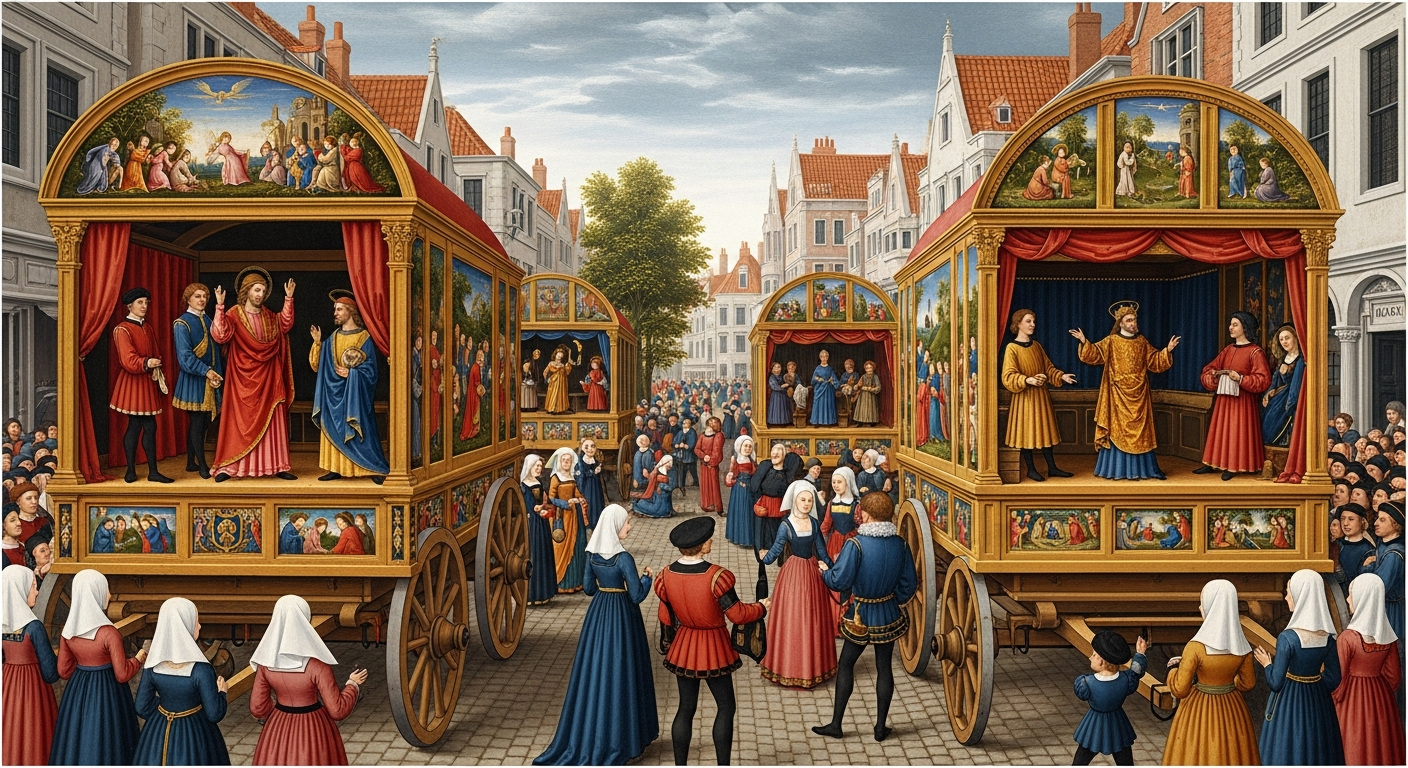
Imagine a city that had, for generations, been the beating cultural heart of the English Midlands. A place where thousands of pilgrims and travellers gathered each summer to witness spectacular theatrical performances that rolled through the streets on great pageant wagons, filling the air with music, colour, and the stories of scripture. Now imagine that tradition vanishing almost overnight, leaving behind a silence that no civic proclamation could quite fill. This is the story of Coventry in 1579, and it is one of the most poignant chapters in all of Tudor England’s cultural history.
The suppression of the Coventry mystery plays was not a single dramatic act of censorship but rather the culmination of decades of religious upheaval, economic strain, and shifting political winds. What had once drawn visitors from across England and beyond was gone, and with it went a vital thread of civic identity that Coventry would struggle to replace. Understanding why this happened, and what it meant for the city, offers a remarkable window into the turbulent world of Elizabethan England.
In this post, we will explore the proud medieval tradition of the Coventry mystery plays, examine the circumstances that led to their end in 1579, consider the wider consequences for the city and its people, and reflect on why this moment still resonates for historians, theatre lovers, and anyone fascinated by the cultural upheavals of the Tudor age.
Historical Background: A City Built on Pageantry
To understand the loss of the mystery plays, one must first appreciate what they represented. The Coventry mystery plays, sometimes called the Coventry Corpus Christi plays, were among the most celebrated dramatic cycles in medieval England. Performed on the feast of Corpus Christi, they depicted episodes from Christian scripture, from the Creation and the Fall through to the Last Judgement. The performances were organised by the city’s trade guilds, each of which sponsored and performed a particular pageant. The Shearmen and Taylors performed the Nativity, for instance, while the Weavers presented the Purification of the Virgin. These were not amateur theatricals in any dismissive sense; they were elaborate, expensive, and deeply serious expressions of civic and religious life.
Coventry was, by the late medieval period, one of the most prosperous cities in England, ranking alongside Bristol and Norwich in terms of wealth and population. The mystery plays were both a reflection of this prosperity and a contributor to it. According to Charles Phythian-Adams in his landmark study Desolation of a City: Coventry and the Urban Crisis of the Late Middle Ages (Cambridge University Press, 1979), the plays attracted significant numbers of visitors to the city, boosting trade and reinforcing Coventry’s reputation as a place of cultural and religious significance. The plays were also a source of immense civic pride, binding together the guilds, the corporation, and the wider community in a shared act of devotion and celebration.
The performances took place in the streets of the city, with pageant wagons moving between fixed stations so that different parts of the audience could see the plays in sequence. Records from the Coventry Leet Book, the official civic register maintained by the city authorities, document the careful organisation and considerable expenditure that went into each year’s performances. These are invaluable primary sources, and entries from the 1570s onwards reveal a growing sense of anxiety about the future of the tradition.
The Reformation cast a long shadow over the mystery plays throughout England. The plays were, after all, products of a Catholic devotional culture, rooted in the theology of Corpus Christi and the veneration of saints. As England moved through the religious convulsions of the sixteenth century, under Henry VIII, Edward VI, Mary I, and finally Elizabeth I, the plays became increasingly problematic from an ecclesiastical and political standpoint. Many cycles across England had already been suppressed or allowed to lapse before Coventry’s finally came to an end.
Significance and Impact: More Than Just a Cultural Loss
The final performance of the Coventry mystery plays took place in 1579. The Coventry Records Office holds Leet Book entries from 1579 to 1580 that document the discussions surrounding this decision, revealing the difficult negotiations between the city authorities, the guilds, and the pressures exerted by reforming ecclesiastical opinion. The plays were not banned with a single sweeping order; rather, the costs of maintaining them had become prohibitive for the guilds, many of which were already struggling in the face of the city’s wider economic decline. The combination of financial strain and religious pressure made continuing the tradition untenable.
The impact on Coventry was profound. Phythian-Adams argues compellingly that the city’s decline in the late fifteenth and sixteenth centuries was not simply a matter of economics but a deeper crisis of urban identity and cohesion. The mystery plays had been a mechanism through which the city’s social fabric was woven together. When they ended, something irreplaceable was lost. The silence that followed was not merely cultural; it was civic and psychological. The guilds that had taken such pride in their pageants found one fewer reason to invest in collective life. The visitors who had come to Coventry for the plays went elsewhere. The city, already shrinking in population and wealth, lost another pillar of its former greatness.
It is worth asking what the people of Coventry themselves felt about this loss. The Leet Book entries suggest a degree of reluctance and regret among the city’s governors, who were acutely aware that the plays had distinguished Coventry among English cities. This was not a community eager to abandon its traditions; it was one caught between the demands of a reforming Protestant state and the weight of its own history.
The wider consequences extended beyond Coventry. The end of the mystery plays across England represented a fundamental reshaping of public culture. Theatre did not disappear, of course; the Elizabethan commercial theatre that would produce Shakespeare was already emerging. But the communal, devotional theatre of the guilds, rooted in locality and religious observance, was gone. England’s cultural landscape was permanently altered.
Connections and Context: Coventry in the Broader Tudor World
Coventry’s experience in 1579 was part of a much broader pattern of cultural suppression that had been unfolding across England for decades. The York mystery plays had effectively ceased by 1569, the Chester plays concluded around 1575, and other cycles had similarly fallen away. Coventry was among the last of the great cycles to survive, which makes its end all the more significant. Did you know that when Queen Margaret of Anjou visited Coventry in the mid-fifteenth century, the plays were performed in her honour? The tradition had once been grand enough to constitute royal entertainment.
The year 1579 also falls within a particularly charged moment in Elizabethan England. The Queen was navigating complex marriage negotiations with Francis, Duke of Anjou, causing considerable anxiety among her Protestant subjects. The puritan preacher John Stubbs famously had his right hand cut off that same year for publishing a pamphlet against the match. It was a period of heightened concern about Catholic influence and the integrity of the Reformation, which provides important context for understanding why pressure on pre-Reformation cultural traditions such as the mystery plays remained intense.
As a historical fiction author, I find this period endlessly compelling precisely because of these layered tensions. The people of Coventry in 1579 were not simply losing a play cycle; they were watching the last living connection to a world their grandparents had known dissolve before their eyes. That sense of living at a hinge point in history, of feeling the past slip away, is something that resonates across the centuries.
Modern Relevance and Fascinating Details
The Coventry mystery plays have not been entirely forgotten. Revivals and reconstructions have been staged in the twentieth and twenty-first centuries, drawing on the two surviving pageant texts, those of the Shearmen and Taylors and the Weavers, to give modern audiences a sense of what was lost. The Coventry Mystery Plays remain of considerable interest to scholars of medieval drama, and performances continue to generate genuine excitement and emotional engagement. There is something deeply moving about hearing the Coventry Carol, which originates in the Shearmen and Taylors’ pageant and depicts the Massacre of the Innocents, performed in the streets of the city once more.
Did you know that the Coventry Carol is one of the oldest surviving English carols, and that its haunting melody has made it one of the most recorded pieces of music from the medieval period? Its survival is, in a sense, a small miracle given how much else was lost. The carol endures as a direct link to the vanished world of the mystery plays and to the grief of the city that once staged them so magnificently.
For those interested in exploring this period through historical fiction, the world of the Coventry guild plays offers extraordinary material. The tensions between Catholic memory and Protestant present, between communal tradition and individual conscience, between civic pride and royal authority, are precisely the kind of rich contradictions that make for compelling storytelling. The guild members who performed the plays were not abstractions; they were weavers, tailors, and smiths who had learned their lines from their fathers and expected to pass them on to their sons. That chain was broken in 1579, and the human cost of that rupture deserves to be remembered.
Conclusion: Remembering What Coventry Lost
The end of the Coventry mystery plays in 1579 was far more than the cancellation of an annual civic event. It was, as Phythian-Adams so persuasively demonstrates, a symptom of a city in crisis and a culture in the midst of profound transformation. The Leet Book records from 1579 to 1580 preserve, in dry administrative language, the traces of a decision that changed Coventry irrevocably. Reading between those lines, one can sense the reluctance, the financial desperation, and the awareness that something precious was being relinquished.
Whether you come to this history as a scholar of Tudor England, a lover of medieval theatre, or simply someone curious about how cities and communities navigate loss and change, the story of Coventry’s mystery plays rewards attention. They remind us that culture is never merely decorative; it is structural, binding communities together in ways that are only fully visible once they are gone. I hope this post has offered you a richer understanding of this remarkable chapter in English history, and I warmly encourage you to explore the surviving texts, the Coventry Records Office archives, and the scholarship of Phythian-Adams for a deeper encounter with a world that was silenced far too soon.