
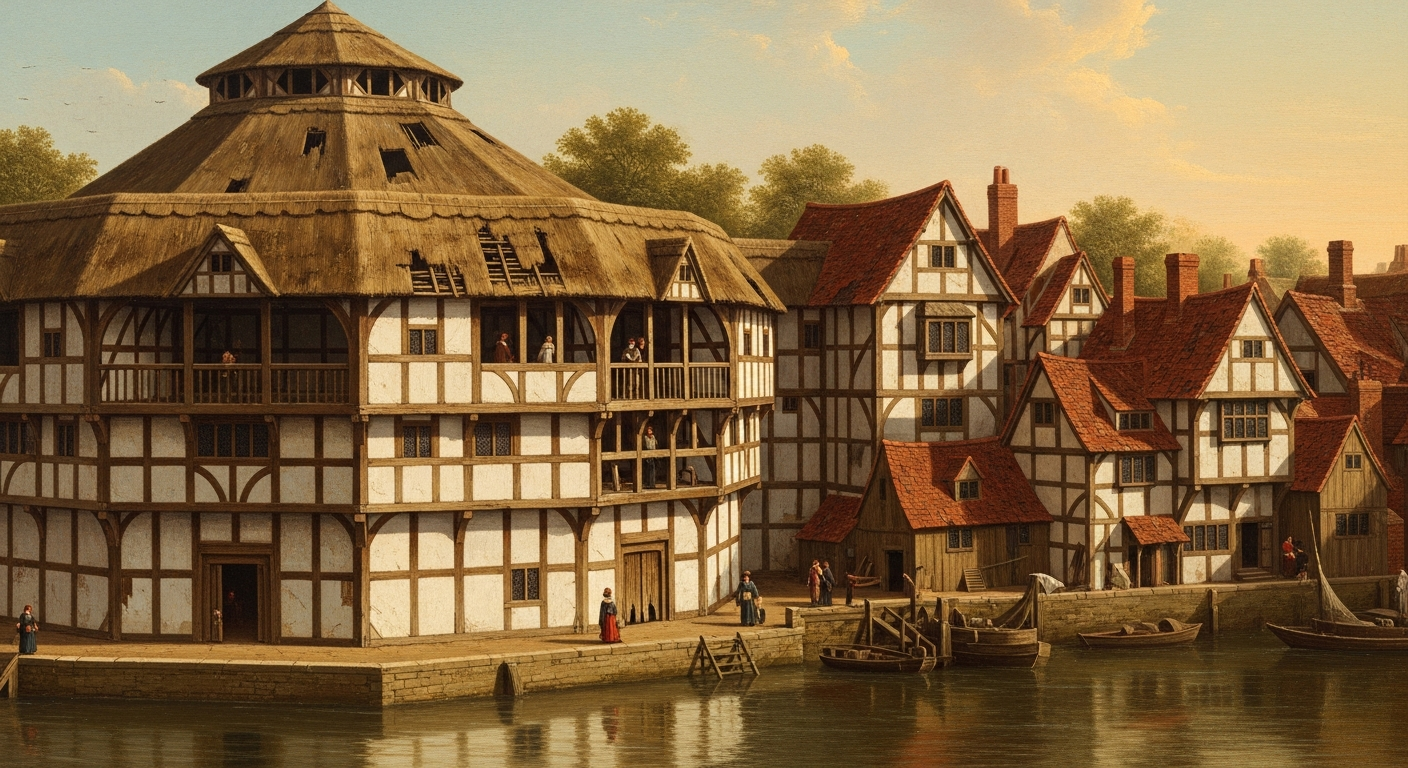
The Greatest Heist in Theatre History: How Shakespeare Stole His Own Playhouse
Imagine dismantling an entire timber-framed building in the dead of winter, hauling it across a frozen river, and reassembling it on the other side, all under the cover of darkness and against the explicit wishes of your landlord. This is not the plot of a historical thriller. This is precisely what William Shakespeare and his colleagues did in December 1598 and January 1599, in one of the most audacious acts of creative self-preservation in the history of English theatre. The result was the Globe Theatre, the most famous playhouse ever built, constructed quite literally from the bones of its predecessor.
As a historical fiction author and Tudor history enthusiast, I find this story endlessly compelling because it captures something essential about the Elizabethan theatrical world: it was scrappy, competitive, legally precarious, and driven by extraordinary individuals who refused to let bureaucracy extinguish their art. The founding of the Globe is not merely an architectural footnote. It is a story of legal wrangling, personal ambition, financial ingenuity, and the sheer determination of a group of players who understood that their future depended on owning, not merely renting, their creative home.
In this post, we will explore the full story behind the Globe Theatre’s construction in 1599, examining who was involved, why they were forced to act so dramatically, and why this moment matters not just to theatre historians but to anyone who wants to understand the cultural explosion of late Elizabethan England.
Historical Background: The Theatre, the Landlord, and the Midnight Move
To understand the Globe, we must first understand its parent building: the Theatre, located in Shoreditch, just north of the City of London. Built in 1576 by James Burbage, a carpenter turned actor turned entrepreneur, the Theatre was one of the first purpose-built playhouses in England. For over two decades, it served as home to various playing companies, including the Lord Chamberlain’s Men, the company to which William Shakespeare belonged as both a shareholder and resident playwright.
The trouble began with the land itself. James Burbage had leased the Shoreditch ground from a man named Giles Allen, and when Burbage died in 1597, the lease was in serious dispute. Allen had no intention of renewing on favourable terms, and there was a particularly vexing clause in the original agreement: if the company did not remove the building they had constructed, the timber and materials would revert to Allen’s ownership. As James Shapiro details in his essential work 1599: A Year in the Life of William Shakespeare (Faber and Faber, 2005), this legal impasse left the Lord Chamberlain’s Men in a precarious position. They owned the building but not the land beneath it.
James Burbage’s sons, Cuthbert and Richard, along with Shakespeare and several other shareholder-actors, devised their solution with remarkable boldness. On or around 28 December 1598, while Giles Allen was away from London for the Christmas period, the company hired a master carpenter named Peter Street and assembled a crew of workmen. They systematically dismantled the Theatre, beam by beam, carrying the timbers south through the streets of London. According to Peter Thomson’s Shakespeare’s Theatre (Routledge, 1983), the timbers were transported across the Thames, most likely using a wherry to ferry materials over the river, to a plot of land on Bankside in Southwark.
Giles Allen was furious. He later brought a legal action claiming the dismantling constituted a 'great disorder' and an unlawful act. But the Burbages and their colleagues had anticipated this, having taken legal advice beforehand. The courts ultimately found in favour of the players. By the spring of 1599, the Globe Theatre was rising from the Southwark marshland, built substantially from the recycled oak and elm of the old Theatre in Shoreditch. It was a theatrical phoenix, reborn south of the river.
Significance and Impact: Why the Globe Changed Everything
The founding of the Globe Theatre on Bankside, Southwark, was not simply a change of address. It represented a fundamental shift in how theatre was organised, financed, and experienced in Elizabethan England. The Globe was structured as a joint-stock venture, with the Burbage brothers holding half the shares and five actor-shareholders, including Shakespeare, holding the remaining half. This meant that the men performing on the stage also had a direct financial stake in its success, creating a uniquely collaborative and motivated working environment.
Southwark itself was significant. Located just south of London Bridge and technically outside the jurisdiction of the City of London authorities, who were frequently hostile to theatrical performance, Bankside was already an entertainment district. Bear-baiting arenas, taverns, and inns clustered along its riverbanks. By establishing the Globe here, the Lord Chamberlain’s Men placed themselves in proximity to their audience while keeping beyond the reach of London’s more restrictive civic ordinances.
The cultural impact was immediate and lasting. It was at the Globe that Shakespeare’s greatest works received their first performances. Julius Caesar was almost certainly performed there in 1599, the very year of its construction. Hamlet, Othello, King Lear, and Macbeth all followed in subsequent years. The Globe became the creative engine of the most productive period in English literary history, and it is no exaggeration to say that without the audacity of that winter dismantling, the theatrical conditions that produced these masterworks might never have existed.
For Tudor society more broadly, the Globe represented the growing commercial and cultural confidence of the age. Theatre was no longer merely an aristocratic entertainment or a civic occasion. It was a popular, commercially driven art form drawing audiences from every social stratum, from the penny-paying groundlings standing in the yard to the wealthy patrons seated in the covered galleries above.
Connections and Context: What Else Was Happening in 1599?
The year 1599 was, as Shapiro’s book makes compellingly clear, one of the most extraordinary in English history. Queen Elizabeth I was sixty-five years old, ageing visibly, and the question of her succession cast a long shadow over everything. The Earl of Essex, her one-time favourite, departed for Ireland in March of that year with a substantial army, tasked with suppressing the rebellion of Hugh O’Neill, Earl of Tyrone. His catastrophic failure would lead eventually to his disgrace and execution in 1601.
It is fascinating to consider that as Peter Street’s workmen were assembling the Globe’s timber frame in early 1599, Shakespeare was almost certainly writing Julius Caesar, a play saturated with anxiety about leadership, succession, and the fragility of political order. The connections between the turbulent politics of the age and the themes of the plays performed at the Globe are not accidental. Theatre in Elizabethan England was a deeply political medium, and the authorities knew it.
Did you know? The Globe was not the only significant playhouse of this period. The Rose Theatre, built in 1587 and home to the rival Admiral’s Men and the great actor Edward Alleyn, stood only a short distance from the Globe on Bankside. The proximity created an intense theatrical rivalry that drove both companies to extraordinary creative heights throughout the 1590s.
Modern Relevance and Fascinating Details
The story of the Globe’s construction continues to captivate scholars, theatre-makers, and general readers for reasons that go far beyond antiquarian interest. There is something deeply appealing about the image of Shakespeare and his colleagues as practical, resourceful people who solved a genuine crisis with physical labour and legal cunning, rather than as remote literary geniuses operating in an ivory tower. As someone who writes historical fiction set in this period, I find this grounded, commercial reality of the Elizabethan theatrical world absolutely essential to portraying the era authentically.
The original Globe Theatre stood until 1613, when a theatrical cannon, fired during a performance of Henry VIII, ignited the thatched roof and burned the building to the ground. Remarkably, it was rebuilt on the same site by 1614, and this second Globe survived until 1644, when it was demolished during the Puritan interregnum. The reconstructed Globe, known as Shakespeare’s Globe, opened on Bankside in 1997, just a few hundred metres from the original site, and remains one of London’s most visited cultural landmarks. Archaeological investigations near Park Street in Southwark have uncovered fragmentary physical remains of both the original Globe and the Rose, offering tantalising glimpses of these vanished structures.
Did you know? The recycled timbers from the Theatre in Shoreditch were not merely repurposed for economy. Seasoned oak of the quality used in the Theatre’s original construction was genuinely difficult and expensive to source. By reusing those materials, the company ensured that the Globe was built to an exceptionally high structural standard, contributing to its longevity as a performance space.
Conclusion: A Building Born of Necessity and Nerve
The Globe Theatre’s founding in 1599 is one of those historical moments that rewards attention precisely because it is so human. Behind the towering literary achievements associated with that stage lay a very practical story of disputed leases, midnight removals, legal battles, and financial partnerships. The men who built the Globe were entrepreneurs as much as artists, and their willingness to act decisively in the face of threat gave English theatre one of its defining institutions.
Whether you are drawn to Tudor history through academic curiosity, through historical fiction, or through a visit to the reconstructed Globe on Bankside, understanding the real story behind the building enriches every encounter with the works first performed within its walls. If this story has sparked your curiosity, I would encourage you to explore Shapiro’s 1599 and Thomson’s Shakespeare’s Theatre as starting points for a deeper journey into the remarkable world of Elizabethan performance. The Globe was built from salvaged timber, but its legacy is anything but second-hand.