
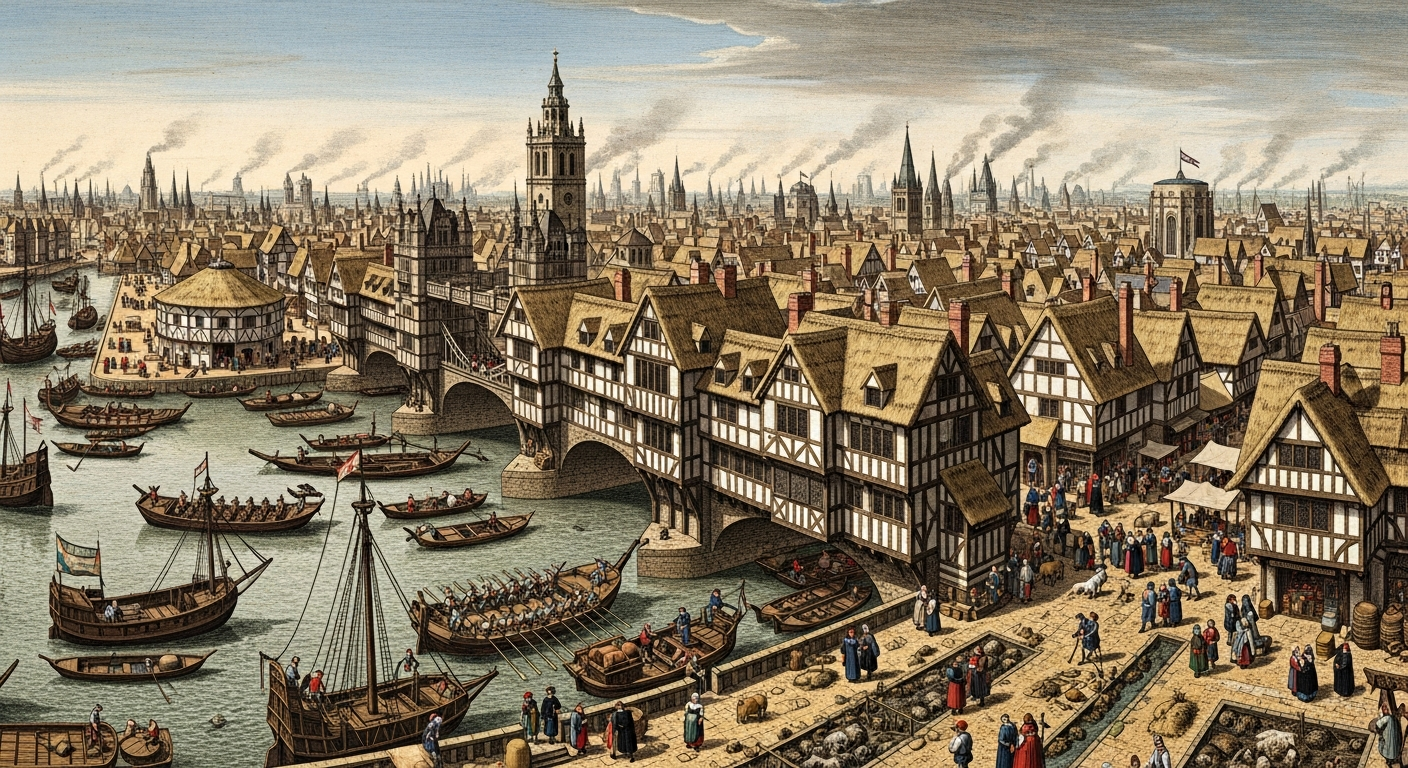
Tudor London’s Population Explosion: How a City of 50,000 Became a Metropolis of 200,000
Imagine stepping into London in the year 1500. The city is bustling, certainly, but it remains a manageable medieval town of roughly 50,000 souls, its boundaries still largely defined by ancient Roman walls, its rhythms shaped by guild halls, parish churches, and the seasonal flow of the Thames. Now fast-forward a single century. By 1600, that same city has transformed into a teeming metropolis of approximately 200,000 people, one of the largest urban centres in all of Europe. This is not gradual drift but a demographic revolution, and it reshaped English society in ways that historians are still unravelling today.
The quadrupling of London’s population across the sixteenth century represents one of the most dramatic urban transformations in pre-industrial history. It brought extraordinary cultural vitality, the theatre of Shakespeare, the commerce of the Royal Exchange, the pageantry of the Tudor court but it also brought disease, poverty, and social tensions that the authorities struggled desperately to contain. Understanding this population explosion means understanding Tudor England itself.
In this post, we will explore who flooded into London and why, what conditions they encountered, how the city attempted to cope, and why this story resonates so powerfully with anyone interested in Tudor history, historical fiction, or indeed the perennial challenges of urban growth.
Historical Background: The Making of a Tudor Metropolis
The roots of London’s sixteenth-century growth lie partly in the disruptions of the preceding century. The Wars of the Roses, enclosure movements that displaced agricultural workers, and the dissolution of the monasteries under Henry VIII all contributed to a restless, mobile population seeking opportunity or simply survival. As Caroline M. Barron notes in her authoritative study London in the Later Middle Ages (Oxford University Press, 2004), London had already established itself as England’s dominant commercial centre by the close of the medieval period, and this gravitational pull only intensified as the Tudor dynasty consolidated power and trade.
The city that migrants entered was centred on a relatively compact core: the walled City of London itself, administered by the Lord Mayor and the ancient livery companies, alongside the distinct city of Westminster to the west, where the royal court and Parliament held sway. Between and beyond these centres, suburbs sprawled with increasing urgency throughout the 1500s. Southwark across the river, Clerkenwell to the north, Whitechapel to the east: these areas became magnets for those who could not afford or were not permitted to settle within the regulated walls of the City proper.
Who were these arrivals? They came from every corner of England and beyond. Agricultural labourers displaced by enclosure, younger sons with no inheritance, skilled craftsmen seeking wider markets, merchants chasing the expanding trade networks that Tudor foreign policy was opening up, religious refugees from the Continent fleeing Catholic persecution, and a steady stream of the desperately poor all poured into London’s expanding streets. A.L. Beier, in his landmark work Masterless Men: The Vagrancy Problem in England 1560-1640 (Routledge, 1985), documents how this influx created an entire underclass of men and women without the guild membership, household position, or parish ties that Tudor society considered essential markers of social legitimacy.
The pace of growth accelerated particularly in the second half of the century. By the reign of Elizabeth I, contemporaries were already alarmed. Royal proclamations repeatedly attempted to restrict new building in and around London, fearing the consequences of unchecked expansion. These proclamations were largely ignored, a telling sign of how powerful the economic and social forces driving migration truly were.
Significance and Impact: When Growth Becomes Crisis
The consequences of London’s population explosion touched virtually every aspect of Tudor life. Most immediately and viscerally, the city faced a sanitation catastrophe. Medieval infrastructure, designed for a town of tens of thousands, buckled under the weight of a population four times larger. Streets that had once drained reasonably well became choked with refuse. The Thames, London’s principal water source as well as its main sewer, grew increasingly contaminated. Plague returned with devastating regularity: the outbreaks of 1563, 1578, 1582, 1592, and 1603 each carried off thousands of Londoners, with mortality rates in the densely packed suburbs running especially high.
Did you know? During the plague outbreak of 1563, it is estimated that London lost roughly a quarter of its population in a single year, a staggering toll that nonetheless failed to permanently check the city’s overall growth trajectory, as fresh migrants replaced the dead with alarming speed.
The social fabric of the city strained under equal pressure. The guilds that had historically regulated trade and provided a framework of social order found their authority challenged by the sheer number of newcomers operating outside their structures. Beier’s research on vagrancy illuminates how London’s streets filled with men and women whom Tudor society classified as dangerously unattached: journeymen without masters, servants without places, pedlars, beggars, and the catch-all category of rogues and vagabonds who featured so prominently in Elizabethan legislation and anxiety alike.
Yet growth also generated extraordinary dynamism. The expanding population created voracious demand for entertainment, producing the theatrical revolution of the 1570s onwards, when purpose-built playhouses like The Theatre (1576) and later the Globe (1599) arose to serve audiences that could only exist in a city of London’s new scale. The same demographic pressure drove commercial innovation, expanded print culture, and fed the cosmopolitan energy that makes Elizabethan London such a compelling subject for historians and historical fiction writers alike.
Connections and Context: Tudor London in the Wider World
London’s growth cannot be separated from the broader currents of Tudor politics and European history. The Reformation fundamentally altered the city’s landscape: the dissolution of the monasteries between 1536 and 1541 released enormous quantities of land and property into the market, reshaping neighbourhoods and displacing the charitable functions that religious houses had previously provided. The urban poor who might once have received alms at a monastery gate now had to look to a nascent and inadequate system of parish poor relief instead.
Internationally, London’s expansion mirrored developments in other European capitals. Paris, Antwerp, and Amsterdam were all experiencing significant growth in the sixteenth century, driven by similar forces of trade expansion, agricultural displacement, and religious conflict. What made London distinctive was the degree to which it dominated its own national economy: unlike France or the Holy Roman Empire, England had no rival city of comparable size, meaning that London absorbed a disproportionate share of the kingdom’s mobile population and commercial energy.
The question of how to govern a rapidly expanding city also connects directly to Elizabethan political culture. The tension between the City of London’s ancient corporate privileges and the Crown’s desire to regulate the suburbs created jurisdictional disputes that rumbled throughout the period. When the Privy Council issued orders restricting new building, it was the Lord Mayor who was expected to enforce them within the walls, while constables and justices of the peace struggled to maintain any order at all in the unruly liberties and suburbs beyond.
Modern Relevance and Fascinating Details
As a historical fiction author, I find Tudor London’s population crisis endlessly generative as a setting precisely because it places characters under pressure from every direction. A servant newly arrived from Yorkshire in 1580 would encounter a city simultaneously thrilling and terrifying: full of opportunity but also full of the very real possibility of falling into the underworld of vagabondage that Beier describes so vividly. The smell alone, contemporaries tell us repeatedly, was almost indescribable.
Did you know? Elizabeth I herself reportedly refused to enter London during periods of plague, conducting business from her various palaces at Richmond, Greenwich, and Hampton Court. The queen who styled herself as intimately connected to her people was, quite sensibly, deeply reluctant to share their most lethal urban experiences.
The story of Tudor London’s growth also resonates with modern readers because it raises questions that remain urgently relevant: How does a city absorb rapid population growth without fracturing socially? Who bears the costs of urban expansion, and who captures its benefits? How do authorities balance freedom of movement against the desire for order and regulation? These were Tudor questions, but they are also contemporary ones, which is perhaps why this period of history continues to attract such passionate interest from both scholars and general readers.
In popular culture, the teeming streets of Elizabethan London have provided the backdrop for countless novels, television series, and films. From the detailed historical fiction of Hilary Mantel to the more swashbuckling adventures of countless other authors, writers have long recognised that a city under demographic pressure is a city alive with narrative possibility: where fortunes are made and lost, where identities can be remade, and where the full range of human ambition and desperation plays out against a backdrop of genuine historical transformation.
Conclusion: A City Transformed
Tudor London’s growth from 50,000 to 200,000 people across the sixteenth century was not merely a demographic statistic. It was a lived revolution that reshaped architecture, governance, culture, and daily experience for hundreds of thousands of men, women, and children. Drawing on the scholarship of historians like Caroline M. Barron and A.L. Beier, we can see how this transformation created both the glittering world of Elizabethan theatre and commerce and the grinding poverty and disease that shadowed it at every turn.
If you are fascinated by Tudor history, whether through academic study, historical fiction, or simple curiosity about how our ancestors lived, London’s population explosion offers an extraordinary window into the period. I invite you to explore further: look into the lives of the migrants who made this city, the authorities who struggled to govern it, and the writers and artists who immortalised it. The streets of Tudor London have much still to tell us.