
Introduction
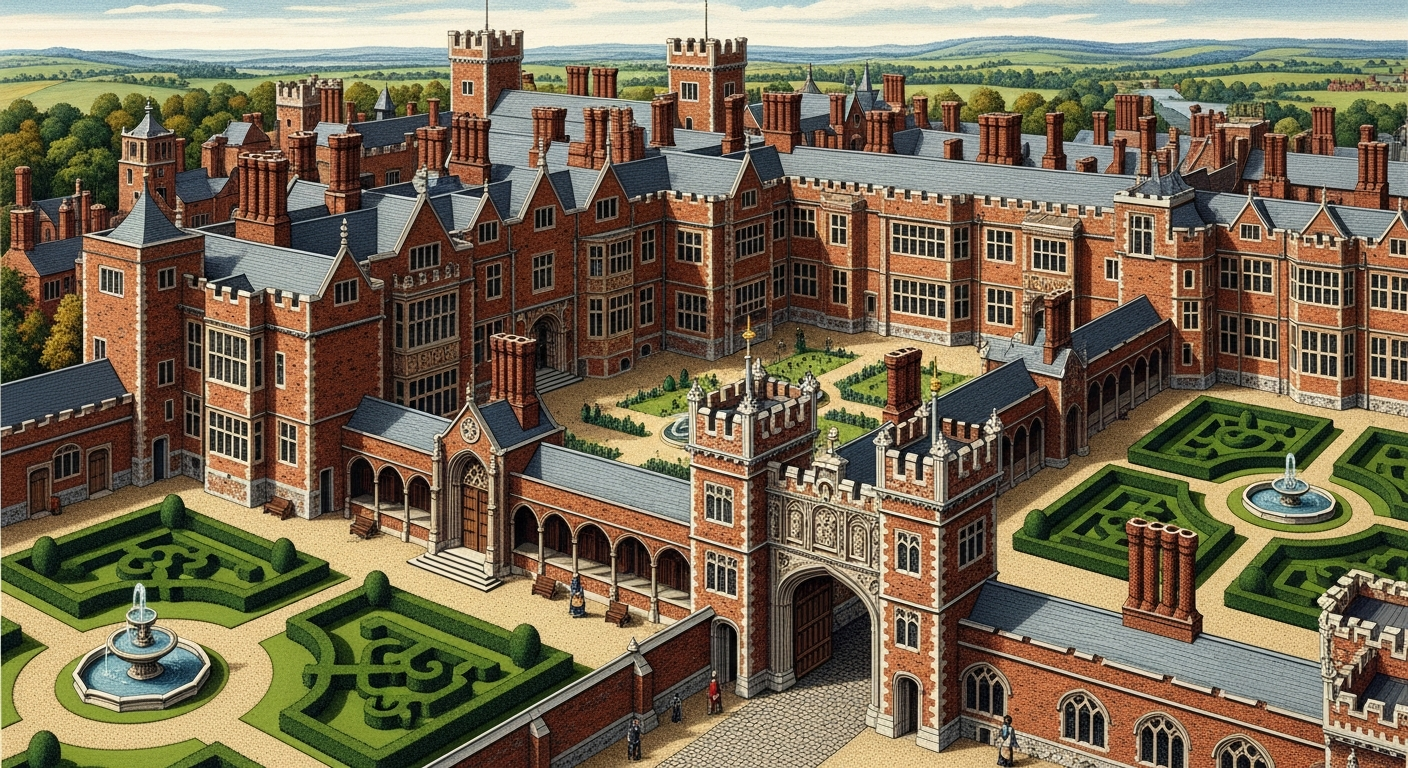
Imagine a palace so vast that foreign ambassadors regularly became lost wandering its labyrinthine corridors, and courtiers required guides to navigate between its 1,500 rooms. This was the reality of Henry VIII’s Palace of Whitehall, a sprawling 23-acre complex that stood as the largest royal residence in Europe during the Tudor period. Far from being merely an impressive architectural feat, Whitehall represented the very heart of English power, where the fate of nations was decided and the course of the English Reformation was shaped.
The sheer scale of Whitehall Palace defied comprehension even by contemporary standards. To put this in perspective, the entire complex was larger than many English towns of the period, yet it served as a single royal household. This magnificent palace witnessed some of the most pivotal moments in English history, from Henry’s break with Rome to the machinations of court politics that would influence the nation for generations to come.
Understanding Whitehall Palace offers us a unique window into Tudor court life, royal power, and the practical challenges of governing a kingdom from what was essentially a small city devoted entirely to the monarch’s needs and desires.
Historical Background
The story of Whitehall Palace begins not with Henry VIII, but with Cardinal Thomas Wolsey, who originally developed the site as York Place in the early 1500s. Wolsey, serving as Henry’s chief minister and one of the most powerful men in England, created a residence befitting his status as both a prince of the Church and the king’s right-hand man. However, Wolsey’s fall from grace in 1529, following his failure to secure Henry’s divorce from Catherine of Aragon, led to the Crown’s acquisition of this magnificent property.
Henry VIII, never one to do things by halves, immediately set about transforming and expanding Wolsey’s already impressive residence. Between 1530 and his death in 1547, Henry spent enormous sums enlarging the palace complex. The king’s vision was nothing short of creating the most magnificent royal residence in Europe, one that would rival the great palaces of France and the Holy Roman Empire whilst serving as a powerful symbol of English sovereignty.
The palace complex stretched along the Thames from what is now Trafalgar Square to Westminster, incorporating numerous existing buildings and creating new ones. As documented in the Calendar of State Papers, Venetian, Volume 4 (1527-1533), foreign visitors were consistently amazed by the palace’s grandeur. The Venetian ambassador’s accounts describe a bewildering maze of courtyards, galleries, and apartments that seemed to extend endlessly.
By the 1540s, Whitehall had become the principal royal residence, superseding the older palaces of Westminster and Greenwich in importance. The complex included everything from the king’s private apartments to vast kitchens capable of feeding thousands, tennis courts for Henry’s favourite sport, and the famous Holbein Gate, which spanned King Street and became an iconic symbol of royal power.
Significance and Impact
The creation of Whitehall Palace represented far more than royal extravagance; it was a calculated political statement that would reshape the very nature of English monarchy. As architectural historian Simon Thurley notes in his definitive work ‘Whitehall Palace: An Architectural History of the Royal Apartments, 1240-1698’, the palace served as a physical manifestation of Henry’s growing assertion of absolute royal authority, particularly following his break with Rome in the 1530s.
The palace’s enormous scale allowed Henry to accommodate the increasingly complex machinery of Tudor government. With 1,500 rooms at his disposal, the king could house not only his immediate household but also the growing number of courtiers, diplomats, and administrators required to run an increasingly centralised state. This concentration of power under one roof was revolutionary for its time and established a template for royal governance that would influence European monarchy for centuries.
Perhaps most significantly, Whitehall became the stage upon which the English Reformation was played out. It was within these walls that Henry met with Thomas Cranmer to discuss the annulment of his marriage, where he conducted his secret wedding to Anne Boleyn in 1533, and where the crucial decisions that would sever England’s ties with Rome were made. The palace’s great hall witnessed the reception of papal legates, the dismissal of Catholic courtiers, and the elevation of Protestant reformers.
The social impact of such a vast royal establishment cannot be understated. Whitehall employed thousands of people, from the highest-ranking nobles to the humblest kitchen servants. This created an entire economy centred around the court, with London tradesmen, suppliers, and craftsmen all dependent on the palace’s enormous appetite for goods and services. The palace thus became not just the centre of political power, but an economic engine that helped drive the growth of Tudor London.
Connections and Context
The construction and expansion of Whitehall Palace occurred during one of the most tumultuous periods in English history. As Henry was enlarging his palace complex in the 1530s, he was simultaneously dismantling the medieval relationship between Crown and Church that had defined English governance for centuries. The timing was no coincidence; the palace served as both a refuge and a fortress during the uncertain years of the Reformation.
The palace’s development also coincided with Henry’s obsessive quest for a male heir. Each of the king’s six wives would have walked these corridors, and it was here that the dramatic scenes of Henry’s matrimonial adventures unfolded. Anne Boleyn processed through Whitehall as queen, and from here she was taken to the Tower for her execution. Jane Seymore died here after giving birth to the longed-for Prince Edward, and it was in Whitehall that Henry’s later wives Catherine Howard and Catherine Parr experienced the terrifying reality of royal marriage.
Contemporaneously, other European monarchs were also engaged in palace-building projects that reflected the growing power and pretensions of Renaissance monarchy. Francis I of France was expanding Fontainebleau, whilst Charles V was developing the Alcázar in Madrid. These parallel developments speak to a broader European trend towards centralised monarchy, with magnificent palaces serving as both practical centres of government and powerful symbols of royal authority.
Modern Relevance and Fascinating Details
Today, virtually nothing remains of Henry VIII’s great palace complex. The devastating fire of 1698 destroyed most of the buildings, leaving only the Banqueting House (built by James I) and a few cellars as physical reminders of what was once Europe’s largest palace. This loss represents one of England’s greatest architectural tragedies, robbing us of what would undoubtedly have been one of the world’s most significant historical sites.
However, recent archaeological work in Whitehall has revealed fascinating details about daily life in the Tudor palace. Excavations have uncovered everything from ornate floor tiles to the remains of Henry’s famous tennis courts, providing tangible connections to this lost world. Did you know that the palace contained its own brewery, laundry, and even a chocolate house (added later in the 17th century)?
The palace’s influence on popular culture remains strong, featuring prominently in historical fiction about the Tudor period. Authors and screenwriters often struggle to convey the sheer scale of Whitehall to modern audiences accustomed to thinking of palaces in terms of buildings like Buckingham Palace or Windsor Castle. The reality is that Whitehall was more comparable to a small city than a single residence, a fact that helps explain how Henry could maintain such tight control over his court whilst simultaneously keeping his enemies close and his friends closer.
For historical fiction writers, understanding Whitehall’s layout and atmosphere is crucial to authentically portraying Tudor court life. The palace’s size meant that courtiers could spend weeks there without encountering the king, yet also allowed for the intimate encounters and private conversations that shaped political events.
Conclusion
Henry VIII’s Palace of Whitehall stands as a testament to the ambitions, power, and complexity of Tudor monarchy. Its 23 acres and 1,500 rooms represented more than royal excess; they embodied a new model of kingship that placed the monarch at the centre of an increasingly sophisticated governmental apparatus. The palace served as the backdrop for some of the most significant events in English history, from the English Reformation to the personal dramas of Henry’s six marriages.
Although the palace itself has largely vanished, its legacy endures in our understanding of how the Tudors transformed English monarchy and laid the foundations for the modern British state. The next time you walk through modern Whitehall, past the government offices and monuments to more recent history, remember that you are treading ground once occupied by the largest palace complex in Europe, where the decisions that shaped a nation were made within walls that have long since crumbled to dust.