
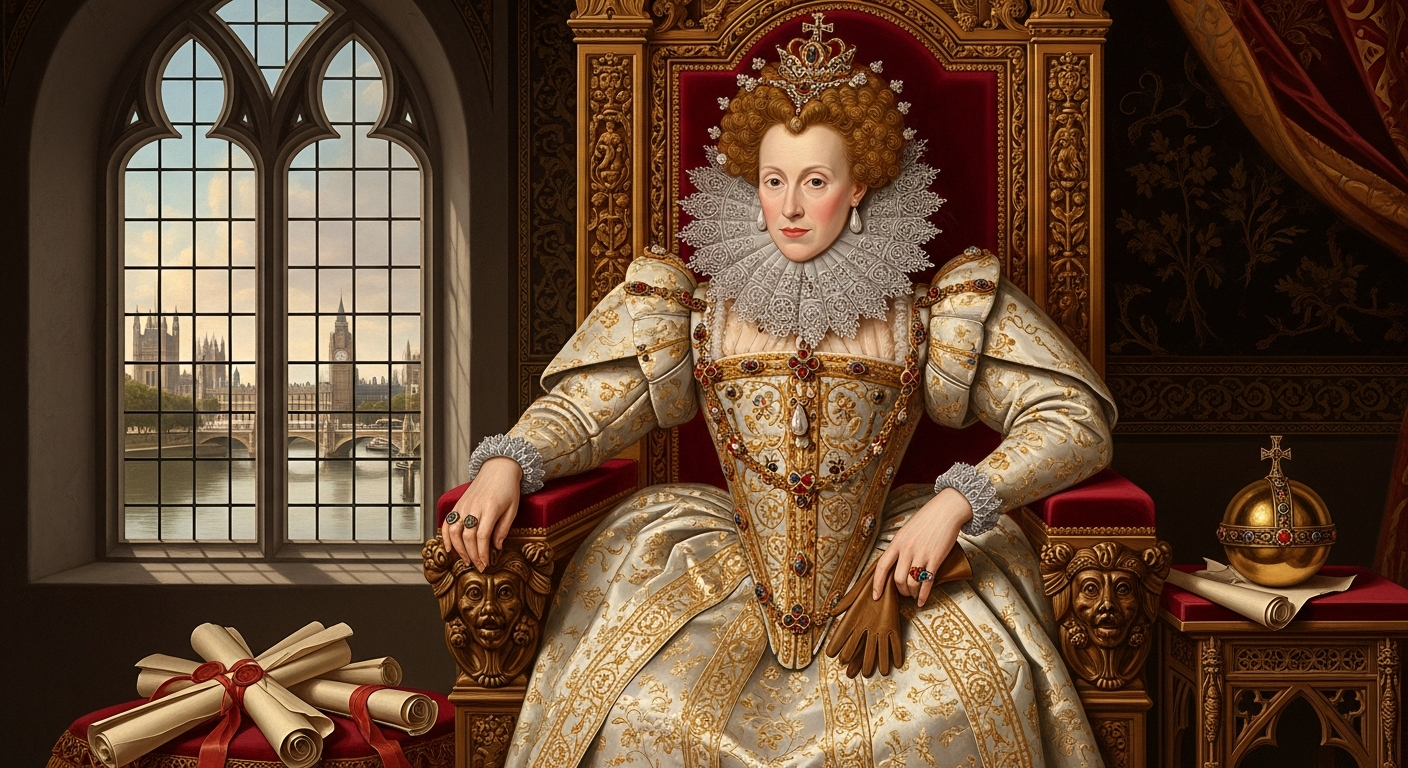
The Virgin Queen: How Elizabeth I Used Marriage as a Political Weapon
Imagine holding the most powerful bargaining chip in sixteenth-century European diplomacy, yet never spending it. That, in essence, is what Elizabeth I of England achieved throughout her remarkable forty-five-year reign. The question of whom she would marry captivated courts from London to Madrid, from Paris to Vienna, and yet the answer, as history would reveal, was nobody at all. Her unmarried status was not a failure of diplomacy or a personal tragedy; it was, arguably, her greatest political masterstroke.
For modern readers, it can be difficult to appreciate just how radical Elizabeth’s position truly was. In the sixteenth century, an unmarried queen regnant was considered an anomaly bordering on the dangerous. Women were expected to wed, to produce heirs, and to defer to their husbands. The very concept of a woman ruling alone, without a king-consort to govern beside her, made many of Elizabeth’s contemporaries deeply uncomfortable. That she not only survived but flourished under these conditions speaks to a quite extraordinary political intelligence.
In this post, we shall explore why Elizabeth chose to remain single, how she wielded the prospect of marriage as a diplomatic instrument, and why her decision to become “The Virgin Queen” continues to fascinate historians, historical fiction readers, and Tudor enthusiasts alike. Whether you have stumbled upon this question through casual curiosity or serious academic study, the story of Elizabeth’s marriage negotiations is one of the most compelling in all of English history.
Historical Background: A Queen Without a King
Elizabeth Tudor was born on 7th September 1533 at Greenwich Palace, the daughter of Henry VIII and his second wife, Anne Boleyn. Her path to the throne was anything but straightforward. Declared illegitimate after her mother’s execution in 1536, restored to the succession under the Third Succession Act of 1544, and imprisoned briefly in the Tower of London under her half-sister Mary I, Elizabeth had endured considerable danger before she was even crowned. When she finally ascended the throne on 17th November 1558, she was twenty-five years old and acutely aware that survival required caution, intelligence, and an almost preternatural ability to read political situations.
The pressure to marry began almost immediately. As Christopher Hibbert notes in The Virgin Queen: Elizabeth I, Genius of the Golden Age (1991), Elizabeth’s councillors, led by the formidable William Cecil, were desperate for her to produce an heir and secure the Protestant succession. Without a child, the throne might pass to the Catholic Mary, Queen of Scots, a prospect that filled Protestant England with dread. Marriage, from Cecil’s perspective, was not merely desirable; it was an urgent necessity of state.
The suitors were numerous and impressive. Philip II of Spain, her late half-sister Mary’s widower, put himself forward almost immediately. Archduke Charles of Austria was considered seriously for well over a decade. Eric XIV of Sweden pressed his case with considerable persistence. French princes, including Henry, Duke of Anjou and later his younger brother Francis, Duke of Alençon, entered the lists at various points. At home, Robert Dudley, Earl of Leicester, was for many years the man most believed to hold Elizabeth’s genuine affections, though his suitability was perpetually complicated by scandal and political opposition.
And yet, through all of these negotiations, which stretched across decades, no marriage ever materialised. The talks would advance, retreat, advance again, and ultimately dissolve, often at precisely the moment when foreign observers believed a match was imminent. As John Guy observes in The Tudors: A Very Short Introduction (2013), Elizabeth demonstrated a consistent genius for keeping suitors hopeful without ever committing herself to a final answer.
Significance and Impact: The Politics of the Perpetual Engagement
To understand why Elizabeth’s unmarried status mattered so profoundly, one must consider the diplomatic landscape of sixteenth-century Europe. England was a relatively small power sandwiched between the competing ambitions of France and Spain, the two great Catholic superpowers of the age. A marriage alliance with either could provide protection; a marriage with the wrong party could provoke the other into hostility. By remaining perpetually available, Elizabeth kept both guessing and both, at least partly, in check.
The negotiations with the Archduke Charles of the Habsburg dynasty, which dragged on through much of the 1560s, illustrate this brilliantly. English ambassadors were dispatched to Vienna, detailed discussions about religion and protocol were conducted, and yet Elizabeth continually found reasons to hesitate. The effect was to maintain cordial relations with the powerful Habsburg Empire without surrendering any English sovereignty. It was, in diplomatic terms, a quite extraordinary performance.
The impact on Tudor society was equally significant. Elizabeth’s court became organised around the fiction of her availability. Courtiers competed to demonstrate their devotion to the Queen, and the language of courtly love, of adoration, service, and eternal fidelity, became the currency of political advancement. Poets, playwrights, and painters collaborated in constructing the image of Gloriana, the eternal virgin goddess-queen, a figure who transcended ordinary human limitations. This was not merely vanity; it was sophisticated political branding that helped stabilise her rule and inspire loyalty among her subjects.
The consequences of her ultimate decision not to marry were, of course, significant. When Elizabeth died on 24th March 1603, she left no direct heir, and the throne passed to James VI of Scotland, uniting the English and Scottish crowns under the Stuart dynasty. The Tudor line ended with her. Whether this outcome was worth the diplomatic and dynastic risks she accepted is a question historians continue to debate with considerable vigour.
Connections and Context: A Europe in Turmoil
It is worth remembering that Elizabeth’s marriage negotiations did not occur in isolation. They unfolded against a backdrop of extraordinary European turbulence. The Reformation had divided the continent along religious lines, the French Wars of Religion were erupting periodically from 1562 onwards, and the Dutch Revolt against Spanish rule created a prolonged crisis on England’s doorstep. Each of these events shaped and reshaped the calculus of any potential English marriage alliance.
The most emotionally charged episode in Elizabeth’s matrimonial history was perhaps her relationship with Francis, Duke of Alençon, who visited England in 1579 and again in 1581. Elizabeth, then in her late forties, appeared genuinely fond of the young Frenchman whom she called her “frog.” She even placed a ring on his finger in a gesture that many observers interpreted as a de facto engagement. Yet the marriage never came to pass, opposed vigorously by her councillors and by a Protestant public alarmed at the prospect of a French Catholic king-consort. The episode reveals a woman who, even at that late stage, may have genuinely wrestled with the choice between personal feeling and political reality.
Did you know? The question of Elizabeth’s marriage was so politically sensitive that her councillors were, on at least one occasion, reportedly reduced to tears when she seemed to be wavering. The emotional stakes of Tudor succession politics were every bit as intense as the diplomatic ones.
Modern Relevance and Fascinating Details
Elizabeth I remains one of the most written-about monarchs in all of history, and the question of her unmarried state is central to virtually every fictional and biographical treatment of her life. From Hilary Mantel‘s broader Tudor explorations to films such as Elizabeth (1998) starring Cate Blanchett, popular culture has returned repeatedly to the drama of her court and the enigma of her choices. As a historical fiction author, I find that Elizabeth’s marriage negotiations offer almost limitless dramatic possibilities precisely because they combine genuine political stakes with intensely personal questions about love, power, and identity.
Lesser-known details add further texture to the story. Elizabeth suffered from a well-documented anxiety about marriage that her biographers have sometimes linked to the fates of her mother and of Catherine Howard, the fifth wife of her father Henry VIII, both of whom were executed. She also witnessed the disastrous marriage of her half-sister Mary I to Philip II, a union widely perceived as having subordinated English interests to Spanish ones. These experiences arguably shaped a deep reluctance to place herself in a position of dependency upon any husband, however powerful or well-intentioned.
Contemporary questions about female leadership, political independence, and the tension between public duty and personal fulfilment give Elizabeth’s story a resonance that extends well beyond the Tudor period. She was, in many respects, navigating dilemmas that remain relevant today, asking how a woman in power can maintain authority in a world that consistently seeks to define her through her relationships with men.
Conclusion: The Enduring Power of the Virgin Queen
Elizabeth I’s decision to remain unmarried was neither accidental nor the result of personal eccentricity. It was, as both Christopher Hibbert and John Guy make clear in their respective works, a carefully calibrated political strategy that served England’s interests across four and a half decades of frequently dangerous diplomacy. By keeping the question of her marriage perpetually open, she maintained leverage over the great powers of Europe, preserved English sovereignty, and constructed around herself a mystique that proved enormously effective in sustaining loyalty at home.
The full story of her marriage negotiations, from Philip II’s early proposal to the bittersweet episode with the Duke of Alençon, is one of the most gripping political dramas of the sixteenth century. If you are eager to explore further, both Hibbert’s The Virgin Queen and Guy’s The Tudors: A Very Short Introduction provide excellent starting points. For those who prefer their history with a narrative drive, the world of Tudor historical fiction offers a wealth of imaginative reconstructions of these extraordinary events. However you choose to approach it, the story of Elizabeth I and the marriage she never made is one that richly rewards closer attention.