
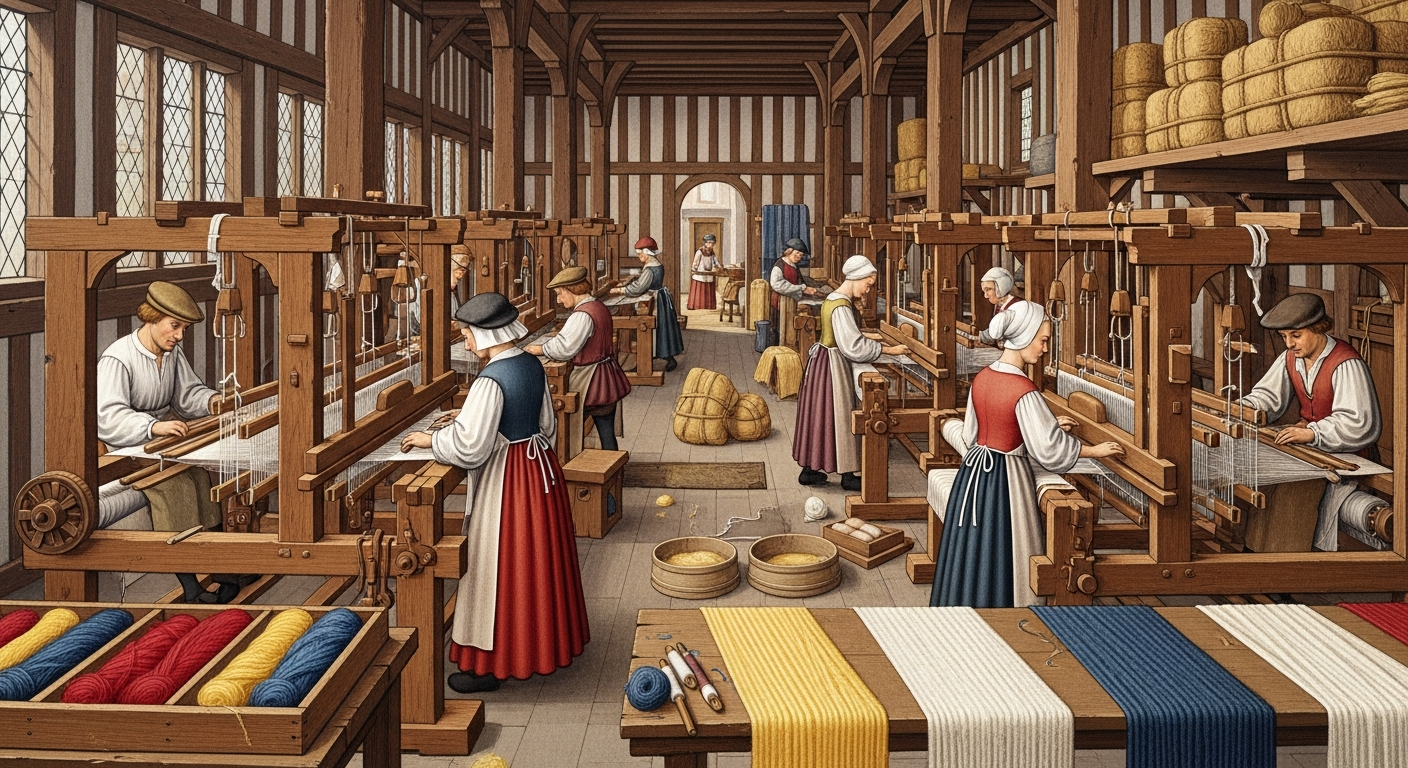
How Flemish Refugees Turned Norwich Into Tudor England’s Second City
Imagine a city so transformed by an influx of foreign craftspeople that it rises from modest provincial town to become the second most important city in all of England. This is not the plot of a historical novel, though it would make a compelling one. It is the remarkable true story of Tudor Norwich, the Strangers, and the textile revolution that reshaped an entire nation’s economy. If you have ever wondered how a wave of refugees could become an engine of prosperity rather than a source of conflict, sixteenth-century Norwich offers one of history’s most instructive and fascinating answers.
The story begins in the turbulent middle decades of the 1500s, when religious persecution in the Low Countries sent thousands of Flemish and Dutch craftspeople fleeing across the North Sea in search of safety. What they brought with them was far more than their families and faith. They carried skills, techniques, and a commercial outlook that would fundamentally alter the economic landscape of their adopted home. Within a generation, Norwich had become a powerhouse of cloth production, its merchants trading across Europe and its streets humming with the sound of looms working day and night.
In this post, we will explore who the Strangers were, why they came to Norwich, what the New Draperies actually were, and why this chapter of Tudor history matters not only to students of the period but to anyone interested in migration, innovation, and the complex relationship between newcomers and established communities. Drawing on the Norwich Records Office’s Strangers’ returns and guild records from 1540 to 1600, as well as W.H. Gressley’s invaluable 1910 study The Strangers in Norwich, published by the Norwich Records Society, this is a story well worth telling in full.
Historical Background: Who Were the Strangers and Why Did They Come?
The term ‘Strangers’ was the official designation used by Norwich authorities to describe the Flemish and Dutch immigrants who settled in the city from the 1560s onwards, though earlier arrivals had trickled in during preceding decades. They were not adventurers or merchants seeking new markets of their own accord. They were, in the truest sense, refugees. The Spanish Habsburg rule over the Low Countries had brought with it the brutal enforcement of Catholic orthodoxy under the Duke of Alba, whose Council of Troubles, grimly nicknamed the Council of Blood by those who suffered under it, executed thousands and drove tens of thousands more into exile.
For Protestant craftspeople in cities such as Antwerp, Ghent, and Bruges, the choice was stark: recant, flee, or face the consequences. Many chose flight, and England, under the Protestant Elizabeth I, offered a relatively welcoming haven. Norwich, with its established but struggling textile trade and its proximity to the eastern ports that received Low Countries traffic, was a natural destination. According to the Strangers’ returns held at the Norwich Records Office, by 1571 there were approximately 4,000 Strangers living in the city, representing a staggering proportion of Norwich’s total population, which stood at perhaps 12,000 to 16,000 at the time.
The civic authorities of Norwich did not simply open the gates out of humanitarian impulse alone, though genuine sympathy for Protestant refugees certainly played its part. The city’s established worsted wool trade had been in serious decline for decades. The old-style heavy worsteds that Norwich weavers had produced were falling out of fashion across Europe, undercut by cheaper competition and shifting tastes. The Mayor and Corporation saw in the Strangers an opportunity: skilled craftspeople who might revive a flagging industry. In 1565, the Corporation formally invited a group of Flemish and Dutch weavers to settle in the city, granting them specific rights and privileges in exchange for teaching their techniques to local workers. It was, by the standards of any era, a remarkably pragmatic and forward-thinking piece of economic policy.
Gressley’s 1910 study provides a vivid picture of how the Strangers were organised and monitored by the civic authorities. They were required to submit regular returns detailing their names, occupations, country of origin, and length of residence. These documents, preserved in the Norwich Records Office, offer historians an extraordinary window into the daily lives of this immigrant community, recording not just statistics but the human texture of a community in transition.
Significance and Impact: The New Draperies and the Rise of a Textile Powerhouse
The phrase ‘New Draperies’ refers to a range of lighter, more varied, and more colourful woollen and mixed-fibre fabrics that the Flemish and Dutch weavers introduced to England. In contrast to the heavy, undyed worsteds that had dominated English cloth production, the New Draperies encompassed fabrics such as says, bays, rashes, and perpetuanas, many of which incorporated silk, linen, or cotton alongside wool. They were brighter, softer, more affordable, and enormously fashionable across European markets from Spain to the Ottoman Empire.
The economic impact on Norwich was nothing short of revolutionary. Within two decades of the Strangers’ formal settlement, the city’s cloth exports had surged dramatically. The Norwich Records Office guild records from the 1580s and 1590s document a thriving industry employing thousands, with Stranger weavers working alongside their English counterparts and, crucially, passing on their techniques as their original agreement with the Corporation required. By the 1580s, Norwich had secured its position as England’s second city, a status it would maintain through much of the seventeenth century, behind only London in terms of population, wealth, and commercial significance.
Beyond economics, the Strangers’ influence permeated Norwich’s cultural and social life. They established their own churches, most notably in the nave of the Church of St Mary the Less, where Dutch and Walloon congregations worshipped in their own languages under their own ministers. They brought new foods, new fashions, and new ideas. Did you know? The canary, which became so strongly associated with Norwich that the city’s football club is nicknamed the Canaries to this day, is widely believed to have been introduced to England by the Dutch Strangers, who bred the birds as pets and traded them alongside their cloth.
Relations between the Strangers and the established Norwich population were not always harmonious. There were periodic complaints from English guildsmen about unfair competition, and moments of genuine social tension. Yet the overall picture drawn from the historical record is one of remarkable, if imperfect, integration. Intermarriage between Stranger and English families became increasingly common by the 1590s, and many Stranger surnames gradually anglicised over the following generations. The Corporation, for its part, maintained a consistent policy of protecting the Strangers’ rights while also managing the concerns of the existing workforce, a balancing act that speaks to the sophistication of Tudor Norwich’s civic governance.
Connections and Context: The Strangers in the Wider Tudor World
To understand the Norwich Strangers fully, it helps to place them within the broader context of Tudor England’s complicated relationship with the Low Countries and with religious refugees more generally. Elizabeth I’s England was simultaneously a Protestant sanctuary for those fleeing Catholic persecution and a state deeply anxious about foreign influence and domestic stability. The same decade that saw the Strangers’ formal settlement in Norwich also saw the beginning of the Dutch Revolt against Spanish rule, a conflict in which England would eventually become directly involved.
The arrival of skilled Protestant refugees was also part of a wider pattern of Elizabethan economic thinking. Figures such as William Cecil, Lord Burghley, Elizabeth’s chief minister, were acutely aware that England’s industrial capacity lagged behind that of the continental powers and actively encouraged the immigration of skilled craftspeople in a range of trades. The Norwich Strangers were perhaps the most successful example of this policy in action, but similar communities of Flemish and Walloon refugees established themselves in Sandwich, Colchester, and other English towns during the same period.
It is also worth noting that the textile revolution the Strangers helped to engineer in Norwich fed directly into England’s expanding overseas trade. The Merchant Adventurers and, later, the nascent East India Company would carry New Draperies fabrics to markets across the globe, and the wealth generated by this trade contributed materially to England’s growing commercial power in the seventeenth century. The looms of Norwich, in other words, played a quiet but significant role in the longer story of English mercantile expansion.
Modern Relevance and Fascinating Details
For anyone interested in the history of migration and its relationship to economic development, the Norwich Strangers offer an endlessly instructive case study. Their story challenges simplistic narratives about immigration in any era, demonstrating the complex, sometimes fraught, but ultimately productive ways in which newcomers and established communities can reshape one another. As a historical fiction author, I find the Strangers irresistible material: their world was one of loss and reinvention, of faith tested by displacement, and of remarkable ingenuity in the face of adversity.
Did you know? The Stranger community in Norwich maintained such a distinct identity that their church registers, preserved in the Norwich Records Office, were kept in Dutch and French well into the seventeenth century. Some of these documents survive in remarkable condition and represent an extraordinary archive of personal names, family relationships, and community life that historians are still mining for new insights. The Strangers’ returns from 1571, in particular, are detailed enough to allow researchers to reconstruct entire family networks and trace the movement of individuals between different English towns.
The Strangers’ legacy is also visible in the physical fabric of Norwich today. Several buildings in the city’s historic core retain architectural features associated with the Stranger community, and the area around Strangers’ Hall, now a museum of domestic life, takes its very name from this chapter of the city’s history. For visitors to Norwich, tracing the footsteps of the Strangers through the city’s medieval streets offers a genuinely moving experience, a reminder that the cosmopolitan, outward-looking character of the city has deep roots indeed.
Conclusion: A Story of Refugees, Resilience, and Reinvention
The story of the Norwich Strangers is one of Tudor England’s most compelling and underappreciated chapters. Driven from their homes by religious persecution, Flemish and Dutch weavers arrived in Norwich carrying skills that would transform the city’s fortunes and, in doing so, help to reshape the English economy at a critical moment in its development. Through the New Draperies, they introduced innovation where stagnation had taken hold. Through their churches, their families, and their daily lives, they wove themselves into the fabric of a new home while enriching it beyond measure. Norwich Records Office archives and Gressley’s foundational study together give us the evidence to tell this story with confidence and detail.
Whether you are a student of Tudor history, a lover of historical fiction, or simply curious about the long and complicated history of migration and its consequences, the Strangers of Norwich deserve your attention. Their story is a reminder that the question of how communities absorb and are changed by newcomers is not a modern invention. It is one of the oldest and most human questions there is, and sixteenth-century Norwich answered it, imperfectly but ultimately remarkably well. If this post has sparked your curiosity, I would encourage you to explore the Norwich Records Office’s digital holdings, seek out Gressley’s study through your local library, and perhaps plan a visit to Strangers’ Hall the next time you find yourself in this extraordinary city.