
Introduction
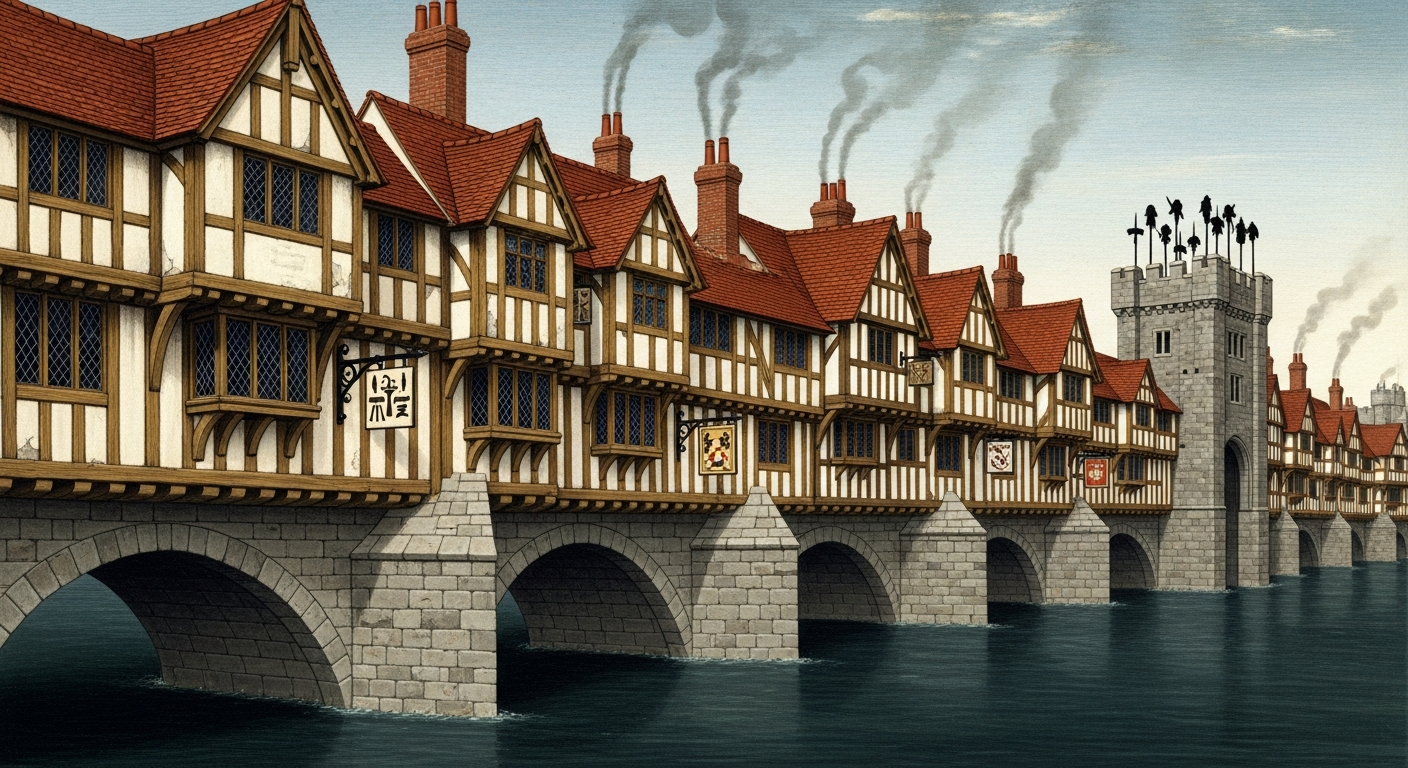
Imagine crossing a bridge so packed with buildings that you could barely glimpse the Thames beneath your feet. In Tudor London, Old London Bridge wasn’t simply a means of crossing the river – it was a bustling street suspended over water, home to over 200 shops, houses, and workshops by 1500. This medieval marvel served as both the city’s commercial heart and a macabre gateway, where the severed heads of executed traitors greeted visitors on spikes at its southern entrance.
For nearly six centuries, Old London Bridge stood as one of Europe’s most remarkable architectural achievements and England’s most important river crossing. During the Tudor period, from 1485 to 1603, this stone bridge became a microcosm of London itself – overcrowded, commercially vibrant, and darkly fascinating. The bridge that Henry VIII, Elizabeth I, and countless ordinary Tudors knew was far more than infrastructure; it was a living, breathing community perched precariously above the rushing Thames.
Understanding Tudor London Bridge reveals much about daily life, commerce, justice, and urban development during one of England’s most transformative periods. From its role in royal processions to its function as a place of public warning, this extraordinary structure shaped London’s identity for generations.
Historical Background
Old London Bridge’s story began long before the Tudors, but it reached its most crowded and commercially significant phase during their reign. The stone bridge, completed around 1209 under King John’s reign, replaced earlier wooden structures dating back to Roman times. By the time Henry VII claimed the throne in 1485, the bridge had evolved into something unprecedented in medieval Europe – a densely packed urban settlement suspended over water.
The bridge stretched approximately 800 feet across the Thames, supported by nineteen Gothic stone arches of varying sizes. What made it extraordinary wasn’t its engineering alone, but the community that flourished upon it. John Stow, the Tudor chronicler who documented London life in his 1598 Survey of London, described a bridge so built up that crossing it felt like navigating a narrow city street rather than traversing water.
By 1500, over 200 buildings crowded the bridge’s span, creating a continuous wall of shops, houses, and workshops on both sides. These structures, some rising four or five storeys high, overhung the bridge’s edges so dramatically that they nearly met in the middle, creating a tunnel-like effect that blocked out much of the sky. The central roadway, squeezed between these overhanging buildings, measured barely twelve feet wide – barely enough for two carts to pass.
The southern gatehouse served a grimmer purpose entirely. Here, the heads of executed traitors were boiled in salt, dipped in tar for preservation, and mounted on iron spikes as a warning to anyone entering London from the south. This ghastly display, visible to all bridge crossers, included the heads of prominent figures such as Sir Thomas More in 1535 and, decades later, conspirators from various Catholic plots against Elizabeth I. Foreign visitors often commented with horror and fascination on this uniquely English custom of displaying justice quite so publicly.
Significance and Impact
The bridge’s overcrowded nature fundamentally shaped Tudor London’s commercial and social life. As the only fixed river crossing for miles, it commanded enormous strategic and economic importance. Every person, cart, and animal crossing between the prosperous south bank and the City of London had to pass through this narrow, building-choked passage, creating both opportunity and chaos in equal measure.
Commercially, the bridge represented some of London’s most valuable real estate. Shop rents were extraordinarily high, but the guaranteed foot traffic made many merchants wealthy. The Worshipful Company of Haberdashers, among other guilds, maintained shops there, whilst goldsmiths, milliners, and booksellers competed for the prime locations. The famous Nonsuch House, built around 1577, stood as the bridge’s most spectacular dwelling – a elaborate timber-framed mansion assembled entirely without nails, prefabricated in Holland and reconstructed on the bridge as a testament to both wealth and engineering skill.
The bridge’s social impact extended beyond commerce. For ordinary Tudors, it served as a daily gathering place, news exchange, and entertainment venue. Street performers, peddlers, and pickpockets mingled with merchants and nobles in the cramped passage. The constant press of humanity created a unique urban environment where social boundaries blurred, even as the displayed traitors’ heads reminded everyone of the consequences of challenging royal authority.
Perhaps most significantly, the bridge influenced London’s development patterns. Its bottleneck effect meant that southern expansion remained limited compared to growth north of the river. The bridge’s tolls and traffic delays encouraged many to conduct business on whichever side of the Thames they found themselves, inadvertently creating distinct commercial districts that would shape London’s geography for centuries.
Connections and Context
Throughout the Tudor period, London Bridge played crucial roles in major historical events. During Henry VIII’s reign, the bridge witnessed numerous royal processions, including those celebrating his various marriages. When Catherine of Aragon arrived for her wedding to Arthur, Prince of Wales, in 1501, she would have passed beneath those grisly heads – a stark reminder of her new country’s approach to justice.
The bridge’s role became particularly significant during times of religious upheaval. As Henry VIII broke with Rome and established the Church of England, the heads of Catholic martyrs like Thomas More and John Fisher joined the ghastly display. Later, during Elizabeth I’s reign, Catholic conspirators from the Babington Plot and other schemes met similar fates, their heads serving as propaganda for Protestant England’s determination to survive.
Interestingly, the bridge’s congested state reflected broader Tudor concerns about urban overcrowding. As London’s population swelled from roughly 50,000 in 1500 to over 200,000 by 1600, housing shortages forced creative solutions. The bridge’s buildings, extended illegally outward over the centuries, exemplified the kind of unauthorised construction that Tudor authorities struggled to control throughout the capital.
The bridge also connected to England’s growing maritime power. Ships had to lower their masts to pass beneath its arches, creating dramatic ‘shooting the bridge’ moments as vessels navigated the dangerous rapids created by the bridge’s supports. This spectacle became a tourist attraction in itself, whilst the bridge’s impediment to river traffic encouraged the development of alternative wharves and docks that would prove crucial to England’s later commercial expansion.
Modern Relevance and Fascinating Details
Today’s readers might struggle to imagine the sensory experience of crossing Tudor London Bridge. The combination of overhanging buildings, thousands of daily pedestrians, horse-drawn traffic, and decomposing heads created an assault on every sense. Contemporary accounts describe the overwhelming noise – shopkeepers calling their wares, wheels rumbling on stone, and the constant chatter of crowds compressed into that twelve-foot-wide passage.
Archaeological evidence, meticulously analysed by Bruce Watson and the Museum of London Archaeology team, reveals fascinating details about bridge life. Excavations have uncovered everything from Tudor-era shoes lost in the Thames mud to elaborate architectural fragments from the bridge’s demolished buildings. These findings suggest that bridge residents enjoyed surprisingly comfortable lives, with access to luxury goods and continental imports that reflected London’s growing international connections.
Modern historical fiction has embraced Old London Bridge as a setting, recognising its dramatic potential. Authors frequently use the bridge’s unique environment to explore themes of social mobility, urban life, and the stark contrasts of Tudor society. The bridge’s combination of commercial prosperity and macabre display provides writers with rich material for examining how ordinary people lived alongside extraordinary brutality.
Perhaps most remarkably, the bridge’s influence on London persisted long after its demolition in 1831. The New London Bridge, completed in 1831, was itself replaced in 1973 by the current crossing. However, the medieval bridge’s impact on London’s development patterns, its role in establishing the City’s commercial dominance, and its place in English cultural memory continue to resonate today.
Conclusion
Tudor London Bridge stands as one of history’s most extraordinary examples of medieval urban ingenuity and the human capacity to adapt space for survival. With over 200 buildings crowding its span and the severed heads of traitors marking its entrance, the bridge embodied both the commercial energy and brutal realities of Tudor England. For nearly three centuries, this remarkable structure served simultaneously as shopping street, residential district, traffic bottleneck, and gallery of royal justice.
The bridge’s legacy extends far beyond its physical presence. It shaped London’s development, influenced England’s commercial growth, and provided a unique urban environment where thousands of Tudors lived, worked, and died above the Thames. Today, as we grapple with our own urban challenges, the story of Old London Bridge reminds us how human communities can thrive in even the most unlikely circumstances, creating vibrant societies in the spaces between necessity and possibility.