
Introduction
Imagine standing in London’s ancient Guildhall today and touching stones that bear the scorch marks of one of history’s most devastating fires. These weathered walls have witnessed over five centuries of London’s tumultuous history, from Tudor magnificence through Victorian grandeur to modern-day ceremonies. What makes this medieval structure truly extraordinary is not just its age, but its remarkable survival story.
The Guildhall represents one of London’s most fascinating architectural survivors, a building that literally bridges the gap between medieval England and the present day. Built in the early 15th century, this magnificent civic hall served as the beating heart of London’s government and commerce throughout the Tudor period and beyond. Its story becomes even more compelling when we consider how it cheated death during the Great Fire of London in 1666, emerging scarred but standing from flames that consumed most of the medieval City.
Today’s visitors can still see the physical evidence of this dramatic survival story etched into the ancient stonework. The scorch marks that blackened these walls over 350 years ago serve as silent witnesses to one of London’s most catastrophic events, whilst the building itself continues to function as a working civic hall, hosting everything from state banquets to legal ceremonies.
Historical Background
The Guildhall’s origins stretch back to the early 1400s, when London’s growing wealth and political influence demanded a suitably impressive civic centre. Construction began around 1411, replacing an earlier 12th-century structure, and the building was substantially complete by 1440. The timing was perfect for what would become London’s golden age under the Tudor monarchs, who would rule England from 1485 to 1603.
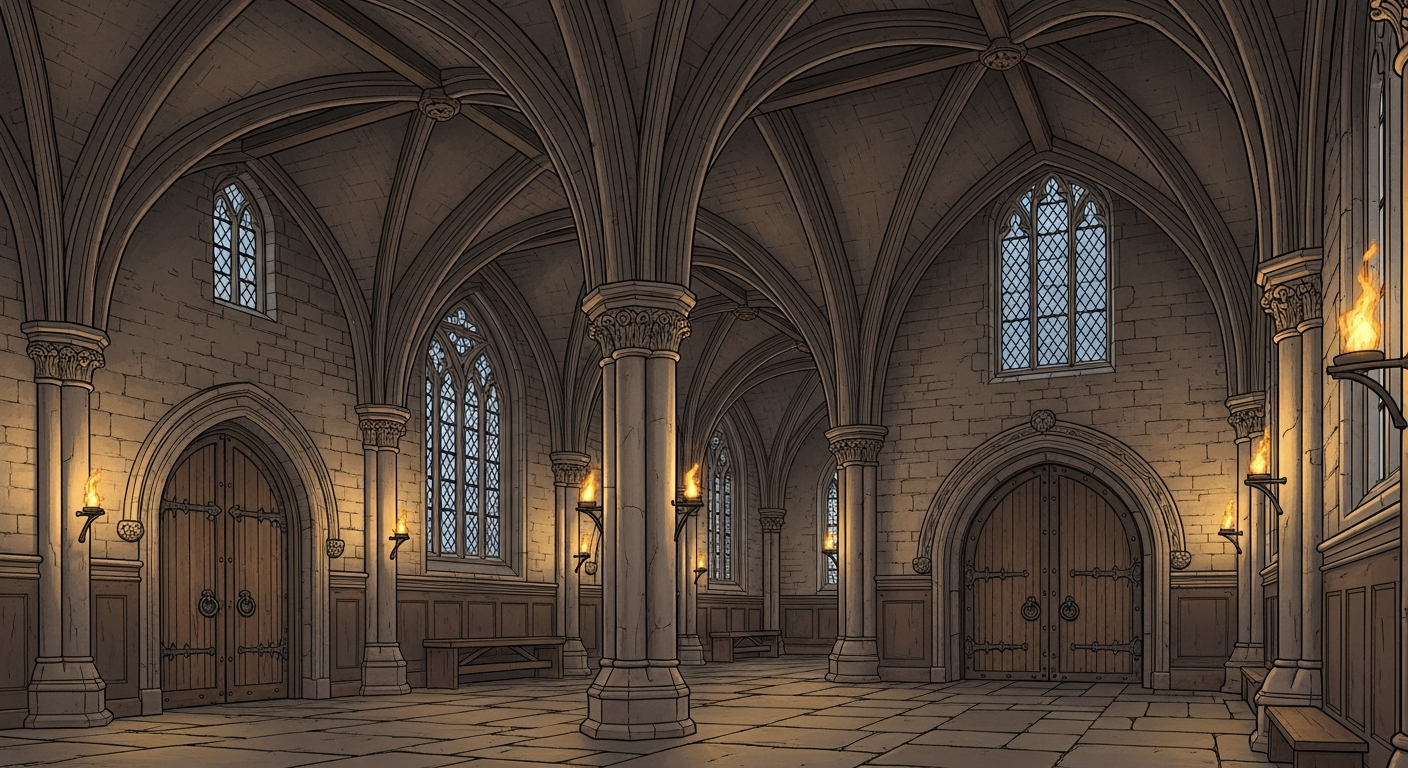
During the Tudor period, the Guildhall served as the administrative heart of the City of London, housing the offices of the Lord Mayor and the Court of Common Council. The great hall witnessed numerous significant events throughout this era, including trials, civic ceremonies, and grand feasts honouring visiting dignitaries and monarchs. Its soaring gothic architecture, with magnificent hammerbeam roof and ornate decorations, provided a suitably impressive backdrop for the growing power and prosperity of London’s merchant classes.
The building’s design reflected the ambitions of medieval London’s guilds and merchants, who wanted to create a structure that could rival the grandest ecclesiastical and royal buildings of the age. The great hall stretched over 150 feet in length, with walls rising to support a spectacular timber roof that was considered one of the finest examples of medieval craftsmanship in the city. Elaborate stone carvings, heraldic displays, and stained glass windows completed this remarkable achievement of civic architecture.
By the time the Tudor dynasty ended in 1603, the Guildhall had established itself as an essential part of London’s identity. It had hosted countless ceremonies celebrating Tudor monarchs, witnessed the trials of political prisoners, and served as the venue for the elaborate pageantry that marked London’s emergence as Europe’s most dynamic commercial centre. The building had become synonymous with London’s civic pride and independence, characteristics that would prove crucial to its survival story.
Significance and Impact
The Guildhall’s survival through the Great Fire of London on 2nd-5th September 1666 represents far more than mere architectural preservation. When the flames finally died down, this medieval structure stood as one of the few tangible links between pre-fire London and the city that would rise from the ashes. The famous diarist Samuel Pepys, who witnessed the destruction firsthand, recorded on 5th September 1666 how the fire had gutted the building’s interior whilst leaving the stone walls standing, a testament to the quality of medieval craftsmanship.
This survival had profound symbolic significance for Londoners rebuilding their city. The Guildhall’s blackened but standing walls provided continuity with the past at a time when most familiar landmarks had been reduced to rubble and ash. The building’s endurance seemed to embody London’s own resilience and determination to survive and prosper despite catastrophic setbacks. Within decades of the fire, the interior had been restored and the building was once again serving its civic functions.
The architectural impact of the Guildhall’s survival cannot be overstated. While Sir Christopher Wren was redesigning much of London with his baroque churches and classical buildings, the Guildhall remained as a remarkable example of medieval gothic architecture in the heart of the modernising city. This created a unique architectural dialogue between old and new that continues to characterise London today. The building’s presence influenced subsequent restoration and conservation practices, establishing precedents for preserving historic structures whilst adapting them for contemporary use.
From a historical perspective, the Guildhall’s survival meant that centuries of civic records, traditions, and institutional memory could continue unbroken. The building’s role in London’s governance remained constant even as the city transformed around it, providing stability and continuity that proved essential during periods of rapid social and economic change. This institutional continuity helped London maintain its unique character as both a modern commercial centre and a city deeply rooted in historical tradition.
Connections and Context
The Guildhall’s story intersects with numerous pivotal moments in Tudor and Stuart history. During the Tudor period, the building hosted several significant trials, including that of Lady Jane Grey in 1553, whose nine-day reign ended in the Guildhall’s great hall. The building also witnessed the elaborate ceremonies marking Elizabeth I’s visits to the City, events that demonstrated the complex relationship between royal authority and civic independence that characterised Tudor London.
The Great Fire of London that nearly destroyed the Guildhall in 1666 was itself partly a consequence of earlier Tudor-era urban development patterns. The timber-framed buildings and narrow medieval streets that fed the flames were largely products of the rapid growth London experienced during the 16th century. Ironically, the Guildhall’s stone construction, which was considered old-fashioned by 1666, proved to be its salvation when more modern timber structures succumbed to the flames.
The building’s survival connects it to the broader story of London’s emergence as a global commercial centre. During the Tudor period, the Guildhall was where London’s merchants planned the trading ventures that would eventually create the British Empire. The same halls that hosted Tudor-era guild meetings would later witness the formation of great trading companies that shaped world history. This continuity of commercial and civic function makes the Guildhall unique among London’s historic buildings.
Modern Relevance and Fascinating Details
Today’s visitors to the Guildhall can still observe physical evidence of its dramatic history. The scorch marks from the 1666 fire remain visible on the medieval stonework, providing a tangible connection to one of London’s most traumatic events. These fire-darkened stones serve as powerful reminders of the building’s resilience and the craftsmanship of medieval builders who constructed walls strong enough to survive both fire and time.
Did you know that the Guildhall is still a working civic building? The Lord Mayor of London continues to use the medieval halls for official ceremonies, making it one of the oldest continuously functioning civic buildings in the world. Modern state banquets, legal ceremonies, and corporate events take place in spaces that once hosted Tudor monarchs, creating remarkable continuity between past and present. The building successfully combines its historical functions with modern requirements, including sophisticated audio-visual equipment discreetly integrated into the medieval architecture.
The Guildhall has also captured the imagination of historical fiction writers and filmmakers. Its atmospheric medieval spaces provide authentic backdrops for period dramas, whilst its survival story offers compelling material for novels exploring London’s resilience through centuries of change. As a historical fiction author, I find the building particularly fascinating because it allows visitors to experience authentic medieval spaces whilst understanding how historical events shaped the London we know today. The scorch marks on the walls provide immediate, visceral connection to historical events that might otherwise seem distant and abstract.
Conclusion
The Guildhall stands as one of London’s most remarkable survivors, a building that has successfully bridged the gap between medieval England and the modern world. Its story encompasses triumph and near-disaster, continuity and change, reminding us that history is not simply about dates and events but about the physical spaces where human drama unfolded. The scorch marks still visible on its ancient stones provide tangible proof of London’s capacity to endure and rebuild after catastrophe.
For anyone interested in Tudor history, medieval architecture, or London’s development, the Guildhall offers an unparalleled opportunity to experience authentic historical spaces whilst understanding how the past continues to shape the present. Whether you’re planning a visit to see the fire damage firsthand or simply want to understand how medieval buildings survived into the modern era, the Guildhall’s story provides fascinating insights into the resilience of both stone and the human communities that created and preserved these remarkable structures.