
Introduction
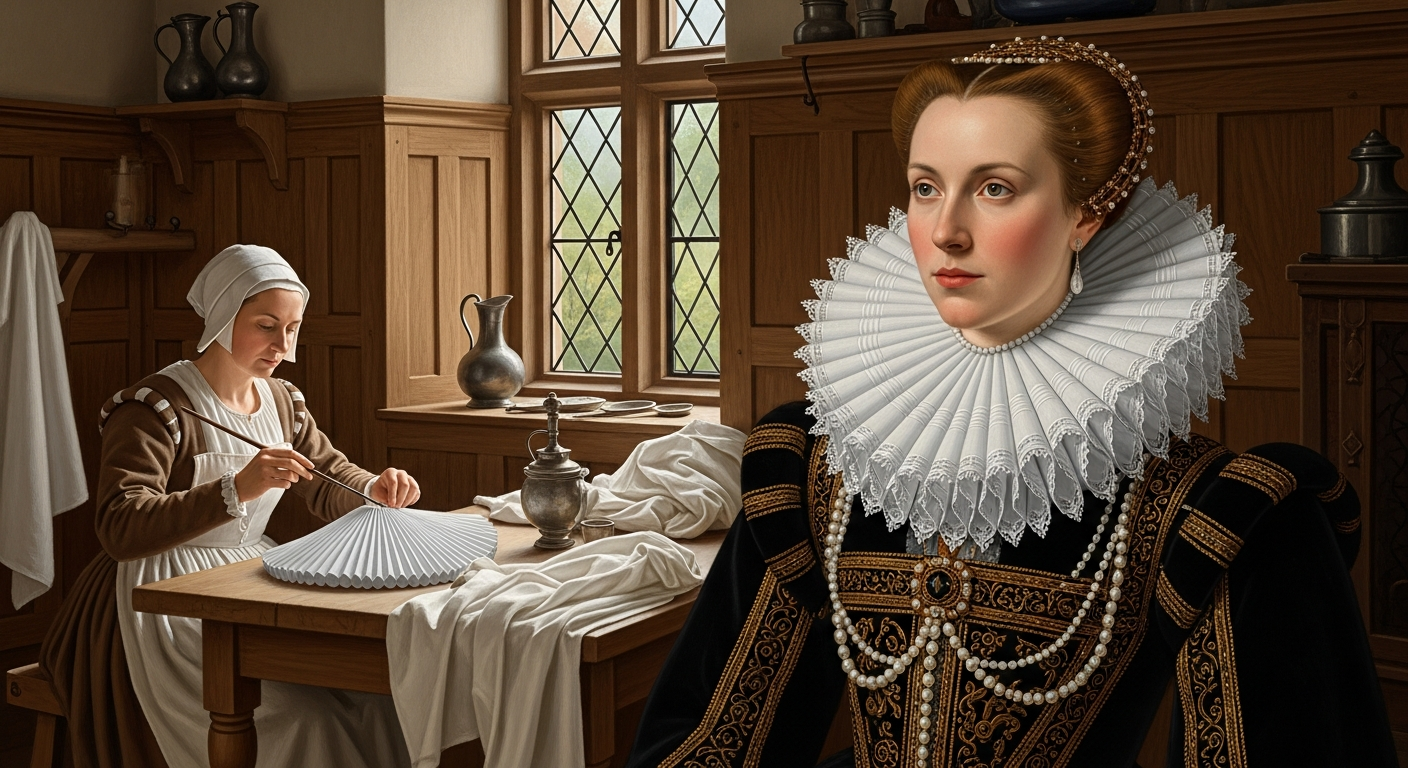
Picture this: a single item of clothing that cost more than a craftsman’s monthly wages, required nearly 20 yards of the finest linen, and took a professional laundress an entire day to prepare properly. Welcome to the extraordinary world of Tudor ruffs, the ultimate status symbol of 16th-century England that could make or break a family’s social standing. These elaborate neck adornments weren’t simply fashion statements; they were complex architectural marvels that demanded specialized skills, expensive materials, and considerable financial investment.
During the Tudor period, particularly from the 1560s through the early 1600s, ruffs became so central to English fashion that they fundamentally altered how people moved, ate, and even slept. The most impressive examples required up to 19 yards of finest linen and the expertise of professional laundresses wielding heated poking sticks to achieve their signature pleated perfection. For middle-class families, owning even a single ruff represented a significant financial commitment, often reserved for the most special occasions when social appearances mattered most.
This fascinating intersection of fashion, economics, and social hierarchy reveals much about Tudor society’s values, the rise of England’s merchant classes, and the lengths to which people would go to display their wealth and status. Let’s explore how these remarkable garments shaped daily life, influenced social mobility, and created an entire industry around their creation and maintenance.
Historical Background
The ruff’s journey to becoming England’s most coveted fashion accessory began in the 1560s during Elizabeth I’s reign, though its origins trace back to the simple gathered neckbands of earlier Tudor clothing. Initially, these modest neck frills served the practical purpose of protecting expensive doublets and gowns from oils and dirt from the skin. However, as England’s economy flourished and trade expanded, what began as functional undergarments evolved into increasingly elaborate displays of wealth and sophistication.
The transformation was remarkable. Early ruffs measured just a few inches in width, but by the 1570s and 1580s, the most fashionable versions extended up to nine inches from the neck, creating the distinctive ‘cartwheel’ silhouette that defined late Tudor portraiture. The process of creating these magnificent garments involved multiple skilled craftspeople: linen weavers who produced the finest fabrics, seamstresses who cut and stitched the enormous lengths into precise pleats, and most crucially, the professional laundresses who possessed the closely guarded secrets of proper ruff maintenance.
These specialist laundresses, often operating from dedicated workshops in London and other major cities, used heated poking sticks (also called setting sticks) made of bone, wood, or even precious metals for wealthy clients. The process was laborious and required considerable skill: each individual pleat had to be carefully shaped whilst damp, then set using the heated implements to create the crisp, uniform folds that would hold their shape. A single mistake could ruin hours of work and destroy expensive linen.
The linen itself came primarily from the Netherlands and France, where the finest flax was grown and processed. The quality of linen was crucial; inferior materials would not hold their pleats properly and would quickly deteriorate under the repeated washing and setting required to maintain a ruff’s appearance. This dependence on imported materials made ruffs even more expensive and turned them into subtle statements about England’s growing international trade connections.
Significance and Impact
The economic impact of ruff fashion on Tudor society extended far beyond individual wardrobes. The demand for these elaborate garments created an entire ecosystem of specialised trades and services that employed thousands of people across England. Professional laundresses, in particular, found themselves elevated to positions of considerable importance and could command substantial fees for their services. Some became so renowned for their expertise that wealthy families would compete for their attention, creating waiting lists for ruff maintenance services.
For England’s emerging middle classes, ruffs represented both opportunity and burden. Successful merchants, skilled craftsmen, and minor gentry recognised that appearing at church, guild meetings, or social gatherings without an appropriately impressive ruff could seriously damage their social standing and business prospects. This created what modern economists might recognise as a ‘positional goods’ market, where the value derived not just from the item itself, but from its ability to signal status relative to others.
The social implications were profound. Sumptuary laws, which attempted to regulate what different classes could wear, struggled to keep pace with ruff fashion. The government found it increasingly difficult to maintain traditional class distinctions when a successful wool merchant could afford a more impressive ruff than a cash-strapped minor nobleman. This contributed to the gradual erosion of rigid social hierarchies and the emergence of a more fluid class system based on wealth rather than birth alone.
Interestingly, the maintenance requirements of ruffs also affected daily routines and social customs. Wearing a large ruff made certain activities nearly impossible: eating required special utensils and techniques, sleeping necessitated special supports, and even simple tasks like writing became challenging. This physical inconvenience became part of the status signal, demonstrating that the wearer was sufficiently wealthy to afford such impractical clothing and had servants to assist with daily tasks.
Connections and Context
The rise of ruff culture coincided with several other significant developments in Tudor England that help explain their extraordinary popularity. Elizabeth I’s court, with its emphasis on display and ceremony, created an environment where fashionable dress became increasingly important for anyone seeking royal favour or advancement. The Queen herself embraced ruffs enthusiastically, commissioning ever more elaborate examples that set trends throughout the realm.
Simultaneously, England’s expanding maritime trade was bringing unprecedented wealth to merchant families, particularly those involved in cloth exports and luxury imports. These ‘new money’ families needed ways to display their success and integrate into established social circles, and ruffs provided the perfect vehicle. The complexity and cost of maintaining proper ruff attire served as a barrier to entry that helped preserve exclusivity whilst still allowing social mobility for those with sufficient determination and resources.
The period also saw significant technological innovations in textile production and processing. Improvements in linen production, the development of better starches (often incorporating exotic ingredients like rice powder imported from Asia), and advances in heating and shaping tools all contributed to making more elaborate ruffs possible. These innovations spread throughout Europe, but England became particularly associated with the most extreme examples of ruff fashion.
Religious and political contexts also played important roles. The Protestant Reformation had abolished many traditional forms of religious display and ceremony, and some historians argue that elaborate secular fashion helped fill this gap, providing new outlets for the human desire for ritual and magnificence. Additionally, England’s growing confidence as a maritime power encouraged displays of wealth and sophistication that could rival those of established continental courts.
Modern Relevance or Fascinating Details
The Tudor ruff phenomenon offers striking parallels to modern luxury fashion markets and social media culture. Just as contemporary influencers invest enormous sums in designer clothing to maintain their status and attract followers, Tudor families mortgaged their financial security to purchase and maintain ruffs that would preserve their social standing. The concept of ‘investment dressing’ has clear historical precedents in the careful calculations Tudor families made about ruff purchases.
Perhaps most fascinating is the discovery, through detailed inventory records preserved in archives, of the elaborate systems families developed to share and maintain their ruffs. Some middle-class households developed informal lending networks, allowing neighbours to borrow ruffs for special occasions. Others invested collectively in particularly expensive examples that could be shared amongst family members or business partners, creating early examples of what we might now call ‘collaborative consumption’.
Modern historical costume designers working on Tudor-period films and television productions still struggle with the technical challenges of creating accurate ruffs. The traditional skills required have largely disappeared, and contemporary materials often cannot replicate the specific qualities of period linen and starches. This has led to fascinating collaborations between historians, textile experts, and fashion designers working to reverse-engineer Tudor techniques using modern tools and materials.
The psychological impact of wearing elaborate ruffs also continues to intrigue researchers studying the relationship between clothing and behaviour. Modern experiments with historical costume demonstrate that wearing restrictive period clothing genuinely affects posture, movement, and even social interactions in ways that help us better understand Tudor society and the daily experiences of our ancestors.
Conclusion
The story of Tudor ruffs reveals how a simple functional garment evolved into a complex social and economic phenomenon that shaped daily life, influenced class mobility, and created entirely new industries. From their humble origins as protective neckbands to their final form as elaborate status symbols requiring 19 yards of precious linen and expert professional maintenance, ruffs embodied the aspirations, anxieties, and economic realities of Tudor England.
Understanding the true cost and complexity of these remarkable garments, as documented by historians like M. Channing Linthicum and John Peacock, helps us appreciate not just the dedication to fashion our Tudor ancestors displayed, but also the sophisticated economic and social systems they created around the pursuit of style and status. The next time you encounter a Tudor portrait featuring an elaborate ruff, remember that you’re looking at the equivalent of a luxury car or designer handbag, representing months of wages and hours of skilled labour, all in service of making the perfect social impression.